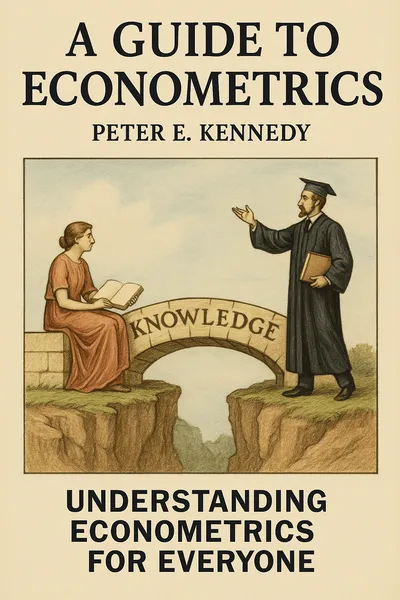
A Guide to Econometrics
Understanding econometrics for everyone
Description
Kennedy's comprehensive treatise emerges within a disciplinary context marked by increasing mathematical sophistication in economics and growing concerns about the disconnect between theoretical elegance and practical applicability. Written for both students and practitioners, this work positions itself as a methodological guide that seeks to reconcile the technical demands of modern econometrics with the interpretive challenges of economic analysis. The author's pedagogical approach reflects broader debates within the economics profession about accessibility, rigor, and the role of quantitative methods in understanding economic phenomena.
The central research question examined is: How can econometric methodology be presented and understood as an integrated approach that serves both statistical precision and economic insight? The defended thesis argues that effective econometric practice requires understanding the philosophical foundations underlying statistical techniques rather than merely mastering computational procedures. The main stake is to demonstrate that econometric literacy depends on grasping the conceptual logic connecting economic theory, statistical method, and empirical interpretation. Econometrics should be understood not merely as a collection of mathematical techniques, but as a coherent methodological framework that bridges economic theory and empirical reality through careful attention to both statistical rigor and economic intuition.
Kennedy's comprehensive analysis reveals econometrics as a complex methodological enterprise that cannot be reduced to purely technical considerations. The work demonstrates that effective econometric practice requires integration of statistical sophistication, economic insight, philosophical reflection, and ethical awareness. Rather than presenting econometrics as a neutral toolkit, Kennedy illuminates it as a form of social practice embedded within institutional contexts and serving particular purposes within broader systems of knowledge production and policy formation. The intellectual contribution lies in providing a framework for understanding econometrics that transcends narrow technical concerns while maintaining commitment to analytical rigor. Kennedy's approach suggests that methodological sophistication requires not merely mastering statistical procedures but developing critical awareness of their foundations, limitations, and implications. This integrated perspective offers resources for more thoughtful and responsible econometric practice.
Table of contents
01 The Philosophical Architecture of Econometric Reasoning
Kennedy's fundamental contribution lies in his systematic examination of the epistemological foundations underlying econometric practice. Rather than treating econometrics as a neutral technical apparatus, the work reveals how methodological choices embody particular assumptions about economic reality and causal relationships. The author demonstrates that econometric models function as mediating devices between abstract theoretical constructs and observable economic phenomena, requiring practitioners to navigate constantly between deductive theoretical reasoning and inductive empirical analysis.

02 The Social Construction of Econometric Knowledge
The work's second major axis examines how econometric knowledge emerges through social processes of validation, criticism, and consensus-building within the economics profession. Kennedy demonstrates that econometric results acquire meaning and credibility not through mechanical application of statistical procedures, but through community-based processes of peer review, replication, and theoretical integration. This sociological dimension reveals econometrics as embedded within institutional contexts that shape both methodological preferences and interpretive frameworks.
03 Tensions Between Theoretical Elegance and Empirical Complexity
A central tension explored throughout Kennedy's analysis concerns the relationship between theoretical sophistication and empirical tractability. The work reveals how the drive toward mathematical rigor in economic theory often conflicts with the messy realities of economic data and the limitations of available statistical techniques. Kennedy demonstrates that this tension cannot be resolved through purely technical means but requires ongoing negotiation between theoretical aspirations and empirical constraints.
04 Ethical Responsibilities and Democratic Implications
Kennedy's final analytical axis addresses the broader societal implications of econometric practice, particularly regarding questions of expertise, democratic accountability, and policy formation. The work demonstrates that econometric analyses increasingly serve as authoritative inputs into public policy decisions, raising fundamental questions about the democratic legitimacy of technocratic governance. When complex statistical analyses inform policy choices affecting millions of people, the technical competence of practitioners becomes a matter of democratic concern.
05 Critical Assessment and Future Directions
Despite its comprehensive scope, Kennedy's analysis exhibits certain limitations that constrain its critical potential. The work's focus on methodological integration, while valuable, sometimes obscures deeper questions about the social functions served by econometric expertise within contemporary capitalism. The emphasis on improving econometric practice may inadvertently reinforce the legitimacy of technocratic approaches to economic governance without adequately examining alternative forms of economic knowledge and democratic participation.
Additionally, the work's pedagogical orientation toward practical guidance sometimes limits critical examination of the institutional structures within which econometric knowledge is produced and applied. While Kennedy acknowledges the social dimensions of econometric practice, the analysis could benefit from more systematic engagement with critical perspectives on the role of economic expertise in maintaining existing power relationships.
Related books