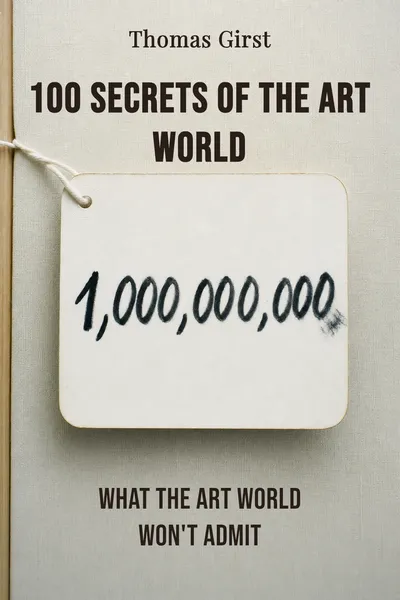
100 Secrets of the Art World
What the art world won't admit
Description
Around 2016, the German art historian Thomas Girst set himself a strange assignment. Rather than write one more explainer about how contemporary art is made, priced and traded, he went around asking the people who actually run the thing — dealers, artists, collectors, curators, auctioneers, museum directors — a single blunt question. What is your best-kept secret? The result was a slim book called 100 Secrets of the Art World, a collection of short confessions from some of the most influential figures in a business famous for saying almost nothing on the record. Girst wasn't after gossip. He was after the quiet operating rules that everyone inside the system knows and almost nobody states out loud.
That framing matters, because the contemporary art world is one of the last major markets that still resists being fully explained. A painting can move from a studio to a fair to an auction house and multiply in value many times over, and at no point does anyone produce a formula for why. Prices float on reputation, relationships and timing. Insiders talk in a code of hints and silences. Girst, who has spent his career both inside institutions and writing about them, was well placed to get people to drop that code for a page or two — not as a takedown, but as a group portrait sketched from the inside.
What comes back from these hundred voices is less scandalous than it is revealing. The secrets rarely concern hidden crimes. They concern how belief, access and confidence actually get produced in a market that pretends to run on pure aesthetic judgment.
The question we’re asking : What do the people who run the art world tell each other that they never tell the public?What we’ll see : A tour, guided by a hundred insiders, of how value and belief are really built where art and money meet.
Table of contents
01Chapter 1 — A confession disguised as a survey
The book's form is its first clever move. Instead of arguing a thesis, Girst hands the microphone to the players and lets them incriminate their own world in one line each. The entries are short — sometimes a sentence, sometimes a paragraph — and they read like overheard remarks at a fair after the champagne has loosened everyone up. A collector admits what actually drives a purchase. A dealer explains what a studio visit is really for. An artist says the quiet part about what a career depends on. Stacked together, these fragments do something a single essay couldn't: they show consensus. When a hundred people who don't coordinate keep circling the same unspoken rules, the rules stop looking like cynicism and start looking like the operating manual.
Girst is careful not to play the exposer. He isn't a disillusioned outsider lifting the curtain to shame anyone. He belongs to this world, has run programs inside it, and writes with the affection of someone who finds its absurdities genuinely lovable. That posture changes the temperature of the whole book. A secret told by an enemy sounds like an accusation; a secret told by a friend sounds like an invitation to understand. The reader isn't being warned off. They're being let in, gently, on the understanding that knowing how the machine works doesn't have to spoil the art. It's a rare tone for the subject — most writing about the market either worships it or wants to burn it down, and Girst does neither.

02Chapter 2 — The market runs on trust nobody can price
The recurring theme across the dealers and collectors is that the art market runs on trust long before it runs on money. A painting has no objective price. It has a price someone is willing to pay, and that willingness is manufactured out of confidence — confidence that the work is authentic, that the artist matters, that the value will hold, that the seller isn't quietly dumping. None of that lives in the object. It lives in the relationships around the object, and those relationships are the dealer's real inventory. Several voices in the book say a version of the same thing: the works come and go, but the client list is the business.
This is why so many of the confessions concern access rather than aesthetics. A hot artist's new work isn't simply sold to the highest bidder. It's placed — with collectors who will lend to the right museums, who won't flip it back onto the market next year, who lend prestige by owning it. Being allowed to buy is itself the reward, and the dealer's power comes from deciding who deserves it. To an outsider this looks backwards: the customer auditions for the seller. Inside, it's the mechanism that keeps a young artist's prices from collapsing. Control the buyers and you control the story. A single careless sale to the wrong collector can undo years of careful reputation-building, which is why the placement matters more than the check.
03Chapter 3 — Taste is manufactured, then called instinct
The second great theme of the book concerns taste — specifically, the open secret that it is made, not found. Curators, critics and museum directors in Girst's survey are surprisingly candid that the judgment they present as trained intuition is downstream of a whole apparatus: which galleries they visit, which peers they respect, which biennial got the buzz that season. An artist becomes important partly because the right people decide to treat them as important, and that decision then hardens into something everyone experiences as obvious quality. The instinct is real enough. It's just been quietly built by the environment the taste-maker swims in.
Several of the confessions describe the machinery of consecration without embarrassment. A gallery show leads to a review, which leads to a fair placement, which leads to a museum acquisition, which leads to the next collector feeling safe. Each step borrows credibility from the last. No single actor decides an artist's worth; the value accrues as a chain of endorsements, each one making the next look reasonable. What the outsider sees as the art world spotting genius is often the art world agreeing, step by step, to agree. The genius may be there too — but the agreement is what turns it into a price. And once the chain is long enough, doubting it starts to feel like bad taste rather than skepticism.
04Chapter 4 — The secret everyone shares is that nobody's sure
Step back from the hundred entries and a single admission runs underneath all of them: nobody is quite sure. The dealers aren't certain which young artist will still matter in a decade. The collectors aren't certain they're not overpaying. The curators aren't certain their taste will age well. What holds the system together isn't secret knowledge that the insiders possess and the public lacks. It's the shared decision to act confidently in the absence of any such knowledge. The real secret of the art world, Girst's chorus suggests, is that its confidence is a performance everyone agrees to keep up together, and that the performance is what produces the very thing it pretends merely to recognize.
This is what makes the book about more than art. Any prestige economy works this way — one where value can't be measured objectively and so has to be produced socially, through reputation, timing and belief. Wine, fashion, universities, certain corners of finance: all of them run on the same trick of turning collective agreement into apparent fact. The art world is simply the purest laboratory, because the object at the center is deliberately useless. A painting does nothing. It only means what a network of people has agreed it means, and its price is the temperature of that agreement on a given day. Strip away the utility and you can watch the pure machinery of shared belief operate with nothing else to hide behind.
05Conclusion
Girst set out to collect a hundred secrets and ended up documenting one. Behind the confessions about access, pricing, placement and taste sits the same quiet truth: the art world runs on collective belief that everyone agrees to treat as certainty. The dealers, artists and collectors he interviewed aren't guarding hidden facts so much as guarding a working consensus — the fragile agreement that makes a useless object priceless.
Related books