The World Cup
Football's global institution
Description
In July 1930, thirteen national teams sailed to Montevideo for the first World Cup. Four of them came from Europe, and they came reluctantly, on a two-week boat crossing that most federations decided wasn't worth the trouble. Uruguay had won gold at the previous two Olympics and offered to build a stadium and pay everyone's expenses; the country was celebrating its centenary and wanted a party. The final drew about 68,000 people into the newly poured Estadio Centenario, and the hosts beat Argentina 4-2 with a ball that, legend has it, was swapped at halftime because each side insisted on its own. That was the whole tournament: a regional grudge match with a handful of guests.
Not quite a century later, the World Cup is watched, in fragments and in full, by something close to half the living planet. The 2022 final in Qatar pulled a global audience counted in the billions. The tournament has its own weather system of sponsorship, broadcast rights, corruption trials and diplomatic manoeuvring, and the body that runs it — FIFA — has turned a summer football competition into one of the most powerful non-governmental organisations on earth. The boat from Europe has become a machine that reorders cities, budgets and national self-images.
How a sailing-optional friendly became a fixture that governments bid billions to host is a story less about football than about what happens when a sport becomes an institution. The football is the easy part. The interesting part is everything that grew around it, and who ended up holding the keys.
The question we’re asking : How did a small invitational tournament become a global institution that nations pay fortunes to stage?What we’ll see : The growth of the competition, the money that reshaped it, the federation that outgrew its own sport, and the strange economy of the right to host it.
Table of contents
01Chapter 1 — Thirteen teams and a wooden trophy
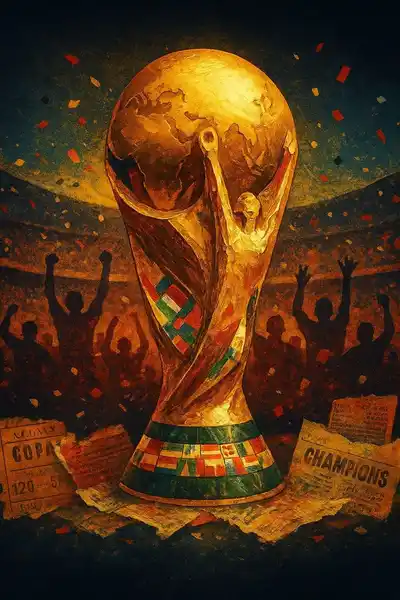
The man behind the first tournament was Jules Rimet, a French lawyer who had run FIFA since 1921 and believed football could bind nations together in a way politics kept failing to. The trophy that carried his name was a small gold-plated figure of Nike, the Greek goddess of victory, and for its early decades it travelled with the winners like a family heirloom. During the Second World War, an Italian official reportedly hid it in a shoebox under his bed to keep it from German troops. The competition itself was fragile, paused entirely from 1942 to 1946, and dependent on whichever country was willing to foot the bill.
The early World Cups were lopsided, provincial affairs. Only four European sides made the 1930 trip; in 1950, several qualified nations simply withdrew, and the final round was a group rather than a knockout, which is why Uruguay's win over Brazil in the Maracanã — the Maracanazo, a silence that a nation still talks about — technically decided nothing by a single dramatic goal but by league points. South America and Europe traded the title among themselves for decades. The rest of the world was mostly absent, not for lack of talent but for lack of a seat at the table.

02Chapter 2 — Television makes it a monster
The 1954 World Cup in Switzerland was the first to be broadcast on television, to a scattering of viewers across a handful of European countries. The pictures were grainy and the audience tiny, but the direction of travel was set. Football, it turned out, was almost perfectly designed for the small screen: continuous, legible, tense, and organised around a single object everyone in the room could follow. As sets spread through living rooms in the 1960s and 70s, the World Cup found an audience no stadium could ever hold.
The 1970 tournament in Mexico was the hinge. It was the first broadcast in colour and beamed by satellite around the world, and it delivered a Brazil side — Pelé, Jairzinho, Carlos Alberto's goal in the final — that looked like an argument for football itself. Suddenly the tournament had a global shop window, and where audiences gather, advertisers follow. The men who understood this best arrived at FIFA in the following decade: João Havelange, who took the presidency in 1974, and Sepp Blatter, the marketing man he brought in. Together they rebuilt the competition as a commercial property.
03Chapter 3 — The federation that grew larger than its sport
FIFA is, on paper, a modest thing: an association of national football federations, registered in Switzerland, run by an elected president and a council. It owns no clubs, employs no players, and stages one major men's tournament every four years. Yet by controlling that tournament, and the money it throws off, it became a body that presidents and kings court, with a membership larger than the United Nations. More national federations belong to FIFA than there are states in the UN — a fact its officials liked to repeat, because it captured how football had outrun ordinary diplomacy.
The trouble was that the structure was built for a small club and never rebuilt for a superpower. Each member federation, from Germany to the smallest island association, has one vote in electing the president and awarding hosts. That equality sounds noble, and it created a system where a handful of powerful officials could accumulate enormous influence by delivering blocs of small votes. Money flowed downward from the centre in the form of development grants, and gratitude flowed back upward as loyalty. For decades, the arrangement ran on trust, patronage and very little scrutiny.
04Chapter 4 — Who gets to hold the party
Ask what the World Cup has become and the sharpest answer is not the final, but the vote that decides where the final will be played. The right to host has turned into the tournament's most valuable and most contested asset — a prize governments pursue with the resources of the state, because staging the World Cup is now a claim about a country's place in the world. A month of football has become a stage on which nations audition for global standing, and FIFA sells the tickets.
The awarding process makes the stakes plain. Bids arrive wrapped in promises of stadiums, transport networks and legacy programmes, and the decision has repeatedly attached itself to scandal. The 2010 vote in Zurich handed the 2018 tournament to Russia and, more startlingly, the 2022 tournament to Qatar — a small, intensely hot Gulf state with no footballing tradition, which moved the competition to winter and built stadiums in the desert. Investigations into how those votes were won became central to the criminal cases that followed, and the human cost of Qatar's construction, borne largely by migrant workers, hung over the tournament long after the final whistle.
05Conclusion
From thirteen teams in Montevideo to forty-eight across three countries, the World Cup grew by learning what it was worth. First it was a party a generous host threw for its neighbours. Then television turned it into a global audience, and marketing turned that audience into a fortune. Finally the tournament became an institution powerful enough that the truly fought-over prize was no longer the trophy but the decision about who gets to raise it and where. The football stayed roughly the same size. Everything around it did not.
Related books