
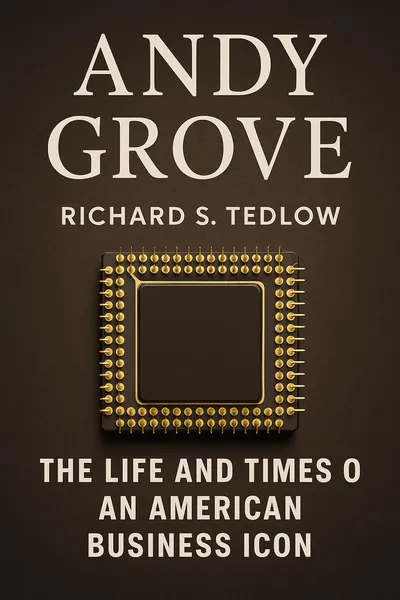
Andy grove
From refugee to chip titan
Description
Born András István Gróf in Budapest, Hungary, Andy Grove survived the adversities of World War II and Soviet oppression. Excelling academically, he fled to Austria during the Hungarian Revolution, eventually reaching the United States.
Grove studied chemical engineering at the City College of New York, then joined Fairchild Semiconductor in California, where he made notable contributions. Following Gordon Moore to Intel, Grove became director of operations. Under his leadership, Intel transitioned from memory chips to microprocessors, experiencing significant growth.
Despite some setbacks, like the ProShare video conferencing system, Grove's tenure as CEO was marked by strategic decisions and a culture of innovation. He was named Time magazine's "Man of the Year" in 1997 and retired as chairman in 2005.
Table of contents
01Early life and escape
Born on September 2, 1936, in Budapest, Hungary, Andras Istvan Grof, later known as Andy Grove, was raised in a middle-class Jewish family. His father, George, was a dairy business partner, and his mother, Maria, had abandoned her concert pianist dreams to start a family. The Grof family, like many others across Europe, was dramatically impacted by the outbreak of World War II in 1939. In 1942, George was conscripted into the Hungarian Army and assigned to a labor-intensive battalion due to his Jewish heritage. He "disappeared" in 1943, leaving Maria and Andy alone in a war-torn landscape. When Germany annexed Hungary in 1944, they evaded deportation to Auschwitz through luck, connections, and street smarts, often leaving Budapest for the countryside during sweeps for Jews. Despite the war's impact on his early education, Andy maintained good grades and overcame a bout of scarlet fever that permanently affected his hearing.

02Education and early career
Among the Hungarian refugees who found a new beginning in the United States was Andy Grove. After arriving, he was initially placed in Camp Kilmer, a former prisoner-of-war camp in New York. His stay there was short-lived as he soon moved to the Bronx to live with his uncle Lajos and his wife Lenke. With a strong determination to continue his education and support his family back in Hungary, Andy faced the challenge of high tuition fees at Brooklyn College and the Brooklyn Polytechnic Institute. Consequently, he enrolled at the City College of New York, a government-funded institution, choosing a demanding curriculum in chemical engineering, physics, chemistry, and calculus. Despite his initial struggles with the English language and the new educational system, Andy quickly adapted, achieving high grades.
03Transition to intel
In 1963, Andy Grove joined Fairchild Semiconductor, bringing a unique skill: Fortran programming. His expertise enabled him to solve a complex problem, challenging the company's focus on surface states. Grove proposed that the observed effects were due to surface charges, a hypothesis that stirred controversy but was eventually proven correct. Despite the presence of brilliant minds, Grove confronted the poor management of Fairchild's research labs. Between 1963 and 1968, he published articles, filed patents, raised a family, taught at Berkeley, and brought his parents from Hungary to Silicon Valley.
04Leadership at intel
In the early years of Intel, Andy Grove, with his technical background, found himself in the role of a business manager, navigating the transition of new products from the lab to mass production. He worked to align strong personalities with the company's goals. During 1971 and 1972, as Intel expanded its product line, it improved its manufacturing capabilities, introducing significant innovations like the erasable programmable read-only memory (EPROM) chip and the microprocessor, which integrated the functions of multiple chips into one. Grove's efforts were recognized in 1974 when he was appointed to Intel's board of directors, becoming vice president of operations and a board member of a leading technology company, a notable rise from his beginnings in Budapest.
05Intel's struggles and successes
In 1978, Intel was ranked 486 on the Fortune 500. By the next year, it had climbed to 386, thanks to a market capitalization increase from $638 million to $1.3 billion. This period also marked significant leadership changes, with Andy Grove becoming president and COO, and Gordon Moore stepping into the CEO role. Intel, previously a lesser-known entity, was now competing directly with major semiconductor companies like Texas Instruments, Motorola, National Semiconductor, Hitachi, and Fujitsu.
To compete with Motorola's superior 16-bit 68000, Intel introduced the 8086 microprocessor and emphasized its customer service. An Intel field engineer pitched the 8086 to IBM during the design phase of the IBM personal computer. IBM, which usually manufactured its own components, agreed to use the 8086 chip, leading to millions of annual unit sales for Intel.
06Shift from memory to microprocessors
In the mid-1980s, the Japanese semiconductor industry's rise posed a significant challenge to Intel, known for its high-quality products, large-scale factories, and aggressive marketing. This competition led to internal debates at Intel, with some advocating for building a massive factory to compete, while others suggested focusing on the more profitable microprocessors. Amidst this uncertainty, CEO Andy Grove and co-founder Gordon Moore decided to shift away from memory production, a move that took three years to implement, involving closing memory factories, informing customers, and reorienting staff towards microprocessor development. This transition was challenging, especially in retaining top talent and redirecting their efforts.
07Marketing success and technological decisions
In the early 1990s, Intel, primarily a business-to-business company, shifted its strategy to market its processors directly to consumers. This led to the successful "Intel Inside" marketing program, which helped establish Intel as a globally recognized brand.
During this period, Intel faced a significant decision. Its 286, 386, and 486 chips used complex instruction set computing (CISC), but a new, potentially more efficient chip based on reduced instruction set computing (RISC) was emerging. Intel even had a division dedicated to developing a RISC chip. However, Intel's significant investment in software for its CISC chips led to the decision to continue improving the current CISC architecture. The RISC team was disbanded and reassigned within the company.
08Grove's legacy
Andy Grove, the former CEO of Intel, was a pivotal figure in the tech industry, known for his transformative leadership and strategic foresight. Despite facing challenges, such as the unsuccessful launch of Intel's video conferencing system, ProShare, Grove's tenure at Intel was marked by significant financial success and strategic decisions that solidified the company's market position. He was instrumental in instilling a culture of constant change and squarely facing facts, leaving a lasting impact on Intel. His mantra, "Only the paranoid survive," perfectly encapsulates his approach to business, emphasizing the importance of vigilance and adaptability in a competitive landscape.
Grove's leadership was not without personal challenges, including a battle with prostate cancer. However, these did not deter him from his role at Intel. His contributions were recognized when he was named "Man of the Year" by Time magazine in 1997. Grove also authored several business books, including the bestseller "Only the Paranoid Survive," sharing his insights and experiences with a broader audience. When he stepped down as CEO in 1998, he left behind a legacy of financial success, strategic direction, and a culture of embracing change.