The Biro
Mass production in one object
Description
In the late 1930s, a Hungarian journalist named László Bíró spent his working days watching ink misbehave. Fountain pens smeared, bled through cheap newsprint, needed refilling, and dried slowly enough that a hurried hand left a smudge across a whole paragraph. Bíró, who had also trained as a hypnotist and dabbled in painting, noticed something in the print shop: newspaper ink dried almost instantly on the page. The problem was that this thick, fast-drying ink would never flow through a fountain pen's fine nib. So Bíró, working with his brother György, a chemist, went looking for a different delivery system — not a nib, but a tiny ball that would roll ink onto the page as it turned.
The idea wasn't entirely new. A patent for a ball-tipped writing tool had been filed in the United States by John Loud back in 1888, and it had gone nowhere. The engineering was unforgiving: too loose a ball and ink flooded, too tight and nothing came out, and the ink itself had to be viscous enough to stay put yet fluid enough to move. The Bíró brothers cracked enough of it to file a patent in 1938 and fled Europe as war closed in, landing in Argentina, where in 1943 they set up production under the name Birome. The pen worked. It was also expensive, temperamental, and sold in small numbers to a niche clientele.
What turned a clever gadget into one of the most-manufactured objects in human history was not the invention itself. It was everything that came after — the war contracts, the manufacturing tricks, the ruthless pursuit of a lower price. The ballpoint pen is one of the rare things you can hold in your hand and read the entire twentieth century off of, from wartime procurement to disposable consumer culture.
The question we’re asking : How did a smudge-proof pen for a handful of buyers become an object almost too cheap to think about?What we’ll see : The road from a Buenos Aires workshop through a wartime order to a French factory that learned to make the same pen for a fraction of a cent.
Table of contents
01 Chapter 1 — A journalist who hated fountain pens
The frustration was specific and daily. As a working journalist in Budapest, Bíró filled notebooks under deadline pressure, and the fountain pen of the 1930s was a fussy instrument. It leaked in pockets, needed a bottle of ink nearby, and its nib demanded a certain angle and a certain patience — neither of which a reporter in a hurry has. The moment of insight, as Bíró told it later, came from watching rotary presses lay down ink that was dry before the paper reached the far end of the machine. The gap between that ink and the pen he carried was the whole problem.
A nib works by capillary action: liquid ink is drawn down a thin slit onto the page. That only works with thin, slow-drying ink. Newspaper ink was the opposite — thick, tacky, fast. To use it you needed a delivery system that didn't rely on a slit, and the answer the Bírós settled on was a socket holding a small metal ball, free to rotate. As the ball rolled across the paper it picked up ink from a reservoir on one side and deposited it on the other, like a miniature printing roller. The ball sealed the reservoir when still, so the pen didn't leak or dry out.

02 Chapter 2 — The war made it fly, the peace made it cheap
The first big customer wasn't a shop full of consumers. It was an air force. Fountain pens had a habit of leaking at altitude, where the pressure drop pushed ink out of the reservoir and onto a navigator's charts and uniform. The ballpoint, with its sealed rolling tip, didn't. British and American aircrews needed a pen that worked in an unpressurised cockpit, and the Bíró design fit precisely. Licensing deals followed, and wartime orders gave the pen its first taste of real volume — the point at which a thing stops being a workshop product and starts being manufactured in earnest.
Then came the peace, and with it a scramble. In 1945 an American entrepreneur named Milton Reynolds, who had seen the pens in Buenos Aires, rushed a version to market in New York, sidestepping the Bíró patents with his own tweaks. Reynolds priced the pen at $12.50 — well over a hundred of today's dollars — and Gimbels department store reportedly sold out its first stock of ten thousand in a single day. The public wanted the pen badly. What it got, in those early postwar years, was often disappointing: cheaply made ballpoints that skipped, blotted, and dried up.
03 Chapter 3 — Marcel Bich and the machine that made it disappear
Marcel Bich was a manufacturer, not an inventor. In the late 1940s he was making pen parts and mechanical-pencil components in a workshop outside Paris, and he looked at the ballpoint's reputation — clever idea, shoddy execution, wildly variable price — and saw an opening. He bought the licence to the Bíró patents, then spent two years doing something unglamorous and decisive: studying how to make the ball and tip to a precision the early manufacturers had never achieved.
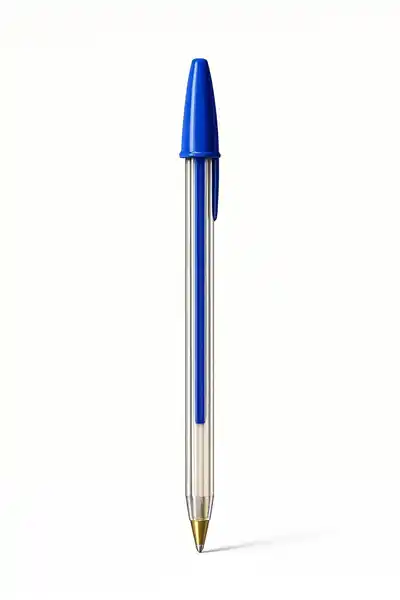
The critical part was the tip. A ballpoint lives or dies on a tungsten-carbide ball, less than a millimetre across, held in a socket machined to microscopic tolerance. Get it slightly wrong and the pen skips or floods. Bich invested in Swiss machining precision to produce these tips consistently, at scale, cheaply — the exact combination the postwar boom had failed to deliver. In 1950 he launched a pen designed from the start to be manufactured, not admired: a clear hexagonal barrel, a simple cap, a shape that resisted rolling off a desk. He named it the Bic Cristal, shortening his surname because he thought Bich would be mispronounced.
04 Chapter 4 — When an object costs less than a thought
Step back from the pen and you're looking at the purest demonstration of what mass production actually does. Everyone knows the slogan — make more, pay less — but the ballpoint shows the mechanism in a single object. Each improvement in tooling shaved a fraction off the tip cost. Each rise in volume spread factory costs across more units. Each cheaper unit reached more buyers, justifying more volume, funding better tooling. The loop runs until the marginal cost of one more pen — the plastic, ink, and machine time for a single additional unit — collapses toward the floor of physics.
That floor is astonishingly low. A basic ballpoint today costs the buyer a few cents, and the manufacturer's cost to make one more is lower still. The object crossed a threshold that changes its nature. Below a certain price, you stop treating a thing as a possession. You don't insure a Bic, name it, mourn it, or hunt for it when it's gone — you take another from the cup. Losing one triggers no calculation because the calculation would cost more attention than the pen is worth.
05 Conclusion
László Bíró died in Buenos Aires in 1985, honoured in Argentina, where Inventor's Day still falls on his birthday, and remembered across much of the world in the word that became generic for the thing itself — the biro. Marcel Bich died in 1994, having built one of the largest empires of consumer disposables on earth, the same logic later extended to lighters and razors. Two men, two different talents, one object carrying both their fingerprints: the tip that made it possible, and the factory that made it free.
Related books