Cynicism
Philosophy as public provocation
Description
Sometime in the fourth century BCE, in the marketplace of Corinth, a man who lived in a large ceramic jar is said to have received a visit from Alexander the Great. Alexander, then the most powerful person in the known world, offered the philosopher anything he wanted. The philosopher, sprawled in the sun, asked him to step aside — he was blocking the light. The man was Diogenes of Sinope, and the story is almost certainly polished by centuries of retelling. But it survived because it captures something true about him: here was a thinker who answered power not with a treatise but with a posture, a body, a joke delivered from the dirt.
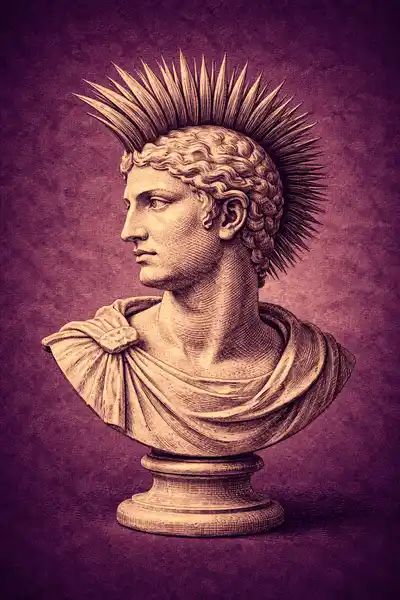
Diogenes belonged to a loose movement the Greeks called the Cynics, from kynikos, "dog-like" — a label meant as an insult and worn as a badge. They wrote little that lasted. What they left instead was a repertoire of scenes: begging from statues, eating in the agora, carrying a lamp in daylight to look for an honest man. Their philosophy was not argued so much as performed, in the open, in front of anyone who happened to be passing.
We tend to file "cynical" today under weary distrust, the shrug of someone who assumes the worst. The ancient Cynics were something stranger and more demanding. They took the noblest questions of Greek ethics — how should we live, what do we actually need — and answered them with their whole bodies, on purpose, in public. The gap between the word we use and the people who inspired it is worth walking into.
The question we’re asking : What were the Cynics actually doing when they turned philosophy into a public spectacle?What we’ll see : A movement that argued with gestures rather than books, and what it means to make a scandal into a claim.
Table of contents
01 Chapter 1 — The man in the barrel
Diogenes of Sinope arrived in Athens after being exiled from his home city on the Black Sea, apparently over a scandal involving defaced coinage. The charge, whatever its exact shape, gave him a phrase he would repurpose for the rest of his life: he set out, he said, to deface the currency — to strike out the counterfeit values people lived by. The pun runs through everything told about him. He treated custom itself as a bad coin in wide circulation.
In Athens and later Corinth he chose to own almost nothing. He slept in a large storage jar, the pithos that later retellings shrank into a "barrel." He carried a cloak, a staff, and a bag, and he begged for his food. The story goes that he once owned a wooden cup, then saw a child drinking from cupped hands and threw the cup away, annoyed that a child had out-simplified him. Whether or not it happened, it tells us what his admirers wanted him to be: a man stripping his needs down to nothing, testing how little a human being can require.

02 Chapter 2 — Living according to nature, in public
The Cynic slogan, as far as they had one, was to live "according to nature." Where their contemporaries built careful ethical systems, the Cynics made a blunter wager: most of what we suffer over is convention dressed up as necessity. Shame, status, property, table manners, the fear of what neighbors think — these were, to them, learned habits, not facts of the world. Peel them away and you find an animal that needs food, shelter from the cold, and very little else.
This is where the dog comes in. The Cynics embraced the "dog" insult because a dog seemed to them a model of honest living: it eats when hungry, sleeps where it lands, feels no embarrassment about its body, and can tell friend from enemy without pretense. Diogenes reportedly said he was called a dog because he fawned on those who gave to him, barked at those who refused, and bit scoundrels. To bark at power and beg without shame was, in his hands, a whole ethics compressed into a metaphor.
03 Chapter 3 — A school with no doctrine, only gestures
Cynicism was never a school in the way the Academy or the later Stoa were. It had no campus, no curriculum, no founding text everyone studied. Antisthenes, a follower of Socrates, is often named as a forerunner, and Diogenes as the figure who gave the movement its face. But the transmission happened person to person, imitation to imitation, more like an apprenticeship in a way of living than an education in a set of ideas.
The most vivid heirs make the point. Crates of Thebes, born into wealth, gave away or renounced his fortune to live as a Cynic on the streets of Athens — and was, unusually, well liked for it, welcomed into homes as a kind of gentle household spirit who settled quarrels. His partner Hipparchia of Maroneia is one of the few women whose philosophical life the ancient sources record at length. She refused an advantageous marriage to live with Crates on his terms, in poverty and in public, and reportedly held her own against men who expected her to stay quiet. That a woman could enter this philosophy at all owed something to its refusal of the conventions that kept women indoors.
04 Chapter 4 — When the body makes the argument
Strip the anecdotes down and the Cynics were testing a possibility that written philosophy tends to avoid: that a life, lived in front of witnesses, can itself be a claim. Most philosophers argue for their conclusions and leave the living for later, or for someone else. The Cynic collapsed the two. To say that we need almost nothing, and then to actually need almost nothing, out in the agora where everyone could check — that was the whole method. The proof was the person.
This makes shamelessness, their most notorious trait, into something closer to a technique than a vice. Shame is the internal enforcer of convention; it is how a society gets us to police ourselves without anyone having to give an order. A person who has genuinely stopped feeling it has slipped the leash. The Cynic's public indecency was a demonstration that the leash was optional — that the rules held only as long as people agreed to be embarrassed. Refuse the embarrassment, and you expose how much rested on it.
05 Conclusion
Diogenes died in Corinth, by tradition on the same day as Alexander, which is almost too neat to be true and was probably arranged by later storytellers who liked the symmetry — the king who conquered the world and the man who owned nothing, leaving it together. His fellow citizens are said to have marked his grave with a marble dog. The animal that had been an insult became a monument, which is the kind of reversal he spent his life staging.
Related books