The Undiscovered Self
Jung on the modern psyche
Description
In 1957, a man in his eighties sat down to write a short, angry book. Carl Gustav Jung had spent half a century listening to people describe their dreams, their fears, their private disorders, and by the late 1950s the private disorder he was most worried about had gone global. Europe had just come through two world wars and the extermination camps; the Cold War had split the planet into two armed blocs, each convinced the other was the source of all evil. The nuclear standoff made the stakes total. Into that atmosphere Jung published a slim essay, barely more than a hundred pages, that first appeared in German and then in English as The Undiscovered Self. It was not a clinical treatise. It read more like a warning delivered by someone who had run out of patience.
The warning was simple to state and uncomfortable to sit with. Modern societies, Jung argued, had learned to see human beings as statistics — as averages, blocs, demographics, masses — and in doing so had quietly lost sight of the actual person, the single irreducible individual who does not appear in any survey. The State loomed larger every year. Ideologies offered ready-made meaning. Science described people as specimens. And the individual, no longer knowing himself, became strangely easy to move, to organize, to enlist. A person who has never met his own interior is a person who will look for direction outside himself — and there is always something waiting to supply it.
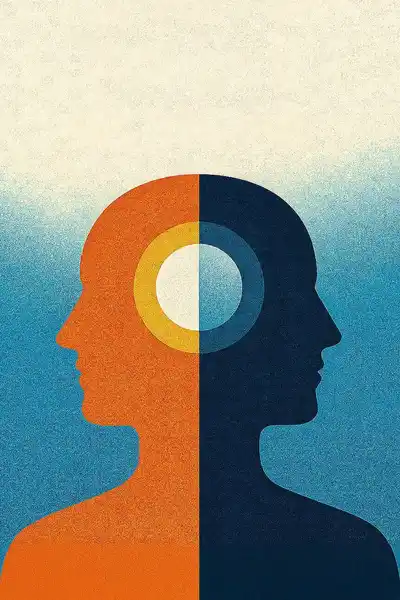
What gives the book its charge is that Jung refuses to locate the danger where his readers expected. Not in the other bloc, not in the enemy across the border, not in the wrong ideology. He locates it inside the reader. The mass, for Jung, is not a crowd somewhere else; it is what each of us becomes when we stop knowing who we are.
The question we’re asking : Why did Jung think the greatest threat of the modern age was not the enemy across the border but the person we have never bothered to meet — ourselves?What we’ll see : An old analyst's quarrel with the century that reduced the person to a number, and his argument that self-knowledge is the last defense against being swept up.
Table of contents
01Chapter 1 — A book written against its decade
By the time Jung wrote The Undiscovered Self, he was the most famous living psychologist after Freud, from whom he had broken decades earlier. He had built a whole vocabulary the culture had absorbed — the collective unconscious, archetypes, introvert and extravert, the process he called individuation. But this book is not really an exposition of that system. It is a polemic, and it is aimed squarely at 1957.
The decade gave him plenty to react against. The two superpowers had turned political disagreement into a metaphysical contest between good and evil, with each side certain the corruption lay entirely on the other. Mass movements had shown, within living memory, what ordinary people were capable of once organized around a cause. And the sheer scale of modern institutions — the State, the party, the bureaucracy — had grown to the point where the single citizen felt, and largely was, powerless before them.

02Chapter 2 — The statistical man and the vanishing person
The heart of Jung's argument is a distinction that sounds almost too simple until its consequences accumulate: the difference between the individual and the mass. An individual is a specific human being, unrepeatable, known from the inside. The mass is what individuals turn into when they gather in numbers and surrender their judgment to the group. In the mass, Jung wrote, the qualities of the single person do not add up — they cancel out. A crowd is not the sum of its members' wisdom; it sinks toward the lowest common level, more suggestible and more prone to extremes than any of its members would be alone.
What worried him was how eager modern life had become to produce this condition. The bigger the organization, the smaller the person feels, and the more readily he hands his conscience to whoever seems to be in charge. The State becomes a kind of substitute parent, then a substitute God — the source of security, meaning, and moral authority all at once. And a citizen who has outsourced those things has, in effect, stopped being a moral agent. He does what the collective does.
03Chapter 3 — The self nobody has met
If the disease is the lost individual, Jung's cure is the recovered one — and the recovery he means is not a slogan about being yourself. It is the long, unglamorous work he called self-knowledge, the effort to become acquainted with what actually lives inside a person rather than the flattering picture we keep on display. Most of us, in his account, know only a fraction of ourselves. The rest sits in the unconscious, unexamined, running the show from behind.
A large part of what sits there is what Jung named the shadow: everything about ourselves we would rather not admit — the cruelty, the envy, the pettiness, the capacity for violence we assign to other people. The shadow does not go away when it is denied. It gets projected. We see our own disowned darkness in the enemy, the outsider, the other side, and then we feel entirely justified in hating it, because it looks like it belongs to them. This, for Jung, is the psychological machinery behind political demonization. The evil is real, but it is misfiled.
04Chapter 4 — When the shadow votes
Read against everything Jung had watched in his lifetime, the book makes a claim that goes well beyond therapy. It says that the great political catastrophes are not primarily failures of systems or ideologies. They are failures of self-knowledge scaled up to the size of a nation. The camps and the purges did not require monsters; they required ordinary people who had projected their shadow onto a designated enemy and then acted on the projection with a clear conscience. That is the mechanism Jung wants his reader to understand, because he thinks it is always available and never fully retired.
This is what makes his argument so uncomfortable. The instinct, when confronting political evil, is to point outward — to the other party, the other regime, the other people who are not like us. Jung tells us that this instinct is itself the danger. The more totally we believe the darkness lies on the far side, the more completely we have handed our own darkness the keys. A population certain of its own innocence is a population capable of anything, because it has removed the one internal brake: the suspicion that it might be wrong.
05Conclusion
The old man's warning has aged in a peculiar way. The specific fear that framed the book — two nuclear blocs, each the other's absolute evil — belongs to a world that has largely passed. But the machinery Jung described did not depend on that world. Wherever a group grows certain that all the corruption sits on the other side, wherever the person dissolves into the demographic and the demographic into the movement, his shadow is doing its work, and the individual he cared about has once again gone missing.
Related books