The Order of Things
The hidden grids that organise knowledge
Description
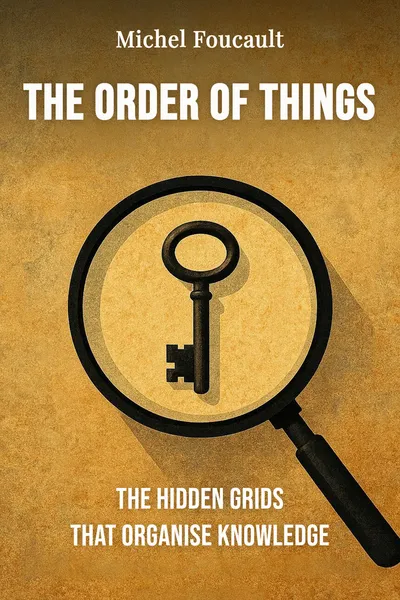
In 1966, a philosopher at Clermont-Ferrand named Michel Foucault published a dense, difficult book with an unpromising title: Les mots et les choses — the words and the things — which reached English readers as The Order of Things. It was not meant to be a bestseller. It was a study of how European knowledge had been organized across three centuries, written in prose that most readers found forbidding. And yet it sold out its first printing within weeks and turned its author, then in his late thirties, into an intellectual celebrity in France almost overnight.
The book opens with a strange scene. Foucault says he got the whole idea from laughing at a passage by Jorge Luis Borges, who cites a supposed Chinese encyclopedia that sorts animals into categories like "belonging to the Emperor," "embalmed," "drawn with a very fine camelhair brush," and "having just broken the water pitcher." The list is absurd — but the laughter it provokes is uneasy. What it shatters, Foucault writes, is our confidence that things naturally fall into an order. Where does our own order come from? Who decided that plants and animals, coins and grammar, belonged in the boxes we put them in?
That is the question the book chases. Not what people in the past believed, but the deeper thing beneath belief — the silent system that decided what could count as true, as visible, as thinkable at all, in a given age. Foucault called this system the episteme, and he argued it changes in ways nobody chooses and nobody quite sees.
The question we’re asking : What is the hidden order that decides, in any given age, what can be known and how — and what happens when that order shifts?What we’ll see : How Foucault reads three centuries of European thought as a sequence of invisible grids, each one dismantling the last, all the way to a figure that may itself be temporary.
Table of contents
01Chapter 1 — A Chinese encyclopedia and a burst of laughter
Foucault begins not with an argument but with that fictional encyclopedia. What unsettles him about Borges's list is not that the categories are wrong — it is that we cannot even imagine a shared space in which such a classification could hold together. Embalmed animals and animals that have just broken a pitcher have nothing in common we can name. The laughter, he says, exposes the limit of our own thought: there is a ground beneath every classification, a tacit sense of what goes with what, and normally we never notice it because we are standing on it.
This is the target of the whole book. Foucault is not interested in the great ideas of great thinkers, the usual currency of the history of philosophy. He is after something more anonymous and more powerful — the underlying code of a culture, the one that fixes in advance the order of resemblances, the order of identities and differences, the grid according to which things can be perceived and grouped. This code is not written down anywhere. It is not a theory anyone defends. It operates below the level of the ideas people argue about, and it makes those arguments possible in the first place.

02Chapter 2 — The invisible grid: what an episteme is
The name Foucault gives to this underlying order is the episteme. It is the total set of relations that, in a given period, binds together the practices that produce knowledge. Not a worldview, which individuals could hold or reject — an episteme is more like the condition of possibility for having views at all. It decides what a valid question looks like, what counts as evidence, what kind of connection between two things will strike people as obvious rather than absurd. A person no more chooses their episteme than they choose their native grammar.
The clearest way to grasp it is through his first great example: resemblance. In the Renaissance, Foucault argues, knowledge was organized by similitude. To know a thing was to trace its likenesses — the walnut resembles the brain, so the walnut heals the head; the stars resemble events below, so the sky can be read. Signs and things were woven into a single fabric, because language itself was thought to bear a real resemblance to the world it named. Words were not arbitrary labels; they were marks left on things, another thread in the web of correspondences.
03Chapter 3 — Words, wealth, and life change their rules together
The most convincing part of The Order of Things is where Foucault shows the same grid at work across fields that seem to have nothing to do with each other. He takes three domains — the study of living beings, the study of wealth, and the study of language — and reads them side by side across two great ruptures. His claim is that they change at the same moments and in the same direction, because they are all governed by the same underlying episteme.
In the classical age, roughly the mid-seventeenth to the late eighteenth century, all three obey the logic of ordered representation. Natural history, as practiced by Linnaeus, does not study life; it describes visible structures and sorts organisms into a great table by their observable characters. The analysis of wealth studies money and exchange as a system of representation, value standing in for goods the way a word stands in for an idea. And general grammar treats language as a transparent instrument for laying out ideas in order. Living things, coins, and words are all handled as elements to be classified and set in their proper cells.
04Chapter 4 — The recent invention of man
That new object is man. Here Foucault makes his most disorienting claim, and it is the one the whole book has been building toward. Man — man as the subject who knows and the object to be known, the living, laboring, speaking being who is also the source of all knowledge about life, labor, and language — did not exist as a figure of thought before the rupture of 1800. The classical age had no science of man. It had natural history, the analysis of wealth, grammar; it studied representations, not the being who represents. Man is not an eternal given. He is a recent invention, and Foucault dates the invention with startling precision.
The reason man appears exactly then is bound up with the new episteme. Once knowledge organizes itself around hidden depths — the life inside the organism, the labor inside value, the history inside language — a strange creature comes into view: the being who is at once one object among others, subject to biology, economics, and philology, and yet also the one for whom all of this exists as knowledge. This being is both an object in the world and the condition of there being a world to know. The modern human sciences — psychology, sociology, the study of man in all its forms — are built on this unstable double figure, and Foucault regards the instability as their permanent, insoluble tension.
05Conclusion
The book that opened with laughter at a Chinese encyclopedia closes with a face dissolving in sand. Between the two lies Foucault's wager: that beneath every confident classification runs a silent grid nobody chose, and that these grids do not improve on one another — they replace one another, wholesale, in ruptures that leave no bridge back. Resemblance gives way to representation, representation to depth, and each time the world of the knowable is remade from the ground up. We read the past not as a slower version of ourselves but as an order we can no longer inhabit.
Related books