The Irreplaceable
Individuals against interchangeability
Description
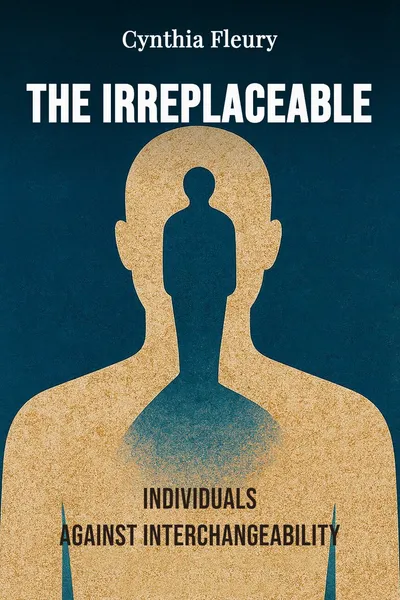
There is a sentence everyone has heard at least once, usually delivered with a shrug: nobody is irreplaceable. It gets said in offices, at the end of relationships, on the day someone is let go. It sounds like humility, even like wisdom — a healthy defense against taking oneself too seriously. In her 2015 book The Irreplaceable, the French philosopher and psychoanalyst Cynthia Fleury takes that sentence and turns it over to look at what is written on the other side. Because the same phrase, said in a slightly different tone, is one of the most quietly violent things a society can tell a person about themselves.
Fleury writes from an unusual double vantage. She teaches philosophy, and she works as a clinician, sitting across from people whose suffering often comes down to the sense of not counting, of being one unit among others, endlessly substitutable. From that chair she watched a very modern feeling take hold: the intuition that we are all managed, ranked, and swapped like parts. The book's wager is that this feeling is not just a private complaint. It is a political symptom, and a dangerous one.
So she does something that sounds abstract but turns out to be concrete. She defends the idea of the irreplaceable individual — not as a flattering compliment we pay ourselves, but as something built, at real cost, over a lifetime. And she argues that a democracy which stops producing such individuals is quietly digging its own grave, whatever its institutions look like on paper.
The question we’re asking : What does it actually mean to become irreplaceable — and why should a society care whether we do?What we’ll see : How a psychoanalyst-philosopher rebuilds the case for singular selves against the logic of the interchangeable.
Table of contents
01Chapter 1 — Everyone is replaceable, and everyone knows it
Fleury starts from a diagnosis rather than a definition. Something in the way we organize work, institutions, and even relationships has made interchangeability the default assumption. The clearest place to see it is the managerial world she knows well: a person becomes a function, a role in an org chart, a set of skills that can be listed, benchmarked, and by definition sourced elsewhere. If everything about you can be written into a job description, then someone else can fulfill that description. You are, in the most literal sense, replaceable.
The trouble is that this logic does not stay in the workplace. It leaks. We start to evaluate ourselves the way an HR process would — by outputs, by comparison, by what we deliver against what the next candidate might deliver. Fleury, sitting across from patients, hears the result over and over: a flat, corrosive sense of not mattering, of being a slot that anyone could fill. It rarely announces itself as a philosophical crisis. It shows up as exhaustion, cynicism, the feeling that showing up or not showing up would change nothing.

02Chapter 2 — The self is not a given, it is a task
Here is where Fleury refuses the easy move. It would be tempting to say that each of us is irreplaceable simply by existing — a unique fingerprint, a one-of-a-kind bundle of DNA and memory. She finds that consoling and, in the end, empty. Biological uniqueness is a fact, not an achievement. A snowflake is unique too. Being different from everyone else is trivially true and does absolutely nothing to make a life count. The irreplaceable, for her, is not a starting condition. It is a result.
So she reframes it as work. Becoming irreplaceable means constructing a singularity — turning the raw material of a life into something that has taken a shape, a direction, a form that is recognizably yours and could not simply be pasted from someone else. This is closer to what she calls individuation than to individualism. Individualism is about asserting the self against others, claiming space, standing apart. Individuation is the slower, harder process of actually becoming a self, which almost always happens through others, through what we love and what we are answerable to.
03Chapter 3 — Sublimation, or the courage to make something
How does one actually do this work? Fleury's answer draws on the psychoanalytic tradition she practices in, and it lands on an old and unfashionable word: sublimation. In everyday use the term has drifted into meaning something like polite repression. In the sense Freud gave it, and which Fleury reclaims, it means the transformation of raw drive — desire, aggression, grief, the whole disorderly interior — into something made and shared. A work, a gesture, a form of care, a contribution that outlasts the impulse behind it.
This is the hinge of the whole book. We do not become irreplaceable by protecting a precious inner core from the world. We become irreplaceable by producing something the world can receive — by turning what is most personal into something offered outward. The paradox she likes is that the most singular thing about a person is often the most generous. The particular novel, the particular cure, the particular way of raising a child or running a room: these are singular precisely because they were made, and made for others, not hoarded as private property of the self.
04Chapter 4 — Democracy as the school of the irreplaceable
Fleury's larger claim is that democracy and the irreplaceable individual need each other, and that this is not a sentimental slogan but a structural fact. A democracy, unlike other regimes, rests its legitimacy on the singular judgment of ordinary people — the citizen who thinks for themselves, who can dissent, who is answerable and not merely obedient. Strip out the irreplaceable individual and you have kept the machinery of democracy while removing what it runs on. The elections still happen; the substance quietly drains away.
This is why she treats the spread of interchangeability as a political danger and not just a personal malaise. When people experience themselves as substitutable units — at work, in institutions, before the state — they lose the sense that their judgment carries weight, that their voice is theirs, that their presence matters. And a population that has stopped believing its members are irreplaceable is a population primed for cynicism and for the strongman who promises to matter on their behalf. The corrosion runs from the inside out. Fleury sees democratic fatigue less as a failure of institutions than as a failure to keep producing citizens who feel they count.
05Conclusion
So the shrug we started with — nobody is irreplaceable — turns out to be doing two jobs at once. As a check on vanity it is fine, even healthy. As a description of what a person is, it is a small act of surrender, and Fleury wants us to hear the difference. Her book is not an argument that we are all secretly special. It is an argument that becoming irreplaceable is difficult, unfinished work, done through what we make and whom we are bound to, and that a society either helps its members do it or quietly stops them.
Related books