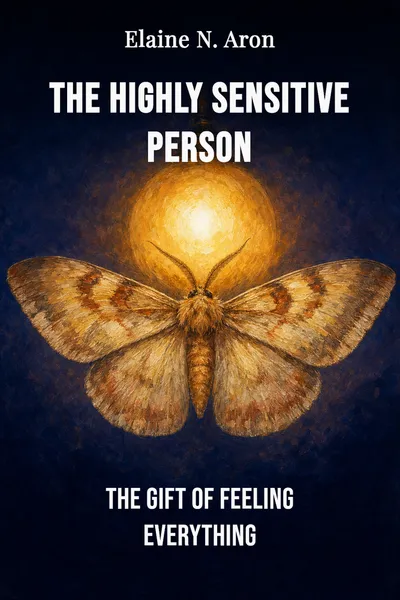
The Highly Sensitive Person
The gift of feeling everything
Description
Picture the last time a room full of noise, small talk and overhead lights left you quietly wrung out while everyone else seemed to be having a fine time. You went home early, or wanted to. You replayed a stray comment for hours. A friend, meaning well, told you to relax, to toughen up, to stop taking things so personally. Somewhere along the way you filed the whole thing under a private flaw, a factory defect you were supposed to fix. In the mid-1990s, a research psychologist named Elaine Aron looked at exactly this pattern and proposed something the people living it rarely hear: it isn't a flaw at all.
Aron called it high sensitivity, and in 1996 she gave it a name that stuck — the Highly Sensitive Person. Her claim was that roughly fifteen to twenty percent of people are born with a nervous system that registers more, processes deeper, and tires faster in overstimulating environments. Vivid dreams, a low tolerance for chaos, a need for solitude as basic as food, a habit of noticing the subtleties everyone else walks past. Not a disorder. A temperament — one biology has kept around across species precisely because it is useful.
The word most highly sensitive people have absorbed about themselves is "too." Too shy, too intense, too easily overwhelmed. Aron's book is an argument that the word is wrong, and that the trait has been mislabeled by a culture that prizes a very particular kind of hardiness. What happens when we stop treating a way of being wired as something to overcome?
The question we’re asking : If sensitivity is a normal inherited trait and not a weakness, why do so many people who have it grow up convinced something is wrong with them?What we’ll see : How a research psychologist reframed a maligned temperament — what it is, what the nervous system is doing, the childhood story that shapes it, and what a life built around it can look like.
Table of contents
01 Chapter 1 — A trait, not a flaw
Elaine Aron came to the subject partly as a scientist and partly as a person who recognized herself in the data. Trained as a psychologist, she began in the early 1990s to study people who reported being easily overwhelmed by bright lights, strong smells, coarse fabrics, loud noise and the sheer volume of other people's moods. What she found was consistent enough to describe as a trait: a bundle of features that traveled together, appeared early in life, and looked biological rather than learned.
The core of it, she argued, is not fragility but depth of processing. Highly sensitive people take in more information and think about it more thoroughly before acting. That is why they notice the detail others miss, catch the tension in a room before a word is spoken, and feel moved by music or landscape in a way that can be hard to explain. The same wiring that produces that richness also fills up faster. When the input exceeds what the system can comfortably handle, the person becomes overstimulated — jangled, exhausted, and desperate to withdraw.

02 Chapter 2 — What the nervous system is actually doing
The reframing only holds if the trait is real in the body, and this is where Aron leaned on biology rather than self-description. Sensitivity, in her account, is not a mood or an attitude one could simply drop. It is a difference in how the nervous system is tuned — a lower threshold at which stimulation registers, and a more elaborate way of processing it once it arrives. Some people are built to notice the faint and respond to the subtle. That tuning has a cost and a payoff built into the same circuit.
She drew on the older idea of arousal, the physiological state of alertness that rises with stimulation. Everyone performs best at a moderate level of it and worse when under- or overaroused; a bored person and a panicked person are both off their game. The highly sensitive person simply reaches the overaroused end sooner. A day that leaves most people pleasantly stimulated can leave them frayed, because they have been processing more of everything the whole time. What looks like weakness is often just a system that hit its ceiling while others were still climbing.
03 Chapter 3 — The wound of being told you're too much
If the trait is neutral, why do so many highly sensitive adults arrive at Aron's book carrying a sense of defect? Her answer runs through childhood. A sensitive child in a supportive family, well matched to a calm environment, tends to flourish — often becoming unusually thoughtful, empathetic and capable. But a sensitive child in a harsh, chaotic or dismissive setting absorbs a very different message, and absorbs it deeply, because absorbing deeply is what this child does best.
The message is usually some version of "you're too much." Too easily upset, too dramatic, too fussy about noise and crowds and rough seams. Parents compare the child unfavorably to a hardier sibling. Teachers read quiet observation as backwardness. Peers punish the child who cries easily or startles at the game everyone else finds thrilling. None of these adults is necessarily cruel; most are simply reading sensitivity through the lens of a culture that treats toughness as the default and everything else as a shortfall.
04 Chapter 4 — Living deliberately with a finer instrument
Step back from the individual and Aron's book describes a mismatch between a temperament and a civilization. Modern life is engineered around the eighty percent — open-plan offices, packed schedules, ambient noise, the assumption that more stimulation is better and that recovery is for the weak. A culture built for the resilient majority ends up treating a natural minority as though its members were failing at a game whose rules were never written with them in mind. The pathology, in this reading, is less in the person than in the fit.
What makes the reframing more than consolation is Aron's claim about value. The societies and organizations that dismiss their sensitive members lose exactly the people who see trouble coming, feel the human cost of a decision, and hold the quiet standards of care and craft. She points to a recurring pattern in which cultures split into two rough classes — the bold ones who act, and the perceptive ones who advise and reflect. A world that only rewards the actors is a world flying without its instruments.
05 Conclusion
Return to the room full of noise, the early exit, the replayed comment. Aron's book does not promise that the room will stop draining you or that the comment will stop landing. It offers something quieter: a different name for what happened. Not weakness, not defect, not failure to cope, but a nervous system doing precisely what it was built to do, in an environment that asks more of it than it was designed to give. The exhaustion was real. So was the reason for it.
Related books