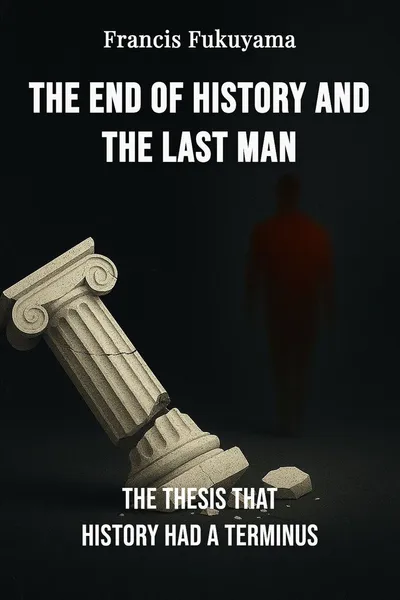
The End of History and the Last Man
The thesis that history had a terminus
Description
In the summer of 1989, a policy analyst at the RAND Corporation named Francis Fukuyama published an essay in the small journal The National Interest with a title that would follow him for the rest of his career: "The End of History?" The question mark was doing real work, but almost nobody kept it. The Berlin Wall was still standing when the piece appeared; it came down that November. Within a couple of years the Soviet Union had dissolved, and the essay looked less like an argument than a prophecy that had already come true.
Fukuyama expanded the essay into a book in 1992, The End of History and the Last Man, and spent much of the next three decades explaining what he had not meant. He did not mean that events would stop. He did not mean that nothing important would ever happen again. He meant something more specific and, to his critics, more provocative: that the long argument over how human beings should organize their collective life had reached a point where liberal democracy had no serious ideological competitor left standing. History as a story of rival systems had, in that sense, arrived somewhere.
The book was read as triumphalism and dismissed as naive almost from the moment it landed. September 11, the rise of China, the resurgence of authoritarian nationalism — each was offered as the refutation. But the caricature and the argument are not the same thing, and the second half of the title, the one about the last man, points to a worry that has aged in unexpected ways.
The question we’re asking : When Fukuyama said history had ended, what exactly did he claim had run out — and did the argument die with the headlines that mocked it?What we’ll see : How a borrowed idea from a nineteenth-century German became a claim about liberalism's last standing rival, and why the book's darkest chapter is the one about us.
Table of contents
01Chapter 1 — The phrase that got misread
The trouble started with the word "history." In ordinary use it means the sequence of things that happen — wars, elections, inventions. Read that way, the claim that history had ended was obviously absurd, and plenty of readers stopped there. But Fukuyama was using the word in a philosophical sense inherited from Hegel: History with a capital H, a single coherent process of human development moving toward some endpoint. What he argued had ended was not events but that directional process — the working-out of a fundamental argument about the best way to live together.
On that reading the claim is narrower and stranger. Fukuyama's contention was that the great ideological contests of the modern era — liberalism against monarchy, against fascism, against communism — had been settled. Not that conflict would cease, but that no rival system remained that could claim to be a genuinely better and more universal alternative to liberal democracy paired with market economics. Coups, wars, and reversals would keep coming. What would not come, he argued, was a new organizing idea capable of superseding the liberal one the way liberalism had superseded what came before it.

02Chapter 2 — What Hegel and Kojève were doing in the argument
Fukuyama did not invent the idea that history has a shape and a destination. He borrowed it, and he was open about the debt. The framework comes from Georg Wilhelm Friedrich Hegel, the German philosopher who, writing in the early nineteenth century, described history as a rational process moving through stages of conflict toward the realization of human freedom. For Hegel, the story was not random; it had a logic, and the logic pointed somewhere.
The more immediate source was a Russian-born thinker named Alexandre Kojève, who lectured on Hegel in Paris in the 1930s to an audience that included much of the next generation of French philosophy. Kojève read Hegel as having already identified the end of history — arriving, controversially, at the conclusion that the universal principles of the French Revolution had settled the fundamental question, and that what remained was their gradual spread. Fukuyama took this reading seriously and updated it: the twentieth century's ideological wars were the last convulsions of a process whose direction Hegel had glimpsed.
03Chapter 3 — The rivals liberalism outlasted
Much of the book is a survey of the competitors that fell away. The nineteenth and twentieth centuries had produced serious, systematic alternatives to liberal democracy, each claiming to be not merely different but better and more universal. Fukuyama's argument is that each was tried, at scale, and failed on its own terms — collapsing not only militarily but in its capacity to command belief.
Hereditary monarchy and aristocracy had been the default order for most of human history, justified by tradition and divine right. The liberal revolutions dismantled the principle that some are born to rule and others to obey; by the twentieth century, almost no regime defended inherited privilege as a principle worth exporting. Fascism was the more violent challenger, offering national and racial glory in place of individual rights. It made an aggressive universal claim in the 1930s and was destroyed on the battlefield within a generation, discredited so thoroughly that the word itself became an accusation rather than a banner.
04Chapter 4 — The last man, and the itch that survives
The second half of the title is the half almost no one quotes, and it carries the book's real unease. "The last man" is a phrase Fukuyama takes from Nietzsche, who used it with contempt to describe the human being at the end of history — comfortable, secure, risk-averse, content with small pleasures and incapable of striving for anything great. If liberal democracy really is the endpoint, Fukuyama asks, what kind of person does it produce, and is that person one we would admire?
This is where the argument turns on itself. The engine of history, in Fukuyama's telling, was the desire for recognition — the thymotic craving to be acknowledged as worthy, sometimes at great cost. Liberal democracy satisfies that craving by distributing recognition equally to everyone. But equal recognition may not fully satisfy the part of us that wants to be recognized as superior, as exceptional, as willing to risk something for a cause larger than comfort. A world of universal dignity might starve the very drive that built it.
05Conclusion
Fukuyama has spent the years since 1992 both defending and revising the argument, most extensively in his later work on political order and on identity. He has conceded that the road to liberal democracy is longer and rougher than the early reception assumed, and that functioning states and social trust cannot be taken for granted. What he has not conceded is the core claim, because the core claim was always narrower than the headline: that no rival system has emerged offering a genuinely better and more universal account of how to grant human beings the recognition they demand.
Related books