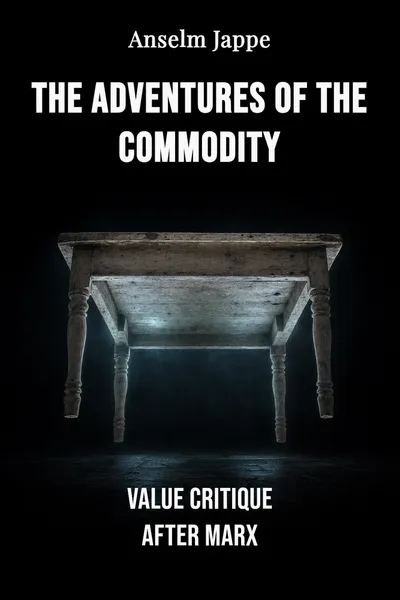
The Adventures of the Commodity
Value critique after Marx
Description
In 1867, in the first chapter of Capital, Karl Marx did something that still reads as oddly patient. Before he got to factories, wages, or revolutions, he spent dozens of pages on a single object: the commodity. A table, a coat, a sack of grain. He turned it over, called it "a very queer thing, abounding in metaphysical subtleties," and refused to move on until he had explained why a plain wooden object could become, the moment it enters a market, something almost haunted. Most readers skip that chapter to get to the drama. Anselm Jappe, a French-German philosopher writing more than a century later, went back and argued that the drama was there all along.
Jappe belongs to a current sometimes called value-form theory, or in German Wertkritik — the critique of value. His book The Adventures of the Commodity, published in French in 2003, makes a claim that unsettles the usual story about Marx. The heart of the matter, he says, is not the fight between bosses and workers over who gets the surplus. It is the strange social form that makes any of it possible: value, the abstraction that lets a haircut, an hour of coding, and a ton of steel all be measured against one another as if they shared some invisible substance.
That shift in emphasis changes what capitalism is and what might be wrong with it. If the problem were only distribution, the cure would be fairer shares. Jappe thinks the object itself — the commodity, and the labour congealed inside it — carries a logic that no redistribution touches. Following that logic is what his book does, and where it leads is somewhere colder and more interesting than a morality tale about greed.
The question we’re asking : What if the real engine of capitalism isn't the clash between classes, but the commodity itself and the kind of labour it demands?What we’ll see : How value-form theory reads Marx against the grain, what it says about the labour we pour into things, and where the whole arrangement runs out of road.
Table of contents
01Chapter 1 — The thing that organizes everything
Start where Jappe starts: with the commodity as a riddle rather than a given. We handle hundreds of them a day without noticing anything odd. A coffee, a phone charger, a train ticket. Each one is useful in its own concrete way — you drink it, you charge with it, you ride with it. Marx called that side of it use-value, and it is as varied as human need itself. But every one of those objects also carries a second, ghostlier quality: it has a price, it can be exchanged, it is worth so much of anything else. That second quality is value, and it is what Jappe wants us to stare at until it stops looking natural.
The puzzle is that use-values have nothing in common. A coat keeps you warm; a kilo of wheat feeds you; they share no physical property that would let you say one is worth exactly three of the other. And yet the market does exactly that, every second, with total confidence. For the equation to work, Marx argued, the objects must be reduced to something they do share — not their usefulness, which differs, but the plain fact that human labour went into making them. Value is that labour made abstract: not this carpenter's skill or that baker's morning, but labour in general, measured in time, drained of all specific content.

02Chapter 2 — Labour that counts, labour that disappears
If value is congealed labour, then labour is the quiet centre of the whole system — but not labour in the warm, dignified sense we usually reach for. This is the move that separates Jappe's reading from the mainstream socialist tradition. For over a century, much of the left celebrated labour: the worker as hero, work as the source of all wealth, the demand that labour finally receive its due. Jappe argues that Marx's deeper point runs the other way. Capitalism does not oppress labour so much as it rests on a peculiar, historically specific kind of labour that deserves no celebration at all.
The distinction is abstract versus concrete labour. Concrete labour is what a particular person actually does — sewing, teaching, hauling, cooking — infinitely varied and bound to real human purposes. Abstract labour is that same activity considered only as a quantity of expended effort over time, indifferent to what is being made. Under capitalism, concrete labour matters only insofar as it produces abstract labour, which is to say value. The weaver's craft is incidental; what counts is how many standardized hours it represents on the market. Human activity gets split in two, and only the ghostly half registers.
03Chapter 3 — The subject that nobody chose
One of the most striking claims in value-form theory is that capitalism has no master. We tend to imagine a culprit — the capitalist, the banker, the corporation — a human will steering the ship for its own gain. Jappe, drawing on Marx and on thinkers like Robert Kurz and Moishe Postone, argues that the real ruler is impersonal. The capitalist himself obeys. He must accumulate, cut costs, expand — not because he is greedy but because value demands it; a firm that refuses the logic simply dies. The abstraction has become, in Marx's phrase, an "automatic subject": a process that uses people to perpetuate itself.
This is what the word fetishism names, and it is not a metaphor for liking shiny things. Commodity fetishism is the condition in which relationships between people take the form of relationships between things. We produce for one another constantly, but we experience that cooperation only indirectly, through prices and markets, as if value were a natural property of objects rather than something we collectively generate and then obey. The social bond is real but inverted: we serve our own product. Money, the purest commodity, becomes the thing everyone chases because it is value in liquid form.
04Chapter 4 — The limits of a world made of commodities
Step back from the mechanics and a larger picture comes into view — the one Jappe most wants us to hold. A civilization built on value is built on an abstraction fundamentally indifferent to the concrete world. Value does not care whether it is embodied in medicine or in weapons, in sustainable farming or in strip-mining, so long as the result sells and the labour congealed in it can be realized on a market. The social form has no internal relation to human need, to meaning, or to the physical limits of a planet. It knows only quantity, only more.
This indifference is why Jappe treats the ecological crisis and the economic one as expressions of the same root rather than separate problems. A system whose governing measure is abstract labour-time cannot register a forest, a climate, or a human life except as it bears on value. Everything concrete — nature, craft, care, community — becomes either raw material for valorization or an obstacle to it. The abstraction eats the world it depends on, not out of malice but because it is constitutionally blind to anything that is not value. There is no steering wheel inside the form that could turn it toward restraint.
05Conclusion
We began with Marx turning a wooden table over in his hands, finding metaphysics in a piece of furniture. The point of Jappe's long detour through value, abstract labour, and the automatic subject is that the table was never innocent. Inside its price sits a whole civilization's decision — made collectively, maintained unconsciously — to measure human life in units of abstract work and let that measure govern everything else. The commodity is the cell, and the body grows entirely from it.
Related books