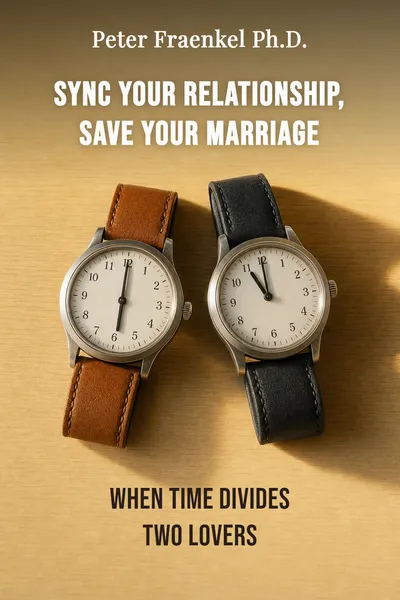
Sync Your Relationship, Save Your Marriage
When time divides two lovers
Description
Picture a couple, together nine years, sitting in a therapist's office arguing about a dishwasher. One of them loads it the moment a plate is dirty; the other lets things pile up and runs it once a day. It sounds trivial, and on the surface it is. But the couples therapist Peter Fraenkel, listening to thousands of arguments like this over a long career, kept noticing something underneath. The fight was rarely about the dishes, or the laundry, or who was late to dinner again. It was about time — how each person moved through it, measured it, spent it, and expected the other to spend it too.
Fraenkel is an award-winning clinician and researcher who has spent decades watching partners collide over things they couldn't quite name. In Sync Your Relationship, Save Your Marriage, he makes a claim that sounds almost too simple until you sit with it: a large share of chronic couple conflict traces back to partners being out of sync on the dimension of time. Not money, not sex, not communication in the abstract — those are often the visible fights. Underneath runs a slower, mostly invisible current: daily rhythms, personal pace, punctuality, how far ahead each person plans, what they think the hours are for.
The twist that makes the book more than a self-help checklist is this. The very time differences that drive couples to therapy are frequently the same ones that drew them together in the first place. The morning person is charmed by the night owl's spontaneity; the planner is soothed by the improviser's ease. What attracts later abrades. Fraenkel spent years researching this pattern and building tools to work with it, and the book is his attempt to hand couples a language for a force they've been fighting blind.
The question we’re asking : Why do couples keep fighting about small things that are never really about the small thing — and what is actually being negotiated underneath?What we’ll see : How a therapist came to read love through the clock, and what he learned about the tempos that pull us together and then set us at odds.
Table of contents
01 Chapter 1 — The fight that was never about the dishes
Fraenkel's starting observation is one most couples would recognize instantly. The arguments that recur — the ones that feel exhausting precisely because they never resolve — tend to be small on their face. He was ten minutes late. She wanted to leave the party two hours ago. One partner needs to plan the vacation in March; the other wants to decide the night before. These aren't the dramatic ruptures of infidelity or betrayal. They're the low, grinding friction of two people trying to share a day.
What he came to believe, watching the same shape appear across very different couples, was that the content of these fights was almost a decoy. The dishwasher, the lateness, the party — each was a proxy for a deeper mismatch in how two people organize their existence in time. And because neither partner had a name for that mismatch, they attacked the symptom. He interprets her impatience as controlling; she reads his lateness as disrespect. Both are half right about the surface and completely wrong about the source.

02 Chapter 2 — Five clocks running at once
To make time usable in a therapy room, Fraenkel breaks it into distinct dimensions rather than treating it as one vague thing. The first is daily rhythm — the larks and the owls, the people who are sharpest at seven in the morning versus those who come alive at eleven at night. This one shapes more than sleep. It determines when a couple talks, when they have sex, when they fight, and when one partner is trying to connect while the other has already checked out for the evening.
The second is pace, or tempo: how fast a person naturally moves, thinks, decides, and speaks. A quick-tempo partner finishes sentences and makes restaurant choices in seconds; a slower-tempo partner needs room to arrive at things. The mismatch reads, wrongly, as impatience on one side and passivity on the other. Third is punctuality — the emotional weight each person attaches to being on time, which is often less about the clock than about anxiety, respect, and how one was raised to treat other people's hours.
03 Chapter 3 — The pull that becomes the wall
Here Fraenkel introduces the idea that gives the book its real charge. The time differences that torment couples are, remarkably often, the same ones that magnetized them at the start. Attraction, he argues, is frequently built on temporal contrast. The steady, future-oriented planner falls for the spontaneous partner who lives in the now, precisely because that partner offers a way of being in time the planner cannot reach alone. The night owl is drawn to the lark's steadiness; the fast mover is captivated by the slow one's depth.
This is not a coincidence, and it's not irony for its own sake. Each person is, in some sense, courting a missing part of their own relationship to time. The improviser supplies the planner with lightness; the planner supplies the improviser with a sense of security about the future. Early on, the difference feels like completion. It reads as excitement, expansion, the pleasant vertigo of being with someone who inhabits the hours differently than you do. The contrast is the spark.
04 Chapter 4 — When two clocks learn to keep time together
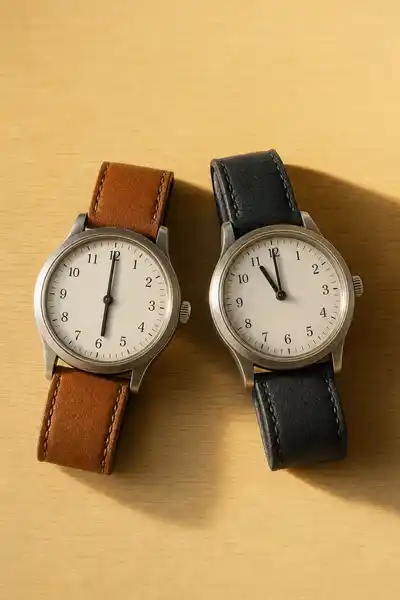
Step back from the individual quizzes and the case studies, and Fraenkel's larger suggestion comes into view: a relationship is less a merger of two selves than an ongoing negotiation between two tempos. We tend to talk about intimacy as a matter of shared values, or communication, or love — and those matter. But underneath sits something more physical and less noticed, the simple fact that two people are trying to synchronize the passage of their days without ever having agreed on what a day is for or how fast it should go.
This reframes what "compatibility" even means. It's tempting to imagine that the right partner is the one whose rhythms match yours automatically, and that friction is evidence of a mistake. Fraenkel's research points the other way. Perfectly matched tempos may be comfortable, but the differences are also generative — they're what let a couple reach experiences neither would find alone. The task isn't to find someone in perfect time with you. It's to become skilled at the negotiation, the way musicians in an ensemble stay together not by playing identically but by listening and adjusting.
05 Conclusion
Return to the couple arguing about the dishwasher. On Fraenkel's reading, the fix was never going to be a rule about when to run it. The rule is a proxy, and a proxy solution leaves the real mismatch untouched, free to resurface as the next small fight and the one after that. What his approach offers instead is a way to see the tempo underneath — to recognize that one partner needs the day cleared as they go and the other needs it to accumulate, and that neither is a flaw. Named accurately, the problem shrinks from a verdict on the marriage to a scheduling question two allies can solve.
Related books