
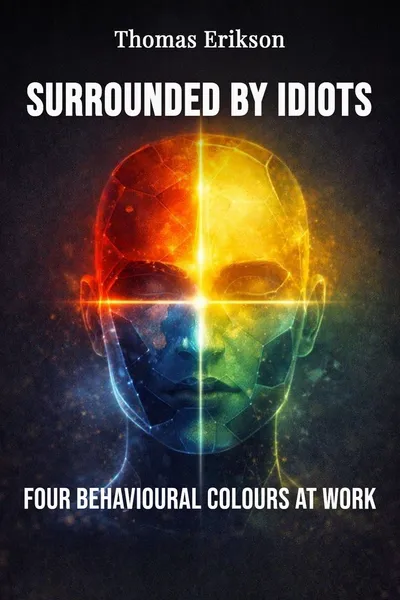
Surrounded by Idiots
Four behavioural colours at work
Description
Somewhere in an office, right now, two competent people are quietly convinced the other one is an idiot. One wants the bottom line and gets a fifteen-minute preamble. The other wants to be heard and gets cut off at the second sentence. Neither is incompetent. Neither is malicious. They just cannot understand why the person across the desk won't communicate like a reasonable human being — meaning, like themselves. This everyday friction is where Thomas Erikson, a Swedish behavioural consultant, plants his book. First published in Swedish in 2014 as "Omgiven av idioter," it became an international bestseller once the English edition landed in 2019, selling into the millions and turning a slightly provocative title into a shorthand people now use half-jokingly at work.
Erikson's premise is disarmingly simple. The people who drive us up the wall usually aren't broken versions of us — they're running on a different operating system. His book takes an old idea about temperament and repaints it in four colours: Red, Yellow, Green, and Blue. Each colour is a cluster of behaviours, a default way of relating to tasks, to people, to conflict and to pace. Learn to read the colours, the argument goes, and the idiots stop being idiots. They become predictable, which is a very different thing.
The title is a joke against itself. Erikson's whole point is that nobody is actually surrounded by idiots — we're surrounded by people wired differently, and the irritation we feel is mostly a failure to translate. What follows is less a personality quiz than a manual for adjusting how we deliver a message depending on who's receiving it, and a running argument about why that adjustment is worth the effort.
The question we’re asking : Why do capable, well-meaning colleagues so often experience each other as impossible to work with?What we’ll see : How Erikson turns temperament into four readable colours, and why the framework has drawn as much criticism as it has praise.
Table of contents
01Chapter 1 — The colleague who is doing it wrong
Erikson opens where most of us live: exasperation. He describes the recurring scene of a workplace where everyone is technically on the same team and nobody seems able to hold a straightforward conversation. The manager who fires off three-word emails and expects action. The colleague who turns a status update into a story with characters and a plot. The quiet one who agrees in the meeting and does the opposite afterward. The perfectionist who answers a yes-or-no question with a spreadsheet. Each of them, from the inside, feels entirely rational. Each of them, from the outside, looks like the problem.
The book's founding observation is that we judge other people's communication against our own as if ours were the neutral standard. We assume the fast talker is aggressive, the careful one is slow, the warm one is unfocused, the reserved one is cold. But these are just readings filtered through our own default setting. Erikson insists the irritation is real and worth taking seriously — not because the other person is wrong, but because it's a reliable signal that we've hit a behavioural difference we haven't learned to name.

02Chapter 2 — Red, Yellow, Green, Blue
The framework rests on two axes. One runs from task-focused to people-focused: are you wired to get the thing done, or to keep the relationship intact? The other runs from introverted to extroverted, in the plain sense of reserved versus outgoing. Cross the two and you get four quadrants, and Erikson paints each one a colour. It's a repackaging of the DISC model that has floated around business training since the 1970s, itself descended from William Marston's 1928 work on emotions — a lineage Erikson mentions but doesn't lean on heavily.
Red is task-focused and extroverted: fast, direct, competitive, allergic to wasted time. Reds decide quickly, speak in headlines, and tend to steamroll people who take too long to get to the point. Yellow is people-focused and extroverted: optimistic, talkative, creative, energised by attention and easily bored by detail. Yellows sell the vision and forget the follow-through. Green is people-focused and introverted: warm, steady, loyal, conflict-averse. Greens are the glue of a team and the hardest to move, because their instinct is to keep the peace even at the cost of saying what they think.
03Chapter 3 — The gap is in the delivery, not the message
The payoff of the model, for Erikson, is not diagnosis but adaptation. Knowing someone is a Blue is useless unless it changes how we speak to them. So the practical heart of the book is a set of translation rules: same content, different packaging, tuned to the colour on the receiving end. Tell a Red the conclusion first and cut the preamble. Give a Yellow room to talk and connect the task to something exciting. Give a Green time, reassurance, and no ambushes. Give a Blue the details, the sources, and space to check before committing.
The failures, in this reading, are almost always failures of delivery. The Red who barks an instruction isn't wrong about the instruction; they've just stripped out the warmth a Green needed to act on it. The Yellow who pitches a plan with enthusiasm and no numbers hasn't done anything dishonest; they've simply handed a Blue nothing to verify. Erikson spends long passages on how each colour hears feedback, handles stress, and behaves in conflict, because that's where mismatches turn from mild irritation into genuine breakdown. A Red under pressure gets blunter; a Green under pressure goes silent; and each reads the other's stress response as proof of bad character.
04Chapter 4 — A model that sells better than it holds up
The four colours are easy to learn, fun to apply, and immediately flattering — you recognise yourself, you recognise your boss, and the whole messy business of human personality snaps into a two-by-two grid. That very smoothness is what draws the sharpest criticism. The DISC family the model comes from has never been regarded, by academic personality psychologists, as a validated measure the way the five-factor model is. Erikson's book presents its categories with the confidence of established science, and much of its authority rests on that tone rather than on the evidence.
The Swedish debate made this explicit. In 2018 a group of researchers awarded Erikson a mock "Deceiver of the Year" prize from a skeptics' society, arguing that the book dresses up a commercial training tool as psychology and overstates what four colours can actually predict. The complaint isn't that the categories are useless — it's that a rich, continuous spread of human behaviour gets flattened into four types, and that once you own a type you start seeing it everywhere, including where it isn't. This is the familiar trap of typologies: they feel true partly because they're vague enough to confirm.
05Conclusion
The two colleagues from the opening are still at their desks, still faintly baffled by each other. Erikson's wager is that the baffled feeling is data, not verdict — the moment we notice someone communicating "wrong" is precisely the moment a difference in wiring has surfaced. Red, Yellow, Green, Blue are his way of making that difference nameable: a rough map that turns "impossible to work with" into "tuned to a channel I haven't tried yet." The book's real subject was never the idiots. It was the small, deflating recognition that we are one too, from where somebody else is sitting.
Related books