Scales of Justice
What social justice requires today
Description
For most of the twentieth century, when people argued about justice, they argued inside a container they never named. The container was the nation-state. A claim for fairness — a fair wage, a fair vote, a fair hearing — was addressed to a government, decided by fellow citizens, enforced within a border. The border itself was not up for discussion. It was simply where the argument happened. Nancy Fraser, a philosopher at the New School in New York, spent the 2000s pointing at that container and asking a question almost nobody was asking: who drew it, and why do we assume the people inside it are the only ones who count?
Her book Scales of Justice, published in 2009, gathers the essays where she works this out. Fraser had already spent years mapping how struggles over money and struggles over respect kept colliding — feminists, minorities and workers making claims that didn't fit neatly into either bucket. But by the 2000s something else had shifted. Climate, finance, migration, global labor: harm was crossing borders while the machinery for demanding justice stayed stubbornly national. The people affected by a decision and the people entitled to contest it were no longer the same people.
Fraser's move is to argue that justice has not two dimensions but three, and that the third one — the question of who belongs to the conversation at all — has quietly become the decisive battleground. It is an unglamorous idea with sharp teeth, because once we take it seriously, a lot of familiar fights turn out to be fights about the frame, not about what happens inside it.
The question we’re asking : When the people harmed by a decision and the people allowed to contest it are no longer the same, what does justice actually require?What we’ll see : How Fraser rebuilds justice around three demands that keep colliding, and why the hardest one is deciding who gets to make a claim in the first place.
Table of contents
01Chapter 1 — The frame nobody was voting on
Fraser starts from a suspicion about how justice claims get processed. Whenever we ask whether an arrangement is fair, we've already made a prior decision — usually without noticing — about who the relevant parties are. A factory closes and jobs move overseas. Is that unjust? The answer depends entirely on who counts as a stakeholder. If it's the workers in the town, one story. If it's the workers everywhere competing for the same jobs, another. If it's the shareholders, a third. The framing decides the outcome before anyone weighs the merits.
She calls the default frame the "Keynesian-Westphalian" one, a slightly clunky pairing that does real work. Westphalian, from the 1648 settlement that fixed the modern idea of sovereign states, marks the assumption that the world divides into bounded territories, each running its own affairs. Keynesian marks the mid-century assumption that each of those territories manages its own national economy. Put together, they produce a picture where justice is something citizens owe each other inside a self-contained space, and outsiders are simply not part of the accounting.

02Chapter 2 — Two claims that kept talking past each other
Before the frame becomes the story, Fraser has to reconstruct what goes on inside it — and here she draws on decades of her own work on two kinds of demand that rarely sit comfortably together. The first is redistribution: claims about who gets what. Wages, taxes, welfare, the split between capital and labor. This is the language of political economy, of class, of material resources. When people say an arrangement is unjust because some have too much and others too little, they are speaking the grammar of redistribution.
The second is recognition: claims about who gets respected. Being seen as an equal, not demeaned or rendered invisible on account of race, gender, sexuality, or culture. This is the grammar of status. When a group protests that the law or the wider culture treats them as lesser kinds of people, the injury isn't primarily about money — it's about standing. Fraser's point, developed in a long public exchange with the philosopher Axel Honneth, is that neither language reduces to the other. You cannot solve a status injury by cutting a check, and you cannot solve poverty with respect alone.
03Chapter 3 — Who gets to be counted
The third dimension is what Fraser calls representation, and it is the hinge of the whole book. Representation is the political dimension of justice: not what you get and not how you're regarded, but whether you are constituted as someone entitled to make claims at all. It concerns the rules of belonging and the procedures of voice — who is admitted to the space where redistribution and recognition get decided.
She splits it into two levels, and the split is what gives the idea its bite. The first level is ordinary and familiar: even among people who clearly belong to a political community, some are effectively silenced — gerrymandered, disenfranchised, drowned out. That's a matter of fair representation within a given frame, and it's the kind of thing electoral reform addresses. The second level is deeper and stranger. It concerns the frame's boundaries themselves. Here the injustice is not being outvoted; it's being wrongly excluded from the community of those who count, having no standing to press a claim in the first place.
04Chapter 4 — When the container itself is unjust
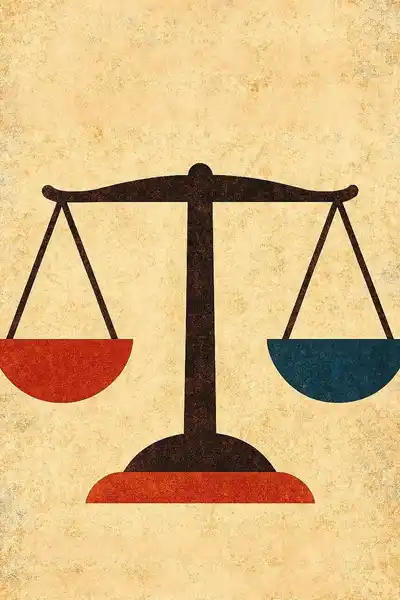
Step back from Fraser's vocabulary and what her three dimensions add up to is a shift in where the deepest political argument actually lives. For a couple of centuries we treated the boundaries of political community as settled — the given inside which the interesting fights took place. Fraser's claim is that the boundaries have themselves become the interesting fight. The scales in her title aren't only the ones that weigh competing claims; they're also the question of scale itself — local, national, global — and at which level a justice claim should be heard.
Her proposed criterion for drawing the frame is deliberately demanding. She calls it the all-affected principle, sharpened into what she terms the all-subjected principle: those who are jointly subject to a given structure of governance have standing to contest how it treats them, whether or not they share a passport. If a body of rules shapes your life — a trade regime, a climate accord, a financial architecture — you belong, by that fact, to the group entitled to argue about it. Citizenship stops being the master key.
05Conclusion
Fraser began by pointing at a container we had stopped noticing: the assumption that justice is something citizens owe each other inside a border someone else had drawn. By the end, that container has been pried open and its walls turned into a question. Redistribution asks who gets what. Recognition asks who is respected. Representation asks who gets to be counted at all — and it is that third demand, she argues, that now decides the fate of the other two. The most effective injustice of our moment isn't a bad share or a slight; it's being misframed out of the conversation entirely, with no address to send the grievance to.
Related books