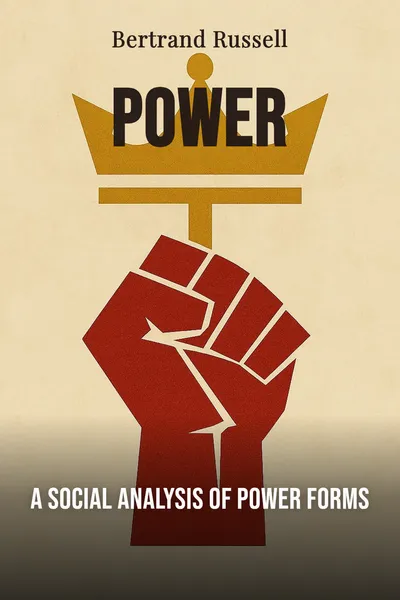
Power
A social analysis of power forms
Description
In 1938, with Europe sliding toward a second war and a certain kind of leader on the rise across the continent, Bertrand Russell — mathematician, philosopher, and by then a public figure who had already been jailed once for his pacifism — sat down to write a book he thought the moment needed. He called it, simply, Power: A New Social Analysis. He was sixty-six. He had spent decades on logic and the foundations of mathematics, and now he wanted to turn the same appetite for clean definitions onto the messiest thing humans do to each other.
His claim was audacious and a little unfashionable. Economists of his day treated wealth as the engine of history; Marxists treated it as the engine of everything. Russell disagreed. Wealth, he argued, was only one form of something larger. The man who wants money usually wants it for what it can command — deference, obedience, safety, glory. Behind the miser and the general and the priest sits the same appetite. And so, Russell proposed, the concept that should stand at the center of social science is not wealth at all. It is power.
That single move reorganizes the whole board. If power is the master concept, then a bank, a church, an army, a newspaper and a schoolroom become variations on one theme, and the interesting question stops being which of them matters most. The interesting question becomes what power actually is, how it changes shape as it moves through a society, and what — if anything — keeps it from crushing the people it runs through.
The question we’re asking : If power, not wealth, is the master concept of social life, what are its real forms — and can any of them be kept in check?What we’ll see : How Russell recasts money, force and belief as one appetite wearing different costumes, and where that leaves the person standing underneath it.
Table of contents
01Chapter 1 — The single word behind money, armies and creeds
Russell opens by refusing the usual starting point. Orthodox economics, he notes, had built its whole picture of human motive around the pursuit of wealth, and Marxism had gone further, treating economic interest as the hidden logic of history itself. He thought this was a genuine error — not a small one. Men do sometimes chase money for its own sake, but far more often they chase what money buys, and what it buys is the ability to make others do what they otherwise would not. Wealth, in other words, is power in one of its more portable forms.
The definition he settles on is deliberately plain: power is the production of intended effects. A person has power to the degree that the world bends toward what they meant to happen. Put that way, the concept stops being the property of kings and tycoons and becomes something present in every human exchange — a teacher over a class, a demagogue over a crowd, a parent over a child. Russell wants the breadth. He is trying to catch the family resemblance between things we normally file in separate drawers.

02Chapter 2 — Where power sits: over bodies, minds, and the space between
Having widened the concept, Russell narrows it again by asking where power actually lands. His first cut is between power over human beings and power over dead matter — the engineer's mastery of steel and steam. The second is the more interesting kind, and he divides it by the means used. You can influence a person's body, as in imprisonment or killing. You can influence their behavior through rewards and punishments, the method of the drill sergeant and the employer. Or you can influence their opinions, through persuasion, education, and what he bluntly calls propaganda.
The third of these fascinates him most, because it is the one that hides its own workings. Power over the body is crude and visible; nobody mistakes a jail cell for freedom. Power over opinion is subtle, and often welcomed by those it acts on. A creed instilled in childhood feels, to the adult who holds it, like their own conviction. Russell had a long memory of how thoroughly education could manufacture loyalty, and he treated the schoolroom and the pulpit as engines of power quite as real as the barracks — only quieter.
03Chapter 3 — The forms it takes and the men who wear them
Russell then walks through the institutional forms power adopts, and he does it partly through the human types each one breeds. Priestly power, he argues, was historically the first great organized form — power resting on a supposed relation to the sacred, and on the claim to interpret the will of the gods. Its strength is that it works on opinion at the deepest level, in the fears and hopes that surround death. Its weakness is that it depends on belief, and belief can decay. Kingly power grew up beside it, sometimes allied, sometimes at war, resting more directly on force and hereditary tradition.
Then there is what he calls the power of the sword — naked military force — which he treats with a cold eye. It can conquer quickly but cannot, by itself, govern long, because a population held only by fear will slip its leash the moment the fear lifts. Successful conquerors have always had to convert their naked power into something more durable, buying legitimacy, marrying into old lines, adopting local gods. Force is the seed of many empires but the maintenance of none. Economic power, the power of wealth and of those who control production, is for Russell one form among these, not the hidden master of the rest — a pointed correction of Marx.
04Chapter 4 — Power as the thing that must be tamed
Step back from the taxonomy and Russell's larger argument comes into focus. His claim is not merely that power comes in many forms; it is that power should occupy in social science the place that energy occupies in physics — the single fundamental concept from which the others are derived. Wealth, prestige, influence, armed force: all are transformations of one quantity, convertible into each other, and a genuine science of society would study the laws of that conversion rather than treating each form as its own separate subject. It is a striking analogy from a man who had spent his life among the exact sciences, and it tells you what kind of unification he was after.
But the analogy carries a warning that mere physics does not. Energy is neutral; power, in Russell's telling, is dangerous precisely because human beings desire it without limit. If the love of power is among the strongest motives, and if it grows by feeding, then a society that leaves power unchecked will be run by those who want it most — which is rarely the same as those fit to hold it. The central practical problem of politics, for Russell, is therefore not who should have power, and not even how it should be distributed, but how it can be tamed: subjected to rules, divided, made answerable, kept from concentrating into forms that no one can resist.
05Conclusion
Russell wrote Power in the shadow of regimes that had made the abstract concrete. The dictatorships of the late 1930s were, for him, laboratory demonstrations of what happens when the appetite he had named meets an organization capable of satisfying it, with nothing left to check either. His book is calm in tone and alarmed in substance, and the two do not cancel out; the calm is what lets the alarm register. He is not warning against power the way one warns against a villain, but the way one warns against fire — indispensable, ordinary, and lethal the moment it is not contained.
Related books