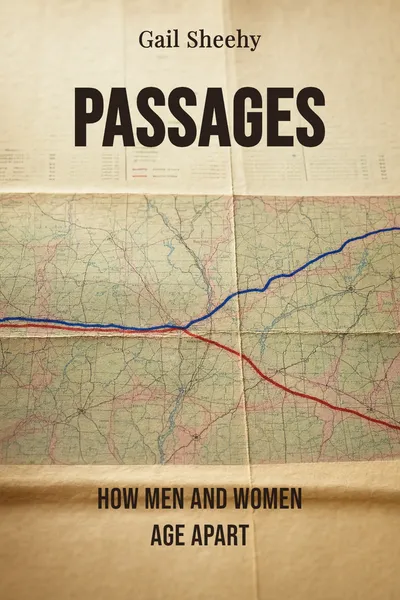
Passages
How men and women age apart
Description
In the early 1970s, a journalist named Gail Sheehy was reporting in Northern Ireland when a young man standing a few feet from her was shot in the face. She was thirty-five. The shock did something odd: it didn't just frighten her, it reorganized her. She came home convinced, without quite having the words yet, that she had reached some invisible border in her own life. When she started asking friends and colleagues about it, she found she wasn't alone. People in their mid-thirties kept describing the same disorientation, the same sense that the map they'd been handed no longer matched the terrain.
Out of that came "Passages," published in 1976, a book built on interviews with 115 mostly middle-class Americans about how adult life actually unfolds. Sheehy's wager was blunt for its time: adulthood is not a plateau you reach and then defend. It is a series of predictable upheavals, each with its own tasks and its own particular ache. Childhood gets all the developmental attention, she argued, and then we pretend the growing stops. It doesn't. It just gets quieter, and lonelier, because nobody warns us it's coming.
The part that lodged deepest with readers was smaller and more intimate. Sheehy noticed that men and women moved through these upheavals on different schedules — that a couple could be lying in the same bed, the same age on paper, and be living in two entirely different seasons of the self. That single observation reframed a great deal of ordinary marital misery, turning what looked like betrayal or coldness into something closer to bad timing.
The question we’re asking : Why do two people the same age, in the same relationship, so often seem to be growing in opposite directions?What we’ll see : How Sheehy mapped adult life as a sequence of passages, and where men's and women's clocks quietly fall out of step.
Table of contents
01 Chapter 1 — The idea that adults keep changing
Before Sheehy, the popular picture of a life was a hill: you climbed through childhood and school, crested somewhere around the wedding and the first promotion, and then coasted. Development was for the young. What happened after was maintenance. "Passages" took that picture and tore it up. Drawing on the work of psychologists like Erik Erikson, and on the emerging research of Daniel Levinson at Yale, Sheehy insisted that the adult self keeps reorganizing itself well into old age, and that each reorganization is stressful enough to feel, from the inside, like coming apart.
Her method was journalism rather than laboratory science, and she was open about it. She sat with people and listened to how they told their own lives. What struck her was how often strangers used the same language — the same restlessness at the same ages, the same quiet panic that arrived roughly on schedule. She began to see adulthood as a shared itinerary rather than a private accident. Everyone thought their crisis was theirs alone. Almost none of them were right.

02 Chapter 2 — The twenties, and the trap of the first big choice
The decade after twenty, in Sheehy's telling, is dominated by a single pressure: to become a fully-fledged adult by picking a shape for one's life and committing to it. She called this era, roughly, the trying twenties. The task is to leave the family, build a first version of a career and a relationship, and construct what she called the Dream — a guiding idea of the person one intends to become. The danger is that these choices feel enormous and permanent when they are, in fact, provisional. Many people spend the following decades unpicking what they locked in at twenty-four.
Here the gender split appears almost immediately. For the men Sheehy interviewed, the Dream in the twenties was usually external and vertical: the work, the title, the mark to be made in the world. Partnership was often folded into the plan as support for the ascent. For many of the women, especially of that generation, the twenties Dream ran through someone else — through a husband whose life would become the vehicle for her own. She poured her ambitions into a shared project and postponed the question of what she, separately, wanted to be.
03 Chapter 3 — Thirty, and the two clocks that don't match
Around thirty, Sheehy observed, a switch flips. The certainties of the twenties loosen, and people feel an urge to tear up the first draft and start a truer one. She described the passage as a moment when the life built in a hurry gets interrogated: the wrong career gets abandoned, the too-early marriage strains or breaks, buried ambitions resurface. It is one of the most divorce-prone stretches of adult life, and Sheehy thought that was no accident. Two people are renovating themselves at once, and the renovations rarely match.
This is where her central insight about mismatched timing does its sharpest work. The woman who spent her twenties inside a partner's Dream often reaches thirty hungry to finally build her own — to go back to work, to study, to expand. At exactly that moment, the man who spent his twenties climbing may be feeling the first fatigue of the ascent, quietly wishing for more warmth, more home, more of the nurturing he assumed would always be there. She is reaching outward just as he is reaching in. Each experiences the other's turn as a withdrawal.
04 Chapter 4 — The forties, and the great crossover
If the thirties are when the clocks fall out of step, the forties, in Sheehy's account, are when they dramatically swap. She described a midlife crossover in which men and women partly trade the very qualities that had defined them. Having spent decades proving himself in the world, the man in his forties often turns toward feeling, intimacy, and the interior life he had shelved — wanting connection, softness, meaning beyond achievement. The woman who spent her earlier decades tending relationships frequently turns outward with new assertiveness, ambition, and appetite for a public self of her own.
This crossover carries a strange, almost cruel comedy. Just as he finally wants to come home and be held, she finally wants to leave the house and be counted. The forties can therefore be a second high-risk zone for couples, not because they've stopped loving each other, but because they are moving in opposite directions through the same doorway. Sheehy saw it as the delayed consequence of the opposite bets made back in the twenties: the postponed self always comes due, and it tends to come due late, loudly, and inconveniently.
05 Conclusion
The young man Sheehy watched die in Northern Ireland sent her home with a question she would spend years answering: why did reaching a certain age feel like standing at a border? Her answer, worked out across those hundred-odd interviews, was that the border was real and that everyone crosses it — just not together. Adult life is a sequence of passages, each with its own task, its own vulnerability, its own timing. And the timing is where couples come undone, because a man and a woman the same age are almost never in the same season at once.
Related books