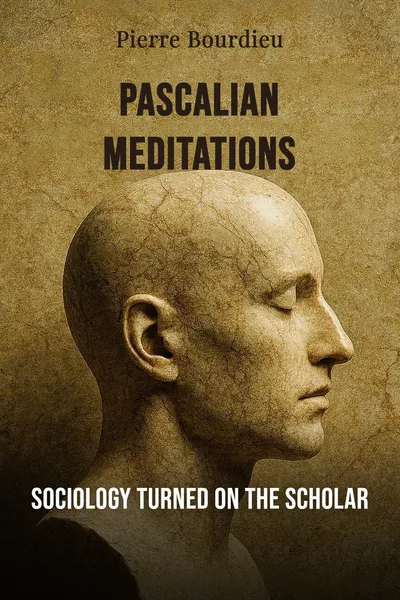
Pascalian Meditations
Sociology turned on the scholar
Description
Near the end of his life, in 1997, Pierre Bourdieu published a book that reads less like a treatise than like a settling of accounts — with himself. He called it Pascalian Meditations, borrowing the name of the seventeenth-century thinker who had turned his sharpest scrutiny not on the world but on the human tendency to deceive itself. Bourdieu had spent four decades studying schools, museums, taste, marriage, poverty, the state. Here he pointed the same instruments back at the one place sociology usually leaves untouched: the mind of the person doing the studying, the scholar comfortably seated at his desk.
The gesture is uncomfortable, and it is meant to be. Philosophy, Bourdieu argued, has always flattered itself as the pure exercise of reason, as thought freed from the noise of ordinary need. But nobody thinks from nowhere. The philosopher who contemplates the good life has been fed, sheltered, exempted from the scramble that fills most human days. That exemption is not a detail. It shapes what he can see, and — more quietly — what he cannot. It even shapes his conviction that he sees clearly.
So the book asks a question that most academic writing is built to avoid. What does it cost, intellectually, to think from a position of comfort you have stopped noticing? Bourdieu names the trap and refuses to pretend he stands outside it. He was, after all, a professor at the Collège de France, the summit of the French system, writing about the blindness of professors. The meditation is genuine because the meditator implicates himself.
The question we’re asking : What does the scholar's protected position do to the very reason he trusts?What we’ll see : How Bourdieu turned his own science back onto the world that made it possible — and named the illusion at its heart.
Table of contents
01Chapter 1 — The scholar who never had to hurry
Bourdieu starts from an image so ordinary we forget it is strange: a person sitting still, thinking about a problem that will not go stale if the answer arrives tomorrow. This is the condition of the scholar, and it is a rare thing. Most human activity happens under pressure — the meal to prepare, the rent due Friday, the decision that cannot wait. The person acting in the world is caught in what Bourdieu calls urgency, the grip of a present that demands a response before all the evidence is in.
The thinker, by contrast, has been released from that grip. He can suspend the question, weigh both sides, return to it after lunch. This suspension is precisely what makes theory possible — you cannot contemplate the structure of justice while you are being evicted. Bourdieu does not sneer at this. He depended on it his whole life, and he insists it is one of the genuine achievements of civilization to have carved out spaces where some people can think without hurrying.

02Chapter 2 — Skholè, or the leisure that hides itself
The Greeks had a word for this condition, and Bourdieu leans hard on it: skholè, from which we get the word school. It meant free time, leisure — specifically the leisure to study, to argue, to pursue knowledge for its own sake. It was the privilege of citizens who did not have to work, sustained by an economy that others, slaves and laborers, kept running. Philosophy was born inside skholè and has never quite left it. The very word school still carries the trace of a freedom that was never universal.
What interests Bourdieu is how completely this condition disappears from view for those who enjoy it. The scholar experiences his leisure not as a social privilege but as the natural atmosphere of the mind. He does not think, my ability to spend three years on a manuscript rests on a whole apparatus of salaries, pensions, and other people's labor. He thinks, I am pursuing truth. The material scaffolding becomes invisible precisely to the degree that it works well. The fish, as the saying goes, does not notice the water.
03Chapter 3 — The body knows before the mind decides
To show what the scholarly gaze misses, Bourdieu returns to a concept he had developed for decades: the habitus, the set of dispositions laid down in us by our upbringing, our class, our whole history — dispositions that live in the body and act faster than reflection. The skilled tennis player does not calculate the angle of the return; she is already moving. The experienced negotiator senses the room before he could explain what he senses. Most competent action in the world runs on this bodily knowing, not on conscious deliberation.
This matters enormously for the argument, because the scholar's model of human beings is a deliberating model. He pictures the mind choosing, comparing, deciding. But that picture describes the exceptional case — the moment when habit breaks down and we are forced to stop and think — while treating it as the rule. The vast, silent competence of ordinary life, the way a person simply knows how to behave at a funeral or a market or a job interview, escapes a science built in the image of contemplation.
04Chapter 4 — When reason forgets where it stands
Bourdieu gives the central error a name: the scholastic illusion. It is the fantasy that thought can float free of the conditions that make it possible — that the scholar, alone among human beings, occupies no position, carries no interest, thinks from pure air. The illusion is seductive precisely because those conditions are so well arranged that they vanish. Comfort that works perfectly feels like no comfort at all; it feels like the natural state of things. And so the person best placed to see the world clearly is also, in one specific way, the most reliably blind.
The danger is not merely academic vanity. When reason forgets where it stands, it universalizes its own particular case and calls the result human nature. It builds a rational actor who is really a professor. It builds an aesthetics that mistakes the detached contemplation of the cultured for a faculty everyone possesses. It measures the whole of humanity against a standard secretly drawn from a small, protected class, and then wonders why so many people seem to fall short. The illusion does violence in the name of universality — it excludes even as it claims to speak for all.
05Conclusion
The book that began as a settling of accounts ends without absolution. Bourdieu does not free the scholar from his privileged perch, and he does not free himself. What he offers is smaller and harder: a permanent suspicion, aimed inward, that the clarity we prize may be a symptom of the comfort we have stopped seeing. Pascal watched the mind flatter itself into false certainty; Bourdieu watches learned reason do the same, dressed in the authority of science.
Related books