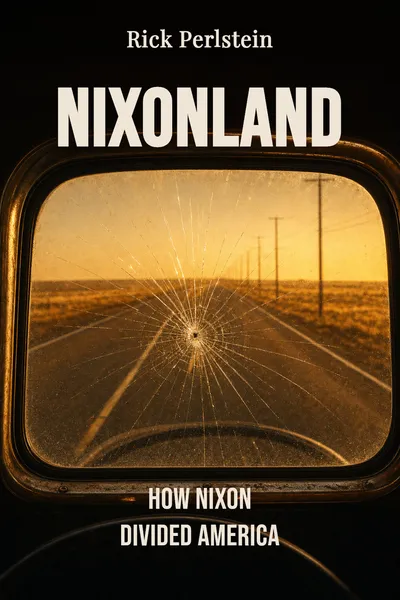
Nixonland
How Nixon divided America
Description
In the fall of 1964, Lyndon Johnson buried Barry Goldwater in one of the largest landslides in American history — forty-four states, sixty-one percent of the vote, a mandate so total that commentators wrote obituaries for the Republican right. The country looked, for a moment, like a broad liberal consensus that had finally settled its arguments. Rick Perlstein opens his history in that exact moment of apparent triumph, because it is where his story turns. Within four years the same electorate would hand the presidency to Richard Nixon, and within eight it would re-elect him in a landslide nearly as large as Johnson's had been. Something had come apart in between.
Perlstein's book, published in 2008, covers a tight window — roughly 1965 to 1972 — and it argues that these seven years remade the emotional map of American politics. The riots in Watts, the escalation in Vietnam, the campus revolts, the assassinations, the backlash and the backlash against the backlash: Perlstein reads all of it through a single organizing figure. Nixon did not create the divisions. He read them better than anyone else, and he learned to run on them.
The title is the argument. "Nixonland" is not a place Nixon governed; it is the country he helped bring into being — a nation split into two camps that could no longer see each other as fully legitimate. Perlstein wants us to understand how a man so awkward, so resented, so temperamentally isolated managed to become the voice of a majority that felt itself under siege.
The question we’re asking : How did a landslide loser's party come back to win the White House twice by turning American against American?What we’ll see : How Nixon read a fracturing country, built a coalition out of resentment, and left behind a political style that outlasted him.
Table of contents
01 Chapter 1 — The two Americas that met at Berkeley
Perlstein begins by drawing the fault line that runs through the whole book, and he draws it in personal terms — with Nixon himself. Here was a man from a hardscrabble Quaker family in Whittier, California, who worked his way up without charm or money, who watched the confident sons of the elite glide past him, and who never stopped feeling the sting. Perlstein calls the people like Nixon the "Franklins" and the "Orthogonians," borrowing the names of two clubs at Nixon's college — the polished insiders and the resentful strivers who banded together against them. That division, he suggests, was the emotional template Nixon carried into national life.
By the mid-1960s the same split was tearing through the country, and it surfaced first on campus. The Free Speech Movement at Berkeley in 1964, then the anti-war teach-ins, then the wider counterculture — to millions of Americans watching on television, this looked less like idealism than like the confident children of privilege sneering at the values their parents had bled for. The students saw an unjust war and a hypocritical establishment. The people watching them saw ingratitude, disorder, and contempt.

02 Chapter 2 — The resentment machine
What made Nixon effective, in Perlstein's telling, was not a program but a posture. He grasped early that a large and growing bloc of Americans felt unseen — people who worked, paid taxes, obeyed the rules, and now watched rioters, protesters, and permissive intellectuals dominate the news while nobody spoke for them. Nixon set out to become their voice. He rarely attacked openly; he spoke of law and order, of respect for institutions, of the quiet people who did not march or shout. The genius was in the framing, which let listeners fill in the enemy themselves.
Perlstein traces how this crystallized into strategy. There was the courting of the white South — the so-called Southern strategy — in which Republicans, without ever quite saying so, positioned themselves as the party of Americans uneasy with the pace of civil rights. There was the deliberate cultivation of the sense that the media, the universities, and the courts were all rigged against ordinary people. Nixon did not invent these grievances, but he built a machine to harvest them and turn them into votes.
03 Chapter 3 — 1968, the year the center gave way
The middle of the book slows down to live inside a single, shattering year. In January 1968 the Tet Offensive erased the official story that Vietnam was being won. In March, Johnson, staggered by a near-loss in the New Hampshire primary, announced he would not seek re-election. In April, Martin Luther King Jr. was assassinated and cities across the country burned. In June, Robert Kennedy — who had seemed capable of holding a fractured Democratic coalition together — was shot dead in Los Angeles moments after winning the California primary. Each blow removed a possibility of the country holding.
Then came Chicago. The Democratic convention that August became a nationally televised spectacle of the party's collapse: antiwar delegates inside the hall, protesters in the streets, and a police force that Perlstein describes beating demonstrators before the cameras. Whatever one thought of the protesters, the images fixed an impression — that the Democrats presided over disorder they could not control. Hubert Humphrey emerged as the nominee, a decent and exhausted man carrying the weight of Johnson's war and a party at civil war with itself.
04 Chapter 4 — The silent majority and the map it drew
Stepping back, Perlstein's deeper argument is about a phrase and a map. In November 1969, with the war still grinding on and protests swelling, Nixon went on television and appealed over the heads of the demonstrators to what he called "the great silent majority" of Americans. The phrase did enormous work. It told a vast, uneasy public that they were the real country, and that the loud, visible dissenters were an unrepresentative minority. It divided the nation into the seen and the unseen, and it flattered the unseen into a coalition.
What Perlstein wants readers to grasp is that this was not merely rhetoric for a single speech; it was a durable way of assembling a majority. Instead of building a coalition around shared interests — the old New Deal logic of jobs, wages, security — Nixon built one around shared grievances against a common set of cultural enemies. The coalition did not need to agree on much. It only needed to agree on what it was against. That is a fundamentally different way of doing politics, and Perlstein argues it became the dominant one.
05 Conclusion
Perlstein closes where the drama of the period ends, with Nixon at the summit — the 1972 landslide, the near-total vindication of a man who had been written off a decade before. The book does not carry the story all the way through Watergate; that fall belongs to a later volume. What matters for "Nixonland" is the arc from Goldwater's ruin to Nixon's triumph, a journey that runs entirely on the country's willingness to divide against itself. The same electorate delivered both landslides. Only the fault lines had moved.
Related books