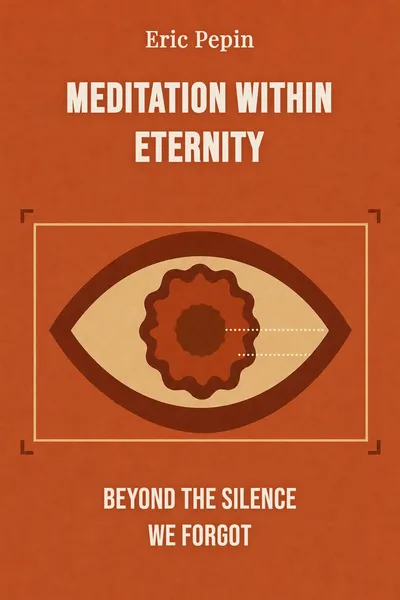
Meditation within Eternity
Beyond the silence we forgot
Description
Somewhere between a yoga app and a mindfulness playlist, meditation became a way to calm down. Ten minutes before a meeting, a breathing exercise before sleep, a voice telling us to notice our thoughts and let them float by. It works, more or less. Eric Pepin, an American teacher who has spent decades on contemplative practice, opens Meditation within Eternity from an odd angle: what if this — the relaxation, the stress relief, the tidy bits of borrowed Zen — is the smallest thing meditation was ever for, and we mistook the vestibule for the house?
His claim is not gentle. Pepin argues that spirituality in the modern West has been quietly hollowed out, kept as a mood and a decor while its actual purpose leaked away. We still have the words — presence, energy, the sacred, the beyond — but we treat them as metaphors, poetic ways of describing ordinary calm. He wants them read literally. For him there is an extraordinary, physical, largely invisible dimension of the universe that human beings once knew how to touch, hear and see, and that most of us have simply stopped exercising, the way a muscle wastes when it is never used.
That is a provocative bet to place in a genre full of soft reassurance, and Pepin knows it. Meditation within Eternity is practical — full of exercises, warnings, and instructions — but it keeps pushing at the boundary between comfort and something stranger. It asks what happens if we stop treating the spiritual as a nice idea and start treating it as a perception we have let go dormant.
The question we’re asking : What did meditation become for, and what did Pepin think we lost when it became a way to relax?What we’ll see : How one contemplative teacher reframes the spiritual life as a forgotten faculty of perception rather than a mood to be managed.
Table of contents
01 Chapter 1 — The spiritual life without the incense
Pepin starts by clearing the table. Meditation, as it circulates now, tends to arrive wrapped in a particular aesthetic — cushions, candles, a hush of Eastern wisdom repackaged for people with busy lives. None of this is wrong, exactly. But he treats it as a kind of costume that has come to stand in for the thing itself. You can own all the props and never once do what the practice was designed to do. The decor, he suggests, is how a serious pursuit gets domesticated into a lifestyle.
The book's tone is deliberately un-mystical for a book about the mystical. Pepin writes like someone giving directions, not delivering revelations. He is wary of the guru voice, the performed serenity, the sense that a teacher is selling enlightenment as a finished product. Spirituality, in his telling, is closer to a craft than a belief system — something you practice badly for a long time before you practice it well, with all the frustration that implies.

02 Chapter 2 — Attention as a muscle nobody trains
The engine of the whole method, for Pepin, is attention — and he means something more specific than concentration. Most of us can focus when we have to: on a screen, a deadline, a conversation we care about. What we rarely do is take attention itself and turn it into an object we can strengthen, direct and hold steady at will. He treats it as a faculty on the same footing as physical strength, something that atrophies through neglect and grows only through repeated, slightly uncomfortable effort.
The exercises reflect that. Rather than asking the reader to simply relax and observe the breath, Pepin sets tasks that resist the mind's tendency to drift and blur. Holding a precise inner focus, sustaining a subtle sensation, keeping the attention from collapsing into daydream — these are framed as reps, not as moments of grace. He is candid that it will feel like work, that the mind will fight it, and that the first weeks mostly reveal how scattered our attention has quietly become.
03 Chapter 3 — The senses we stopped using
Here the book turns strange, and Pepin means it to. Once attention is steadied, he argues, it can be pointed at something most of us never learned to register: a felt, energetic dimension of reality that he insists is not a figure of speech. He describes sensing energy in the body, between people, in a room, in the space around objects — and he is careful to present this as a matter of perception rather than faith. He is not asking the reader to believe in it. He is asking them to try to feel it, and to notice honestly whether anything is there.
The claim is that these are latent senses, not supernatural gifts. In the same way a wine taster develops a palate that seems almost fictional to a beginner, Pepin suggests that sensitivity to subtle energy is a trainable perception that has simply fallen out of the standard human repertoire. Children, he notes, often report perceiving more than adults, and we teach them out of it, filing such experiences under imagination. The book treats that filing away as a loss, not a maturing.
04 Chapter 4 — When the invisible stops being a metaphor
Step back from the exercises and a larger argument comes into view — one about what happened to spirituality itself. Pepin's whole project rests on a suspicion that modern culture inherited the vocabulary of the sacred while quietly losing the faculty it was meant to name. We kept the words presence, energy, spirit, the beyond, and we turned them into decoration, poetic ways of gesturing at feelings we could not otherwise express. What we let go was the assumption that these words once pointed at something a trained person could actually perceive.
This reframes the disagreement he is picking. The dominant modern move is to make spirituality respectable by making it psychological: meditation as stress management, the sacred as a metaphor for meaning, transcendence as a nice word for feeling connected. It is a bargain that keeps the practice while dropping its claims. Pepin refuses the bargain. His wager is that spirituality is not a comforting story we tell but a mode of perception we can either develop or neglect — and that we have overwhelmingly chosen to neglect it, then called the neglect maturity.
05 Conclusion
Meditation within Eternity ends where it began, with a quiet accusation dressed as an invitation. We treat meditation as a tool for calm, and Pepin keeps insisting that calm was never the point — only the ground floor of a building most of us never explore. The relaxation is real, the stress relief is real, but they are the vestibule, and he spends the whole book trying to describe the rooms beyond it and hand the reader a key that only works with effort.
Related books