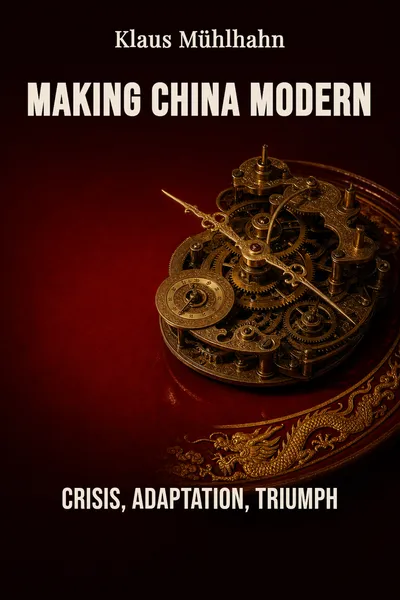
Making China Modern
Crisis, adaptation, triumph
Description
In 1793, the British envoy Lord Macartney arrived at the Qing court expecting to open a market of unimaginable size. The Qianlong Emperor sent him home with a famous brush-off: the Middle Kingdom possessed all things and had no need of British manufactures. For a long time that letter was read as the perfect emblem of a proud, frozen empire that would soon be humiliated by gunboats. Klaus Mühlhahn, a German historian of China, opens his sweeping account roughly there — but to argue almost the opposite of the cliché. The Qing were not asleep. They were running one of the largest, richest, most administratively sophisticated states on earth.
The story that follows in Mühlhahn's telling is not the familiar one of a great civilization that stagnated, collapsed, and then belatedly copied the West. It is the story of a society that spent more than two and a half centuries lurching through crisis — defeat, rebellion, famine, occupation, revolution — and each time improvising new institutions out of the wreckage. The humiliations were real. So were the recoveries. Mühlhahn's China is less a patient waiting to be modernized than a workshop of constant, often violent, adaptation.
That reframing matters because it changes how we read the present. The People's Republic that now unsettles boardrooms and foreign ministries did not arrive from nowhere in 1978. In Mühlhahn's account it sits at the end of a long chain of institutional experiments, some catastrophic, some astonishingly effective, stretching back to the imperial reformers. Read this way, China's triumphs and its most troubling tendencies come from the same source.
The question we’re asking : How does Mühlhahn explain the making of modern China as a single, unbroken story of crisis and adaptation rather than a sudden leap into the modern world?What we’ll see : How one historian traces a two-hundred-year pattern of collapse and reinvention that still shapes the country we watch today.
Table of contents
01 Chapter 1 — The empire that was never as static as we thought
Mühlhahn begins his revision with the Qing dynasty itself, which ruled from 1644 to 1912. The old textbook picture had the Manchus presiding over a rigid Confucian order, incurious about the outside world and doomed by its own conservatism. Mühlhahn replaces that with something more dynamic. The eighteenth-century Qing were an expanding empire that roughly doubled their territory, absorbed Tibet, Xinjiang and Mongolia, and governed a population that grew past four hundred million. Managing that scale required real administrative invention — tax systems, granaries, a civil bureaucracy recruited through examinations that Europeans openly admired.
The trouble, in his account, was not stagnation but success outrunning its own structures. Population boomed, land did not, and the machinery of a mid-sized empire was asked to run a giant one. Then came the shocks from outside. The First Opium War of 1839 to 1842 ended with the Treaty of Nanjing, the ceding of Hong Kong, and the opening of treaty ports on terms China had not chosen. Mühlhahn is careful here: the defeat exposed weakness, but it did not create a passive victim.

02 Chapter 2 — Institutions built, broken, rebuilt
When the Qing finally fell in 1912, China did not become a functioning republic so much as a contested space. Mühlhahn spends real attention on the decades that historians often rush through — the warlord fragmentation, the Republican experiment under the Nationalists, the years of Japanese invasion. His argument is that this was not a void between empire and communism but a laboratory. Modern universities, professional armies, chambers of commerce, newspapers, banks, legal codes and a genuine urban culture all took shape in these turbulent years, especially in cities like Shanghai.
The Nationalist government under Chiang Kai-shek, which nominally unified the country in 1928, gets a more textured treatment than the usual portrait of corrupt failure. It built state institutions and had a coherent modernizing project. What it lacked was time and peace. The Japanese invasion from 1937, the horrors of Nanjing, and the grinding war that followed shattered whatever state capacity had been assembled. Mühlhahn treats the war years as the decisive rupture — the catastrophe that discredited one modernizing elite and cleared the ground for another.
03 Chapter 3 — The engine of the reform decades
The turn most readers come to the book for is 1978, when Deng Xiaoping and his allies began dismantling the command economy. Mühlhahn frames the reform era less as a sudden conversion to capitalism than as another round of the old improvisation — pragmatic, experimental, and consciously incremental. Deng's crossing-the-river-by-feeling-the-stones approach meant piloting changes locally, watching what worked, and scaling it. Special economic zones like Shenzhen, decollectivized farms, and township enterprises were tried before they were doctrine.
What Mühlhahn stresses is that this worked precisely because it drew on capacities accumulated over the previous century. The reformers did not start from zero. They had a literate population, a disciplined party-state that could enforce decisions, basic industrial infrastructure, and a diaspora and neighbors — Hong Kong, Taiwan, overseas Chinese networks — ready to supply capital and know-how. The growth that followed, sustained near double digits for three decades, was extraordinary, but it rested on foundations laid, painfully, in the eras of crisis before it.
04 Chapter 4 — A history that keeps rhyming
Step back, and Mühlhahn's larger claim comes into focus. He is arguing against two familiar stories at once. One says China stagnated for centuries and only became modern by importing Western models. The other says China's rise is a smooth, almost inevitable return to natural greatness. Both are too tidy. His China is neither frozen nor destined — it is a country that has repeatedly been knocked down and has repeatedly rebuilt itself with whatever materials were at hand, borrowing freely, discarding what failed, and improvising institutions under enormous pressure.
The point of reading two hundred years as one continuous process is that it dissolves the line between the country's achievements and its anxieties. The same instinct that produced Shenzhen produced the surveillance state. The same fear of chaos that motivated genuine development also motivates repression. In Mühlhahn's telling, the party's obsession with stability, its distrust of independent civil society, its readiness to mobilize the whole society for a single goal — these are not new communist inventions. They are inherited reflexes, forged in the Taiping catastrophe, the warlord years, the Japanese occupation, the famines.
05 Conclusion
Return, for a moment, to Macartney's dismissal and the century of humiliation that seemed to follow it. Mühlhahn's book asks us to read that whole arc differently — not as proof of a civilization's decline and rescue, but as the first chapter in a long story of a society improvising its way through disaster. The empire that turned away the British was not asleep; the republic that failed was not empty; the reforms that made China rich were not a break with the past but its continuation by other means.
Related books