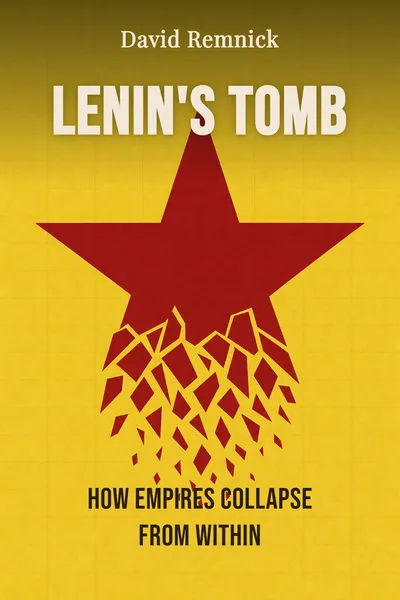
Lenin's Tomb
How empires collapse from within
Description
On Red Square, a few hundred yards from the Kremlin wall, a granite mausoleum holds the embalmed body of Vladimir Lenin, tended for decades by a secret laboratory of scientists whose only job was to keep a dead man looking alive. For most of the twentieth century, an endless line of citizens shuffled past the glass coffin in respectful silence. The body was the state's most sacred object — proof that the revolution had produced not just a government but a kind of religion, complete with relics and pilgrims. David Remnick, who covered Moscow for the Washington Post from 1988 to 1991, understood the tomb as the perfect symbol of the whole enterprise: a corpse propped up, maintained at great expense, insisted upon as living.
When Remnick arrived, the Soviet Union looked eternal. It had nuclear weapons, a vast army, an empire stretching from Berlin to the Pacific, and a security apparatus that had crushed every internal challenge for seventy years. When he left, it was gone — dissolved not by invasion or economic sabotage from abroad but by something happening inside its own citizens. His book, published in 1993 and awarded the Pulitzer Prize, is an eyewitness account of that dissolution, built from hundreds of interviews with dissidents, miners, historians, apparatchiks, and old Stalinists who had never expected to be asked what they had done.
What makes the account gripping is that Remnick was not watching a war. He was watching a lie lose its grip. The Soviet order had always depended less on belief than on the appearance of belief — on everyone agreeing to repeat what no one privately accepted. When that agreement broke, the machinery that had seemed unbreakable simply stopped working, faster than anyone, including the men who dismantled it, thought possible.
The question we’re asking : How does an empire that survived war, terror, and famine come apart in a matter of a few years, and largely from the inside?What we’ll see : How a reporter watched the world's second superpower unravel, from the embalmed body on Red Square to the dead of the purges to the crowds who finally stopped being afraid.
Table of contents
01 Chapter 1 — The corpse in the Mausoleum
Remnick opens with the body because the body explains everything. Lenin died in 1924, and against the wishes of his widow, Stalin had him embalmed and put on permanent display. A cult of scientists took over the maintenance: the skin re-treated every eighteen months, the tissues injected, the whole thing lit to look serene. The point was never Lenin the man. The point was to convert a political movement into something eternal and holy, a faith that could not be questioned because its founder had, in a sense, never died.
The genius and the horror of the system, as Remnick tells it, was that it demanded participation more than conviction. You did not have to believe the propaganda. You had to act as though you did — vote in the meaningless elections, applaud the speeches, denounce when denunciation was required, keep quiet about what you knew. Millions performed this ritual daily. The performance itself was the glue. As long as everyone kept performing, the collective fiction held, and each person, watching everyone else comply, assumed the belief was real somewhere, in someone.

02 Chapter 2 — The graves that would not stay buried
The first thing that came pouring out was the dead. Remnick devotes some of his most powerful reporting to the recovery of Soviet memory — the slow, agonizing public reckoning with what Stalin had done. For decades the numbers had been unspeakable: the millions killed in the collectivization famines, the show trials, the labor camps of the Gulag, the executions of 1937 and 1938 in which the state shot its own citizens by the hundreds of thousands. Officially, none of it had a proper history. Families did not know where relatives were buried, or whether they had even been killed.
He follows the work of Memorial, the grassroots organization founded in the late 1980s to document the repressions and find the mass graves. Ordinary people, often elderly, came forward with photographs, letters, the names of the disappeared. Near Minsk, at a site called Kuropaty, investigators exhumed the remains of tens of thousands shot by the secret police. Across the country, the ground was giving up its evidence, and the evidence contradicted everything the state had spent seventy years insisting on.
03 Chapter 3 — The system that ran on lies
Alongside the moral collapse, Remnick tracks the material one, and shows how tightly they were bound. The Soviet economy in the late 1980s was a theater of pretense: factories reported production that did not exist, planners set targets everyone knew were fictional, shops stood empty while newspapers announced abundance. The whole apparatus ran, as the old joke went, on the principle that they pretend to pay us and we pretend to work. Glasnost let people finally say this in public, and once they did, the pretense had nowhere to hide.
He goes down into the coal mines and reports the great miners' strikes of 1989, when workers in the Kuzbass and elsewhere walked out — not initially over politics but over soap, over the absence of the most basic goods after lifetimes of labor. The strikes revealed that the working class, in whose name the entire state existed, had lost all faith in it. The gap between the official story and the felt reality had simply become too wide to bridge with slogans.
04 Chapter 4 — When the fear finally lifted
The climax came in August 1991, when a group of hardliners — KGB men, generals, the vice president — placed Gorbachev under house arrest at his Crimean dacha and announced they were taking control to save the Union. On paper, they held everything: the army, the security services, the state media. By the old logic, the coup should have worked. It had worked in Budapest in 1956 and Prague in 1968. Force, applied by the center, had always won.
It did not work this time, and Remnick, reporting from Moscow through those three days, shows why. Crowds gathered at the Russian parliament building, the White House, to defend it. Yeltsin climbed onto a tank and called the coup illegal in front of the cameras. Soldiers hesitated and would not fire. The plotters, some of them visibly drunk, lost their nerve. What had changed was not the balance of firepower but the balance of fear. The population had simply stopped being afraid, and a system that governed by fear had nothing left once fear was gone.
05 Conclusion
Lenin's body is still there. After everything — the recovered graves, the strikes, the coup, the flag lowered over the Kremlin on the last night of 1991 — the embalmed corpse remains in its mausoleum on Red Square, tended by the same laboratory, argued over by a country that has never quite decided whether to bury it. Remnick ends more or less where he began, with the relic that outlasted the faith it was meant to embody, a preserved thing at the center of a state that could not preserve itself.
Related books