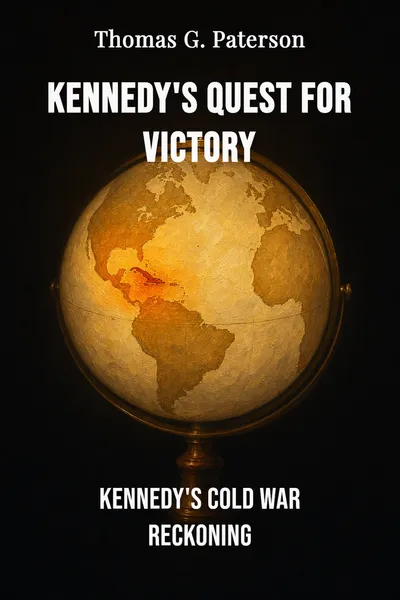
Kennedy's Quest for Victory
Kennedy's Cold War reckoning
Description
When John Kennedy took the oath in January 1961, he did it with a promise that has outlived almost everything else he said: the United States would pay any price, bear any burden, to assure the survival and success of liberty. It reads like idealism. Read again, and it reads like a man keeping score. Kennedy came into the White House convinced the country had been losing — losing to Moscow, losing in the developing world, losing the momentum of history itself. The mission of his presidency, in his own framing, was to reverse the trend. To win.
That word — victory — is the one Thomas Paterson and eleven other historians put at the center of a book that gathered them for the first serious rethinking of Kennedy's foreign policy after decades of admiring memoir. They went back to the archives, the declassified cables, the oral histories of the men who sat in the room. What they found was not the cool, calculating strategist of legend, nor the reckless cowboy of the counter-legend, but something more unsettling: a president whose whole approach to the world ran on a single assumption almost no one around him questioned.
The assumption was that the Cold War could be won, and that nearly every event on the planet — a coup in a country most Americans couldn't place, a jungle insurgency, a missile on an island ninety miles from Florida — was a move in that one enormous game. Kennedy's thousand days look different once we take that assumption seriously rather than as background noise. They start to explain both the moments we remember as triumphs and the ones we'd rather forget.
The question we’re asking : What did Kennedy actually believe he was doing in the world, and what did the pursuit of victory cost?What we’ll see : Twelve historians reopen the files on a presidency that treated the entire globe as one contest to be won.
Table of contents
01 Chapter 1 — The winner who inherited a losing game
Kennedy arrived believing the United States was behind, and behind in a way that had a clock on it. The campaign against Nixon had run partly on a fiction — the so-called missile gap, the claim that Moscow had pulled ahead in nuclear weapons — which turned out to be the reverse of the truth. The gap ran the other way. But the belief that America was slipping was not just campaign theater for Kennedy. He genuinely thought the Eisenhower years had been complacent, that Soviet influence was spreading through the newly independent nations of Africa, Asia, and Latin America, and that the West was losing the argument about which system delivered the future.
The historians in Paterson's volume trace how deeply this sense of a losing position shaped the men Kennedy chose and the tools he built. He wanted flexibility, options, the ability to respond anywhere at any scale. Out went Eisenhower's reliance on the threat of massive nuclear retaliation; in came a doctrine of flexible response, counterinsurgency training, the Green Berets, economic aid programs, and a new appetite for covert action. The point was to be able to compete on every board at once — to never again be caught, as Kennedy felt the country had been, watching a region tip toward Moscow with no usable answer.

02 Chapter 2 — The globe as a scoreboard
Once the world is a scoreboard, small places acquire enormous stakes. The essays move across the map Kennedy actually worried about, and it is striking how much of it lay outside the traditional theaters of Europe. Cuba, of course, but also Laos, Vietnam, the Congo, Berlin, British Guiana, the Dominican Republic — places where a shift of a few thousand votes or a single assassination could be scored as a gain for one camp and a defeat for the other. The contributors show an administration that took each of these as a test of resolve, worried constantly that failing one would embolden Moscow to press harder on the next.
The Bay of Pigs, in April 1961, is the case where this logic bit first and hardest. Kennedy inherited the invasion plan from the Eisenhower CIA, but he owned it once he approved it, and the historians here are careful about what went wrong. It was not simply bad luck. The operation rested on wishful assumptions — that Cubans would rise against Castro, that the thing could be kept plausibly deniable — that flowed directly from the belief that a communist gain so close to home was intolerable and had to be reversed. The failure humiliated a new president who had staked his credibility on competence.
03 Chapter 3 — What the crises actually taught
The thirteen days of October 1962 are the reason Kennedy's reputation survived the harder revisions. When American spy planes found Soviet nuclear missiles being installed in Cuba, the president assembled his advisers and, over nearly two weeks, resisted the immediate push for air strikes in favor of a naval quarantine and a negotiated exit. The historians grant him the credit that is due: he left Khrushchev a way out, kept the generals from stampeding him, and struck a private bargain to withdraw American missiles from Turkey that let the Soviets retreat without total humiliation. It was the scoreboard mind at its most disciplined — a determination to win that stopped short of insisting the other side be seen to lose everything.
But the volume refuses to let the crisis stand alone as vindication. The missiles were in Cuba partly because of the pressure Kennedy himself had kept on Castro — the invasion, the assassination plots, the endless covert harassment of Operation Mongoose. Khrushchev's gamble was reckless, but it did not come from nowhere. The contributors ask a question the triumphant version skips: was the near-catastrophe of October the price of a Cuba policy that had treated one small island as a wound to national prestige that could not be allowed to fester?
04 Chapter 4 — The cost of measuring peace by wins
Step back from the individual episodes and the book's larger argument comes into focus. Kennedy's foreign policy was not undone by cowardice or by recklessness, the two charges the older debates kept trading. It was shaped, at every turn, by a picture of the world as a single contest with a running score — and that picture had costs that no amount of tactical skill could cancel. When every disturbance is a move by the other side, a foreign policy loses the ability to see local reality on its own terms. Nationalism looks like communism. A neutralist looks like a defector in waiting. The map fills up with dominoes.
The contributors are not writing to convict Kennedy of bad faith. Several of them note the real movement in his last year — the American University speech in June 1963, with its call to reexamine American attitudes toward peace and the Soviet Union; the limited test ban treaty signed that summer; the first tentative reach toward détente. There are grounds to think he had begun to sense the limits of the scoreboard, that a man can win Berlin and Cuba and still conclude the game itself is too dangerous to keep playing at that pitch. The book leaves that possibility open without pretending to resolve it.
05 Conclusion
The Kennedy who emerges from these twelve essays is neither the martyred idealist of the memoirs nor the cold gambler of the debunkers. He is a president who genuinely believed the country was losing and made reversing that his defining purpose — and who, in the pursuit, got some things spectacularly right and others catastrophically wrong, for the same underlying reason. The quest for victory gave him his discipline in October 1962 and his blind spot in Vietnam. The archives, read carefully, will not let one be separated from the other.
Related books