Intellectuals in the Middle Ages
When scholars became a class
Description
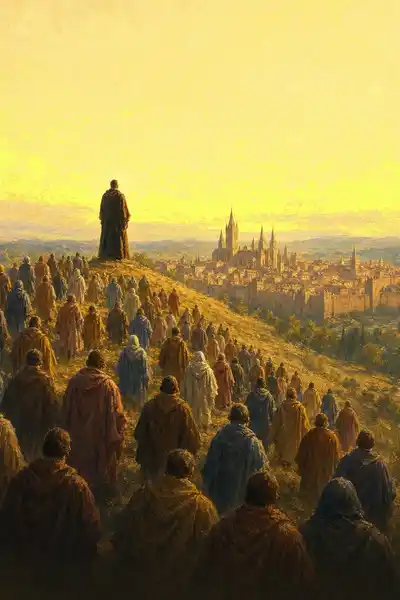
Around the year 1100, in the cathedral schools of northern France, something changed in the way learning was done. For centuries the life of the mind had belonged to the cloister — monks copying manuscripts, praying, keeping the inherited texts safe through unstable times. Then, in the growing towns, a different figure appeared: a man who taught for a living, who argued in public, who drew students the way a market drew buyers. Pierre Abélard, brilliant and combative, lectured in Paris to crowds that followed him from hill to hill. He was not a monk withdrawing from the world. He was a professional of thought, and he knew it.
The historian Jacques Le Goff gave this figure a name that felt almost anachronistic for the twelfth century: the intellectual. In his book Intellectuals in the Middle Ages, first published in 1957, he traced how a distinct social type emerged in the medieval West — someone whose job was to think, to teach, to handle words and ideas as a craftsman handles his materials. This person was tied to the new towns, to the schools that became universities, to an economy that suddenly had room for specialists who produced neither bread nor cloth but knowledge.
Le Goff's move was to treat learning not as a pure history of ideas floating above society, but as a social history — a story of work, wages, status, and the slow formation of a group with its own interests. The scholar, in this telling, has a place in the medieval world as concrete as the weaver or the merchant, and a trajectory that runs from confident emergence to comfortable settlement.
The question we’re asking : How did the scholar stop being a solitary figure and become a recognized social class in the medieval West?What we’ll see : How a new kind of worker took shape between the town and the school, gained tools and a trade, and eventually hardened into an established order.
Table of contents
01 Chapter 1 — The man who worked with words
Le Goff opens by insisting on a distinction that the modern reader tends to blur. Learning existed long before the twelfth century — in monasteries, in the courts of Charlemagne, wherever a few literate men kept the classical and Christian inheritance alive. But the monk who studied did so as part of a life of prayer and withdrawal; knowledge was a form of devotion, not an occupation. What appeared around 1100 was different. It was a man who lived from teaching, who thought of thinking as his métier, and who located himself in the town rather than the cloister.
This is why Le Goff reaches for the word intellectual, aware that it belongs to a much later vocabulary. He uses it deliberately, to mark the birth of someone who works with his mind the way an artisan works with his hands — and who, crucially, is paid for it. Abélard becomes the emblem of this first generation. He drew students by his brilliance, charged for his lessons, quarreled with rival masters, and treated the contest of ideas as a public performance with real stakes. He was not humble about his gifts, and he did not pretend the schools were anything other than a place where reputations and livelihoods were made.

02 Chapter 2 — The town made the school
The intellectual did not appear by accident, and Le Goff ties his emergence tightly to the revival of urban life. From the eleventh century onward, towns across western Europe grew again after long centuries of shrinkage. Trade moved, populations concentrated, and cities became places where different kinds of specialized labor could find customers. The scholar was one such specialist, and the town was his natural habitat. Where people gathered to exchange goods, they also gathered to exchange knowledge — and to buy it.
The cathedral schools were the first sites of this concentration. Attached to urban churches rather than to remote abbeys, they drew students who traveled long distances to study under a famous master. Paris, Chartres, Bologna, Oxford — these names mark the map of a new geography of learning, one built around towns rather than monasteries. The division was not merely physical. The monastery cultivated meditation and the slow rumination of sacred texts; the urban school cultivated argument, speed, and the sharp handling of questions. Le Goff draws the contrast as one between two whole styles of intellectual life.
03 Chapter 3 — The trade and its tools
If the intellectual was a worker, Le Goff asks what, concretely, his work consisted of — and here the book becomes a kind of anthropology of a profession. The scholar's raw material was the authoritative text: Scripture, the Church Fathers, and increasingly the recovered works of Aristotle. His tools were the techniques of reading, glossing, and disputation. His workplace was the lecture hall, where he read a text aloud and commented on it, and the formal disputation, where opposing positions were argued to a resolution. This was intellectual labor with a method, a rhythm, and recognizable products.
The great product of the thirteenth century was the summa — the vast, systematic ordering of knowledge that reached its height with Thomas Aquinas. Le Goff treats scholasticism not as dry hair-splitting but as a genuine achievement of organization: the attempt to reconcile faith and reason, to arrange the whole of what could be known into a coherent architecture. The method proceeded by posing a question, marshaling arguments on each side, then resolving them. It was demanding, collective, cumulative work, the output of an entire trade rather than isolated geniuses.
04 Chapter 4 — When a class settles into place
What Le Goff's story ultimately reveals is that the intellectual is not a timeless human type but a social product — and, like any social group, one with a trajectory. Having emerged with the town and organized itself through the university, the class of scholars did not remain the restless, contentious body it had been in Abélard's day. Over the fourteenth and fifteenth centuries, Le Goff argues, it settled. The intellectual grew comfortable, acquired privileges, and increasingly resembled the established orders around him rather than a group defined by the risk of thinking freely.
This settling had visible signs. Masters obtained benefices and titles, moved closer to the powerful, and enjoyed the immunities that came with corporate status. The university, once a fighting guild that had wrung concessions from bishops and kings, became an institution woven into the machinery of Church and state. The sharp separation between the scholar and the gentleman began to soften; learning became a mark of rank as much as a trade. What had started as a profession open to poor but talented young men drifted toward an élite that guarded its comforts.
05 Conclusion
We began with Abélard on his Parisian hill, drawing crowds and charging for the privilege — a man who had turned thinking into a public trade. By the close of the Middle Ages, his successors sat in chartered universities, held benefices, and enjoyed the security of an established order. The distance between those two images is the whole story Le Goff tells: the passage from a bold new occupation to a settled social class, with all the gains and losses that settling brings.
Related books