Humans Are Storytellers
Narrative as a human instrument
Description
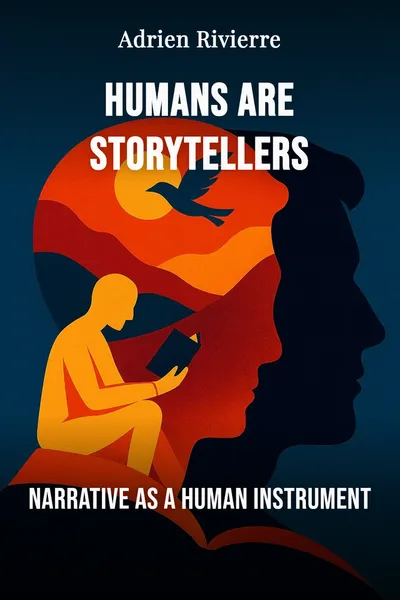
Picture a job interview that is going badly. The candidate has recited every bullet point on the résumé, hit every keyword, and the room is politely dying. Then, almost by accident, she says: "the first time I ran a project, I lost a client in week two." The energy in the room changes. People lean in. She hasn't added a single qualification — she's told a story, and the story did what the qualifications couldn't. This is the small, ordinary miracle Adrien Rivierre sets out to explain in his book "Humans Are Storytellers."
Rivierre, a speaker and author who has spent years studying how ideas move between people, starts from a claim that sounds almost too simple: we are not a species that occasionally tells stories. We are a species that cannot stop. Long before writing, before cities, before money, humans sat around fires passing on accounts of hunts, ancestors, close calls and betrayals. The content changed; the format never did. And the format, Rivierre argues, is not a charming leftover from a less rational past. It's a tool — one of the most powerful cognitive and social instruments we've ever built, and one most of us use without noticing.
That's the unsettling part. We trust facts, we admire logic, and yet the thing that actually moves us, that we remember and repeat and act on, almost always arrives wrapped in narrative. Rivierre's book is an attempt to take that instrument apart and see how it works — why the brain reaches for a story over a spreadsheet, and what separates the stories that land from the ones that evaporate.
The question we’re asking : Why do humans reach for stories to make sense of the world, and what makes some stories work while others fall flat?What we’ll see : How Rivierre traces storytelling from an ancient survival habit to a precise instrument the brain, and the group, still run on.
Table of contents
01Chapter 1 — The species that couldn't stop telling tales
Rivierre opens with a long view. For most of human history, there was no other way to keep knowledge alive. A tribe that knew which berries killed and which fed, which river flooded and which held fish, survived better than one that didn't — and that knowledge traveled not as a list of rules but as stories. The hunter who never came back. The season the rains failed. Narrative was the hard drive before there were hard drives, and it had a property no list has: it stuck. People forgot instructions by morning and remembered a gripping tale for years.
The reason, Rivierre suggests, is that stories carry information in a form the mind is built to hold. A rule is abstract and weightless. A story has characters, stakes, a before and an after — hooks the memory can grab. Anthropologists have noted the same thing across wildly different cultures: the knowledge a group most needs to pass down tends to arrive bundled in myth, parable, and account, not in bare propositions. The wrapping isn't decoration. It's what lets the cargo survive the trip from one generation to the next.

02Chapter 2 — Why the brain prefers a story to a fact
The core of Rivierre's argument is physiological, not mystical. When we're handed a dry fact, only the parts of the brain that handle language light up. When the same fact arrives inside a story — someone wanting something, running into trouble, feeling the sting of it — far more of the brain joins in. The regions that process movement, emotion, even taste and touch activate as if we were living the scene ourselves. A story doesn't just inform us. It makes us simulate. And what we've simulated, we remember as if it happened to us.
This is why the interview candidate's confession worked. Her credentials asked the room to file information. Her story asked the room to feel a stakes-laden moment — and the brain cannot help but comply. Rivierre leans on this to explain a frustrating truth every teacher and communicator knows: data rarely changes minds on its own. We can show someone the numbers and watch them nod and forget. Wrap the same point in a human being who wanted something and lost it, and the point lodges.
03Chapter 3 — The ingredients that make a story land
Having explained why stories work, Rivierre turns to how. His answer is reassuringly concrete: the stories that land share a handful of structural ingredients, and none of them require a gift. The first is a character we can attach to — someone specific, with a desire. Abstraction kills narrative; a nameless "people" moves no one, while one named person wanting one clear thing pulls us in instantly. We don't bond with categories. We bond with somebody.
The second ingredient is an obstacle. A story in which the character simply gets what they want is not a story — it's a report. Tension comes from the gap between desire and reality, and that gap is where the listener's attention lives. Rivierre keeps insisting that the difficulty is the point: the moment of failure, the thing that nearly went wrong, is almost always the part people remember, because it's the part that felt real. The candidate didn't win the room by describing a triumph. She won it by admitting she'd lost a client.
04Chapter 4 — Telling, and what it does to the people we tell
Step back from the techniques and a larger claim comes into view. For Rivierre, storytelling is ultimately a social instrument, not a solitary one. A story is told to someone, and in the telling it does something between people that no amount of private thinking can do: it builds a shared reality. When a group holds the same story — about who they are, where they came from, what they're trying to build — they can act together. This is how teams, families, movements and whole nations cohere. Not around facts, which people dispute endlessly, but around narratives, which people inhabit.
That's the quiet power the book keeps circling. Shared facts don't bind a group; shared stories do. A company isn't held together by its balance sheet but by the story it tells about why it exists. A friendship is a running narrative two people keep co-authoring. Even memory, Rivierre notes, is social — we edit our own past in the telling, and the version we repeat becomes the version we believe. The storyteller isn't just describing the world. They're proposing one, and inviting others to live inside it.
05Conclusion
The interview candidate who turned a room with one admitted failure wasn't lucky, and she wasn't especially eloquent. She had simply stumbled onto something humans have been doing for as long as there have been humans: she offered a character, a stakes-laden moment, and a change — and the people listening couldn't help but lean in. Rivierre's book is an argument that this is not a trick but a tool, as old as the first fire-side account and as current as the next pitch meeting, and that most of us wield it half-asleep.
Related books