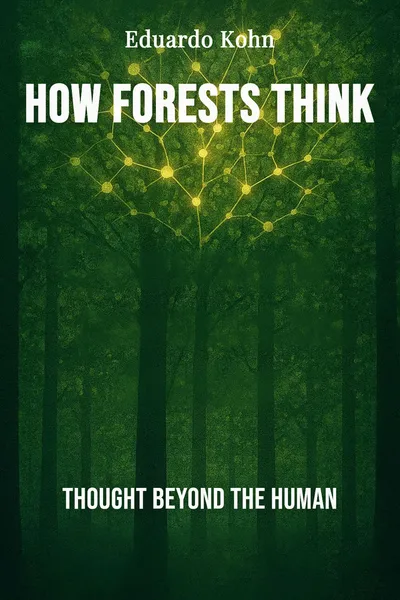
How Forests Think
Thought beyond the human
Description
In the Ávila region of Ecuador's Upper Amazon, the anthropologist Eduardo Kohn spent four years among the Runa, a Quichua-speaking people whose lives are threaded through the forest around them. One night his hosts warned him how to sleep: face up. Jaguars, they said, recognize a being that can look back at them and leave it alone; a creature lying face down reads as prey — dead meat. Sleep on your back, and the jaguar sees a self, a you. The instruction sounds like folklore. Kohn takes it as a starting point for something far stranger: the idea that the jaguar is, in some real sense, interpreting. That a look can carry meaning across the species line.
His book, How Forests Think, published in 2013, grew out of that fieldwork and out of a discomfort with how his own discipline handles the non-human world. Anthropology, Kohn noticed, keeps the human sealed off — language, symbols, culture, the whole apparatus of meaning stays a strictly human affair, and everything else becomes mere backdrop, matter without mind. But the Runa don't live that way. They read the forest as a dense field of signs: bird calls that announce a predator, a monkey's alarm that betrays its position, dreams that carry information about tomorrow's hunt. To live in Ávila is to be one interpreter among many.
So Kohn asks a question that sounds almost reckless for a social scientist to pose seriously. What if meaning isn't ours alone? What if the capacity to represent the world, to be affected by signs, runs through living things far beyond us — not as a metaphor, but as a fact about how life works? The forest, on this view, is not a stage for human thought. It is thick with thought of its own.
The question we’re asking : If meaning-making is not a uniquely human trick, how far down and how far out into the living world does thought actually reach?What we’ll see : We follow Kohn from a hunting camp in the Ecuadorian Amazon into a theory of signs that unsettles the line we draw between the human and everything else.
Table of contents
01Chapter 1 — A dog dies in the Amazon
Early in the book, a hunting dog belonging to Kohn's hosts is killed by a jaguar in the forest. The loss is practical — a good dog is valuable — but the Runa's response is what catches Kohn's attention. Before the dog left that morning, the family had tried to interpret its dreams, feeding it a hallucinogen so they could read what the animal had glimpsed of the day ahead. The dog, in their world, dreamed. It had a point of view. Its death was not just the failure of a tool but the end of a being that meant things and to which things meant something.
This is the everyday texture of Ávila life, and Kohn insists we take it literally rather than filing it under charming native belief. The Runa are not projecting human minds onto animals for comfort. They are skilled ecologists who survive by reading a world saturated with other perspectives — the fear of a monkey, the hunger of a jaguar, the intentions of a dog. Their livelihood depends on getting those readings right. A hunter who cannot think like his prey does not eat.

02Chapter 2 — Signs that don't need words
For that theory, Kohn turns to a nineteenth-century American thinker, the philosopher Charles Sanders Peirce, who spent his life working out how signs function. Most modern thinking about meaning descends instead from Ferdinand de Saussure, for whom a sign is a word whose meaning comes from its difference from other words. Language, on that model, is a closed human system — and if meaning is language, then meaning stops at the edge of the human. Peirce offers a wider door.
Peirce distinguished kinds of signs, and only one of them is language-like. There are symbols, where the link between sign and object is conventional — the word 'jaguar' has no natural connection to the animal. But there are also icons, which mean by resemblance, and indices, which mean by pointing: smoke is an index of fire, a footprint an index of the foot that made it. Icons and indices don't need language, don't need conventions, don't need a human speaker. They work anywhere a living thing responds to something as standing for something else.
03Chapter 3 — The forest as a thinking web
If every organism interprets, then the forest is not a collection of separate readers but a vast, interlocking web of signs reading signs. Kohn calls this an ecology of selves. A jaguar's behavior is shaped by how it reads deer; the deer is shaped by how it reads the jaguar; the Runa hunter inserts himself into this chain by reading both. Meanings propagate outward, each creature's interpretation becoming part of the environment the next one must interpret in turn. Thought, in this sense, doesn't sit inside skulls. It circulates through the forest.
Kohn pushes the point with the idea that these webs actually shape life over time. When many species must read one another to survive, their forms and habits come to fit together like question and answer — the moth's bark-patterned wing is a kind of guess about what the bird will see. The forest, over generations, thinks its inhabitants into their shapes. This is not mysticism; it is Kohn's rereading of how living things co-constrain one another, described in the language of signs rather than pure mechanism.
04Chapter 4 — What it means to be a self
Step back, and Kohn's real target comes into view: the idea of the self, and who gets to have one. For most of modern thought, selfhood is a human possession, tied to language, self-awareness, the capacity to say 'I'. Kohn's semiotics loosens that grip. A self, in his account, is simply a locus of interpretation — anything that takes the world as signs and acts on that reading. By that measure, selves are everywhere in the Amazon, and the human is one kind among many, distinctive but not alone.
This is why the book is subtitled an anthropology beyond the human. Kohn is not abandoning anthropology; he is trying to free it from the assumption that meaning stops where humanity does. The discipline was built to study the human as the sole maker of significance — culture, symbol, language — and that founding move, Kohn argues, quietly reproduced the anthropocentrism it should be examining. An anthropology beyond the human keeps studying humans, but as beings entangled in webs of other selves, shaped by interpretations that were never ours to begin with.
05Conclusion
The instruction to sleep face up returns, at the end, transformed. What began as a piece of practical advice about jaguars turns out to encode Kohn's whole argument: that to survive in the forest is to be recognized as a self by other selves, and to recognize them in return. The jaguar looking back, the dog dreaming, the monkey reading a snapped branch — none of these are human fantasies dressed up as wisdom. They are what an ecology of interpretation looks like from the inside, and the Runa have spent generations learning to move through it with their eyes open.
Related books