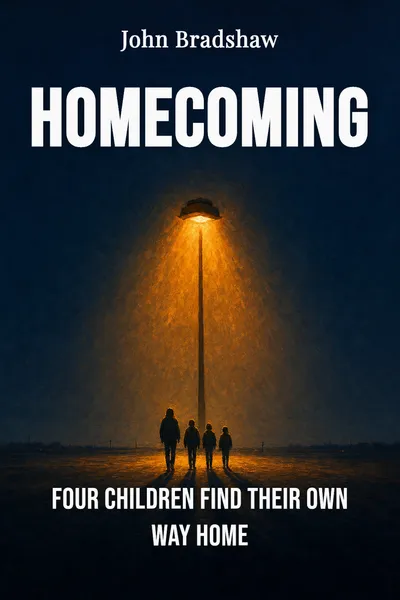
Homecoming
Four children find their own way home
Description
It starts in a parked car outside a shopping mall in Peewauket, somewhere along the coast of Connecticut. A mother tells her four children to wait while she goes inside. They wait. The afternoon burns off, the mall lights come on, and she does not come back. The oldest, Dicey, is thirteen. The youngest, Sammy, is six. Between them are James, who is ten and reads everything, and Maybeth, nine, who barely speaks and whom the school has already decided is slow. There is a little money in Dicey's pocket and a name in her head: Aunt Cilla, in Bridgeport, the destination the family was driving toward when the car stopped moving.
This is the opening of Homecoming, the 1981 novel by the American writer Cynthia Voigt, the first of what became the Tillerman cycle. What follows is not a rescue story. No adult arrives to sort things out. Dicey does the arithmetic — a bus costs more than they have, a phone call to the wrong grown-up ends with all four of them split up and taken away — and reaches a conclusion that a thirteen-year-old should not have to reach. They will walk. Down the highway shoulder, along the beach roads, sleeping in state parks and behind churches, they will get themselves to Bridgeport on foot.
The book won the Newbery Medal and has stayed in print for four decades, and the reason has less to do with the walk than with what the walk forces. Four abandoned children have to decide, day by day, what they owe each other and who they are without a mother to name them a family. The road tests that. So does what waits at the end of it.
The question we’re asking : When the adults vanish, what actually holds a family together — the address, the blood tie, or something the children have to make themselves?What we’ll see : How four children turn a highway shoulder into a household, and what they find when the road finally runs out.
Table of contents
01 Chapter 1 — A shopping-mall parking lot in Peewauket
The Tillerman children have been living at the edge of things for a long time before the car ever stops. Their mother, Liza, has been coming apart quietly for months — losing jobs, going silent, staring at nothing. There is no father in the picture and never really was. When she loads the four of them into the car and points it toward Bridgeport, toward a great-aunt none of them have met, it is already the act of a woman who has run out of other moves. The parking lot is where she runs out of that one too.
Dicey understands, faster than she wants to, that this is not a delay. She keeps the others calm, doles out the food, and spends the first night in the car doing sums. Aunt Cilla is a name on old Christmas cards, an address on an envelope. It is the only thread they have, so it becomes the plan. What Dicey refuses to do is hand the four of them to the authorities, because she has already grasped the arithmetic of that: children with no parent get parceled out, and parceling out means the four of them stop being four.

02 Chapter 2 — The road becomes a household
What the walk does, over its long middle stretch, is convert four children into a working unit. Roles get assigned by necessity rather than affection. Dicey leads, decides, and worries — she carries the map of the whole thing in her head, and she carries the fear too, mostly alone. James becomes the strategist, the one who reasons out routes and rules and the way institutions think. Maybeth, whom teachers have written off, turns out to be the one who reads people, who senses when a stranger is safe and when to keep moving. Sammy, the youngest and the most stubborn, is muscle and morale, the one whose refusal to quit sometimes carries the others.
Voigt is careful about how this works. The children do not become a happy team. They fight, they resent Dicey's authority, they get tired and mean and scared. What holds is not warmth but function: each of them is doing something the others cannot, and each of them knows it. That mutual dependence is the household's real foundation. A family, the book quietly suggests, might be less a feeling than a division of labor that people keep honoring even when they would rather not.
03 Chapter 3 — Kindness has a shape, and so does its opposite
The road is full of strangers, and Voigt uses each of them to test what the children can afford to trust. Early on they fall in with a pair of young runaways, a couple drifting with no more plan than the Tillermans have. There is a fellow feeling there — other people the system has let slip through — but Dicey learns quickly that shared misfortune is not the same as safety. The couple is generous and unreliable at once, and she files away the lesson: kindness that cannot be counted on is a luxury they cannot build a plan around.
The clearest gift comes from Stewart, a Yale student they meet along the way. He is a stranger with a car and no obligation to them whatsoever, and he simply drives them a long stretch toward Bridgeport, asking little in return. Voigt lets the encounter be exactly what it is — an act of grace that shortens an impossible journey — without turning Stewart into a rescuer. He helps and then he is gone. The children remain responsible for themselves. What he offers is not salvation but relief, and the difference matters to the book's honesty.
04 Chapter 4 — What a family turns out to be made of
Step back from the miles and the meals, and Voigt is making one steady argument through all of it: that home is not a place you are owed and family is not a fact of birth. Both are things that have to be actively made and remade, mostly by whoever is willing to do the work. The Tillermans lose the address they aimed for, discover the blood relative they hoped for is gone, and are handed a cousin who will house them without wanting them. Each of these losses strips away one more assumption about where belonging is supposed to come from.
What is left, once the address and the aunt and the dutiful cousin have failed to add up to home, is the thing the children built on the road: the unit, the roles, the loyalty that got them there. Voigt's design puts the weight there. The family that matters is not the one they set out to reach. It is the one Dicey assembled out of four abandoned kids and a highway, and the achievement of the book is to make that constructed family feel more real and more durable than any of the official ones on offer.
05 Conclusion
The story that begins in a parking lot ends without the neat closure the walk seemed to promise. The Tillermans reach Bridgeport, and Bridgeport turns out to be the wrong ending — Aunt Cilla gone, cousin Eunice a shelter and not a home. The destination that pulled them down every highway shoulder dissolves on contact, and the children who have spent the whole book getting somewhere discover they are not yet anywhere they can stay.
Related books