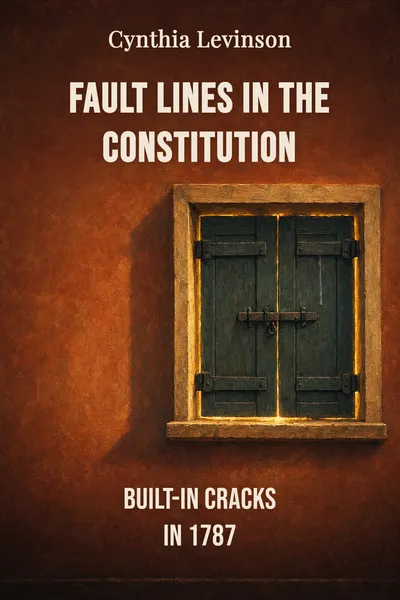
Fault Lines in the Constitution
Built-in cracks in 1787
Description
In the summer of 1787, fifty-five delegates gathered in a brick building in Philadelphia, closed the windows against eavesdroppers, and spent nearly four months arguing in the heat. They kept the shutters sealed even as the temperature climbed, because George Washington had insisted the debates stay secret. Out of that sweltering, closed room came a document of roughly four thousand words that still runs the United States today. It was not handed down from anywhere. It was haggled into existence by tired men who disagreed about almost everything and who left the room having compromised on nearly all of it.
Cynthia Levinson, a children's-book author, and her husband Sanford Levinson, a constitutional law scholar, went back to that room to ask a simple question with uncomfortable answers. Many of the problems that dominate American politics now — the Electoral College that can crown a loser of the popular vote, a Senate where a state of six hundred thousand has the same weight as one of forty million, gerrymandered districts, government shutdowns — are not accidents or recent corruptions. They are features. They were built in, on purpose or by exhaustion, during those Philadelphia weeks, and we have been living inside the consequences ever since.
Their book treats the Constitution not as sacred text but as engineering: a structure with load-bearing walls and hairline cracks that were visible from the start. Most of us take the machinery for granted, the way we take a house for granted until the ceiling sags. The Levinsons open the ceiling and point at the beams. What they find is less a story of villains than a story of trade-offs that made sense in 1787 and have quietly outlived their reasons.
The question we’re asking : Why do so many of today's political dysfunctions trace back to a single overheated room in 1787?What we’ll see : How a handful of eighteenth-century compromises hardened into the machinery we live with, and why the Levinsons think we've forgotten they were ever meant to be fixed.
Table of contents
01 Chapter 1 — The room they wouldn't let out
The delegates who arrived in Philadelphia in May 1787 had been sent to patch up the Articles of Confederation, the loose arrangement that had held the states together since independence. Instead they quietly decided to scrap it and build something new. The Levinsons linger on this detail because it sets the tone for everything that follows: the Constitution was written by people who had already agreed to exceed their instructions. They were improvising a country, and they knew it.
The conditions mattered. The windows stayed shut for secrecy, which meant the men argued through a brutal East Coast summer with no air and no public looking over their shoulders. Secrecy let them change their minds, cut deals, and abandon positions without being called hypocrites back home. It also meant that the reasoning behind the biggest compromises survives mostly through James Madison's private notes, which he wouldn't allow published until after his death in 1836 — nearly half a century after the fact.

02 Chapter 2 — The bargains that never expired
The single most consequential deal in Philadelphia was over representation. Large states wanted seats in the legislature to track population; small states, terrified of being outvoted, wanted every state treated equally. The fight nearly broke the convention apart. What saved it was the so-called Great Compromise: a House of Representatives based on population and a Senate where every state, regardless of size, gets exactly two votes. It was a peace treaty between big and small, not a theory of good government.
The Levinsons press hard on what that treaty costs today. Two senators from Wyoming, home to fewer than six hundred thousand people, carry the same weight as two from California, home to roughly forty million. A minority of the country's population can, through the Senate, block what a large majority wants. This wasn't an oversight the framers failed to foresee — it was the price small states demanded to sign. The compromise did its job in 1787. It has simply never been renegotiated, because the Senate's structure is the one part of the Constitution that Article V makes almost impossible to amend without a state's consent.
03 Chapter 3 — What the framers left half-finished
Not every fault line is a deliberate compromise. Some are simply gaps — places where the framers wrote too little, or nothing at all, and left later generations to improvise inside the silence. The Levinsons treat these omissions as their own category of trouble, because a vague rule under pressure tends to break in whichever direction power wants it to.
Take the timeline for transferring power. The original Constitution had a new president take office in March, four full months after the November election. In the winter of 1932 to 1933, with the Depression deepening, that gap meant a defeated Herbert Hoover and an incoming Franklin Roosevelt shared a paralyzed government for months while the economy cratered. The Twentieth Amendment eventually moved inauguration to January, but the episode showed how a schedule chosen for the pace of eighteenth-century travel could become a genuine crisis in a modern emergency.
04 Chapter 4 — A document that forgets it can be rewritten
Step back from any single clause and the Levinsons' larger argument comes into view. The framers did not think they had written scripture. They built an amendment process into Article V precisely because they assumed the document would need fixing, and George Washington himself said the Constitution was less than perfect and expected posterity to improve it. They saw themselves as drafting a version one, not a final word.
Americans, over two centuries, have come to feel the opposite. The Constitution has acquired an almost sacred aura — quoted like a holy book, defended as if any change were a betrayal, treated as the finished expression of a founding genius rather than the negotiated settlement it actually was. The Levinsons find this reverence more dangerous than any specific flaw, because it converts fixable engineering problems into untouchable articles of faith.
05 Conclusion
The men in that closed Philadelphia room knew exactly what they were doing when they compromised, and they knew the compromises weren't perfect. They shut the windows, argued through the heat, split the difference on representation and slavery and the presidency, and produced a document held together by trade-offs. What they did not do was pretend those trade-offs were eternal. That part came later, from us.
Related books