Fall of Constantinople
When Byzantium fell to the Turks
Description
On the morning of Tuesday, May 29, 1453, the last Roman emperor threw off his imperial insignia and disappeared into the fighting at a broken stretch of wall, and no one has ever found his body. Constantine XI Palaiologos had ruled a capital that was, by then, mostly ghost. Constantinople had once held perhaps half a million people; on that spring morning it could barely muster seven thousand defenders, a couple thousand of them foreigners, to hold fourteen miles of ancient fortifications against an Ottoman army that historians put somewhere around eighty thousand. The odds were not close. They had not been close for a long time.
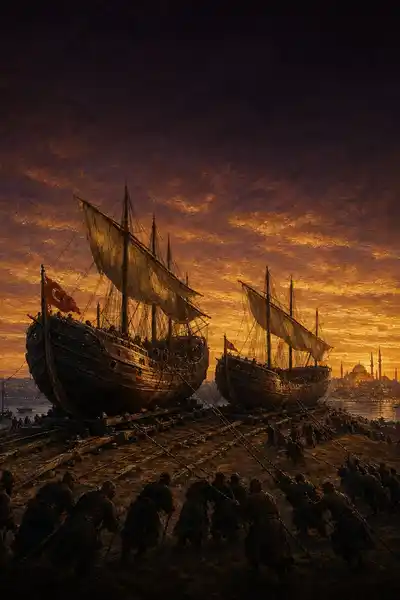
The siege had lasted fifty-three days. Sultan Mehmed II, twenty-one years old and determined to take the prize that had eluded his ancestors for seven centuries, had dragged a monstrous cannon to the walls, floated a fleet overland on greased timbers to get around the harbor chain, and pressed wave after wave against the defenders until they thinned to nothing. When the city finally broke, it broke fast. By nightfall the Ottoman flag flew over what had been, for over a thousand years, the capital of Christian Rome — and Western Europe reacted with the horror of people surprised by a death they had watched coming for decades.
That surprise is the strange part. Byzantium had been begging for help for years, sending emperors in person to Western courts, offering to heal the church schism, receiving warm words and almost nothing else. The great English historian Steven Runciman told this story in 1965 with an eye for exactly that gap — between how much the fall mattered and how little anyone did to prevent it. What follows draws on his account: not a battle chronicle so much as the closing scene of a civilization, and the long echo it left behind.
The question we’re asking : How did a city that Christendom claimed to revere fall almost alone, and what did its loss actually change?What we’ll see : A dying capital, a siege against impossible odds, the hours the empire ended, and the world that inherited the silence.
Table of contents
01 Chapter 1 — A city that was already a memory
By 1453 the Byzantine Empire was an empire in name only. What Constantine XI actually governed was the city of Constantinople, a strip of the Peloponnese, and a few scattered islands. The territory that had once run from Italy to Syria had been eaten away over centuries — by Arabs, by Normans, by the Fourth Crusade that sacked the city in 1204 in a wound it never recovered from, and now by the Ottomans who surrounded it on every side. The empire was a head without a body.
The city itself reflected the decline. Runciman describes a Constantinople of empty spaces and ruined districts, vineyards and orchards growing inside the walls where dense neighborhoods had once stood. Great churches stood half-maintained. The court kept up its elaborate ceremonies, its titles and processions, with a dignity that had become largely theatrical. The Venetian and Genoese merchants who did the real business of the place lived across the Golden Horn in Galata, hedging their bets, unsure whether to defend the city or protect their trade with the sultan.

02 Chapter 2 — Fifty-three days behind the walls
The Ottoman army arrived in early April 1453 and settled in front of the land walls, the triple line of fortifications that had turned back besiegers for a thousand years. Those walls were the city's genius and its faith. What made this siege different was that Mehmed had brought something the walls had never faced: artillery on an unprecedented scale. A Hungarian engineer named Orban, whom the Byzantines could not afford to hire, had sold his services to the sultan and cast an enormous bronze cannon that could throw a stone ball weighing over half a ton. It took hours to reload and sometimes cracked, but it did what no army had done before — it began to bring the walls down.
The defenders held anyway, and held remarkably well. Under a Genoese commander named Giovanni Giustiniani, who had arrived with several hundred professional soldiers, they repaired the breaches by night with earth and timber and barrels, and beat back assault after assault. The numbers were desperate — a few thousand men stretched along miles of wall — but the fortifications and the discipline compensated. For weeks the siege settled into a grinding rhythm of bombardment, repair, and repulse.
03 Chapter 3 — The morning the empire ended
The final assault came in the small hours of May 29. Mehmed sent his troops forward in successive waves, the least disciplined first to wear the defenders down, the elite janissaries last. For hours the line held at the most battered section of wall, near the gate of St. Romanus, where Giustiniani and the emperor fought together. The defenders were exhausted but unbroken, and there was a moment when the assault seemed on the edge of failing.
Two things broke the balance. Giustiniani was badly wounded and carried from the wall, and his soldiers, seeing their commander go, began to waver and pull back. And a small postern gate, the Kerkoporta, had been left open — through it a group of Ottoman soldiers got inside and raised their banner on a tower. The cry that the enemy was within the walls did what the bombardment had not: it broke the defenders' will. The line dissolved. Constantine, according to the accounts Runciman weighs, tore off the marks of his rank and charged into the press, and was never seen again.
04 Chapter 4 — What Europe lost and pretended not to
For the Ottomans, 1453 was not just a conquest but a transformation. Runciman is clear that possessing Constantinople changed what the Ottoman state was. A warrior dynasty that had spread across Anatolia and the Balkans suddenly held the greatest city of the eastern world, the natural crossroads of two continents, the imperial capital that every regional power had coveted for a millennium. Mehmed set to repopulating it, rebuilding it, drawing in Greeks, Armenians, Jews, and Muslims to fill the emptied quarters. The capital gave the empire a center of gravity and a legitimacy that made it, for the next four and a half centuries, a permanent great power rather than a passing conquest.
For the Greeks, the same event meant the end of a world. Byzantium had been the last living link to classical antiquity, the place where Greek learning, Roman law, and Orthodox Christianity had been preserved continuously since the ancient world. Its disappearance closed that continuity. And here Runciman traces the strange, generative afterlife of the catastrophe: for decades scholars had been drifting west, carrying manuscripts and the knowledge of Greek that the Latin world had largely lost. The fall accelerated the exodus into a flood. Men like Bessarion had already been building bridges to Italy; the collapse sent the rest.
05 Conclusion
The body of Constantine XI was never identified, and that missing corpse became the seed of a legend: the marble emperor, turned to stone by an angel, waiting in a hidden chamber to return and reclaim the city. It is a fitting close to Runciman's account, because the fall of Constantinople was never quite a clean ending. The empire vanished as a state, but its scholars, its liturgy, and its idea of itself scattered outward and kept working in other soil.
Related books