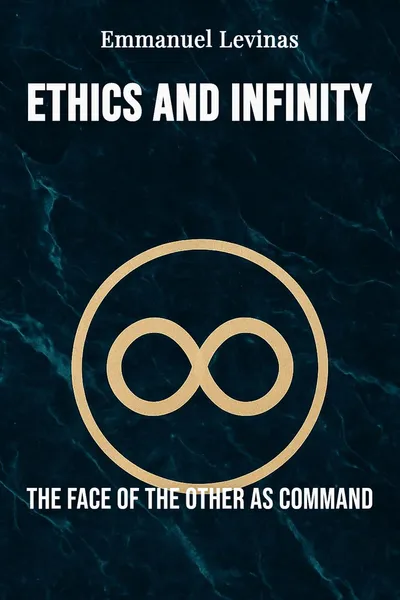
Ethics and Infinity
The face of the other as command
Description
In 1981 and 1982, a French radio producer named Philippe Nemo sat down with Emmanuel Levinas for a series of interviews on France Culture. Levinas was in his mid-seventies by then, a philosopher who had spent a career at the edge of the spotlight — a Lithuanian-born Jew who had studied with Husserl and Heidegger in Germany in the 1920s, survived the war in a prisoner-of-war camp while most of his family was murdered, and then written dense, difficult books that few outside the academy had read. The conversations were meant to make him accessible. They became a small book called Ethics and Infinity, and for many readers it is still the clearest door into one of the strangest and most demanding ideas in twentieth-century thought.
The idea sounds almost too simple when you first hear it. For most of the Western tradition, philosophy begins with a question about being — what exists, what is real, what can we know. The self comes first: I think, therefore I am. Levinas turns this around. Before I think, before I am even a self worth speaking of, there is someone else in front of me. And that someone, just by being there, by having a face I cannot look away from, makes a claim on me. Ethics, for Levinas, is not a branch of philosophy. It is where philosophy starts.
What makes the interviews worth reading is that Levinas talks about all of this without the fortress of jargon that armors his major works. He talks about insomnia, about the death of the other person mattering more than one's own, about a responsibility that arrives before we ever agreed to it. He is trying to say something that ordinary language resists, and you can hear him working at it.
The question we’re asking : What does it mean to say that our obligation to another person comes before our freedom to choose it?What we’ll see : How a survivor of the century's worst violence built a philosophy around the one thing that stops us in our tracks — the face of another human being.
Table of contents
01Chapter 1 — Philosophy that starts somewhere else
Levinas came to philosophy through phenomenology, the method Edmund Husserl was developing in Germany in the early twentieth century. Husserl wanted to describe experience exactly as it presents itself to consciousness, before theory gets in the way. Levinas, arriving in Freiburg in 1928, was one of the people who carried this method back into France. His early work introduced Husserl and then Heidegger to French readers, and for a while he was best known as an importer of German ideas.
But he grew uneasy with what he had imported. Heidegger's philosophy, whatever its brilliance, put the question of being at the center of everything — and Levinas came to see this as a kind of tyranny. In the interviews he keeps circling back to a suspicion that a thought organized entirely around being, around what is, leaves no room for the one thing that matters most: the other person, who is not a thing among things, not something I can absorb into my understanding of the world.

02Chapter 2 — The face that cannot be reduced
The word that runs through everything Levinas says is the face. He does not mean the face as a set of features you could describe — the color of the eyes, the shape of the nose, the expression you might read like a text. In fact he insists the face resists exactly that kind of reading. The moment you turn a person's face into information, into something you know, you have missed what it actually is.
What the face is, for Levinas, is a presence that overflows every idea you could form of it. When another person stands before you, something exceeds your grasp. You cannot contain them, cannot reduce them to a category, cannot make them a footnote in your own experience. He calls this the infinity in the title — not infinity as endless space or endless time, but the way another person is always more than anything I can think about them. The other is, in his phrase, absolutely other.
03Chapter 3 — A responsibility we did not choose
Here is where Levinas parts ways most sharply with the tradition he came out of. In most moral philosophy, responsibility follows freedom. I am responsible for my actions because I chose them freely; without the choice, there is no obligation. Levinas reverses the order completely. Responsibility, he says, comes before freedom. I am answerable for the other person before I have decided anything, before any contract, before I even consented to be answerable.
He pushes this to a point that unsettles most readers. My responsibility for the other, he says, is not symmetrical. I am responsible for the other more than the other is responsible for me — and whether the other reciprocates is, strictly speaking, the other's business, not mine. He goes so far as to say I am responsible even for the other's responsibility. The obligation does not wait to be balanced. It falls on me, singularly, and I cannot pass it off.
04Chapter 4 — Ethics before everything
The largest claim in these interviews is easy to state and hard to absorb: ethics is first philosophy. Not one discipline among several, not the part of thought that deals with right conduct after metaphysics has settled what exists. For Levinas, the relation to the other person is the founding event of human life, and everything philosophy usually treats as fundamental — being, knowledge, freedom, the self — is built on top of it. Reverse the usual order, and the whole landscape looks different.
It is worth remembering what stands behind this claim. Levinas lived through the century that made the reduction of persons to categories into an industrial project. He lost almost his entire family. He rarely names this directly in the interviews, but it is impossible not to hear it underneath the insistence that the other person can never be absorbed, never be counted, never be treated as an instance of a type. A philosophy that begins with being, he suspected, can always find a way to justify what is. A philosophy that begins with the face of the other cannot, because the face is precisely what interrupts every justification.
05Conclusion
The interviews end without a grand conclusion, which suits the man. Levinas spent his life resisting the tidy summary, the idea reduced to a formula you could pocket and carry off. What comes through Philippe Nemo's questions is not a finished doctrine but a persistent gesture — a philosopher turning our attention, again and again, back to the person in front of us, and to the strange weight that person carries before we have decided anything about them.
Related books