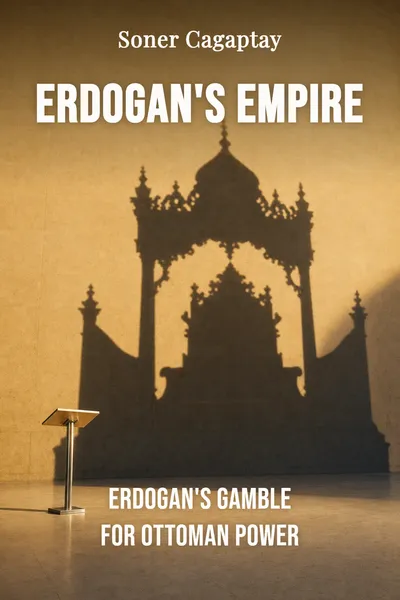
Erdogan's Empire
Erdogan's gamble for Ottoman power
Description
On a June evening in 2016, Recep Tayyip Erdogan stood in Istanbul and told a crowd that Turkey would no longer be told what to do. He had been in power since 2003, first as prime minister, then, after 2014, as president — long enough to remake the country in his own image. A month later, a faction of the military tried to overthrow him, and he beat back the coup by holding up a phone to a television camera and calling his supporters into the streets. He survived. And the man who emerged from that night was more convinced than ever that Turkey's future lay not in Brussels or Washington, but in a role its leaders had dreamed of for more than a century: a great power in its own right.
The Turkey scholar Soner Cagaptay, who wrote the first English-language biography of Erdogan, reads this ambition as the through-line of the whole Erdogan project. From roughly 2003 onward, Cagaptay argues, Erdogan has been trying to cast Turkey as a stand-alone power in the Middle East — reaching back toward the Ottoman-era footprint in the Arab world and the Balkans, and loosening the country's long anchoring in the Western alliance. It is an old dream in new clothes. The late sultans wanted it. Ataturk, who founded the republic in 1923, wanted a version of it. Erdogan wants it too, on his own terms.
The trouble, in Cagaptay's telling, is that the gamble has not paid off the way it was meant to. Turkey today has almost no friends left in the region it hoped to lead, and it sits between two resurgent historical rivals, Russia and Iran, whose interests keep cutting across its own. At home, the crackdown on journalists and opponents has hardened. Abroad, the Western allies Turkey once relied on no longer offer unconditional backing. A country that reached outward for greatness has ended up, on several fronts, more alone.
The question we’re asking : Can Erdogan's bid to make Turkey a stand-alone great power actually deliver the country to safety — or has the reach itself become the danger?What we’ll see : How an old Turkish dream took an unorthodox turn under Erdogan, where it collided with the region and the world, and what the whole gamble reveals about a middle power chasing an imperial destiny.
Table of contents
01 Chapter 1 — The sultan who wanted an empire
Cagaptay begins with a paradox that has followed Erdogan his whole career: the man who now behaves like an emperor rose from the losing side of Turkish politics. He came out of the pious, working-class conservatism that the secular republic founded by Mustafa Kemal Ataturk had spent decades pushing to the margins. When Erdogan's party, the AKP, won power in 2002 and formed a government in 2003, it looked, to many Western observers, like a reformist bet — a religiously rooted party willing to modernize, court the European Union, and open the economy. For a while, that reading held.
The early years were genuinely good for Turkey. Growth was strong, the currency stabilized, and Erdogan pushed EU accession talks and reined in the army's habit of intervening in politics. Cagaptay is careful about this period, because it is where Erdogan built the credibility he would later spend. A rising middle class, new roads and airports and hospitals, and a sense that ordinary devout Turks finally had a government that spoke for them — this was the foundation of a popularity that has proven remarkably durable.

02 Chapter 2 — Zero problems, then every problem
The doctrine had a name and an architect. Ahmet Davutoglu, the academic who became Erdogan's foreign-policy brain and later prime minister, called it "zero problems with neighbors." The idea was elegant: Turkey would use trade, diplomacy, and cultural affinity to become the indispensable hub of its region, friends with everyone from Damascus to Tehran to the Gulf. For a few years around 2010, it looked plausible. Erdogan was popular on the Arab street, Turkish soap operas were playing across the region, and Ankara seemed to have found a role that Washington could not fill.
Then the Arab Spring arrived in 2011, and the doctrine ran into reality. Cagaptay tracks how Erdogan bet heavily on the uprisings, backing Islamist movements — especially the Muslim Brotherhood — that he expected to inherit the region. In Egypt, that bet won and then lost, when the military overthrew the Brotherhood government in 2013 and Erdogan lost a key partner and gained a bitter rival in Cairo. In Syria, the bet turned catastrophic. Erdogan called early for the fall of Bashar al-Assad, assuming it would come quickly. It did not.
03 Chapter 3 — The geography Erdogan cannot escape
If the first half of the book is about ambition, the second is about the map. Cagaptay keeps returning to a stubborn fact: Turkey sits where three worlds meet, and its two great historical rivals never really went away. Russia and Iran have been Turkey's competitors for centuries, contesting the Caucasus, the Black Sea, and the lands in between. Erdogan's reach into the Arab Middle East put Turkey back into direct friction with both, and this time without the full weight of the Western alliance behind it.
Syria made the collision unavoidable. Russia intervened militarily in 2015 to save Assad, precisely the outcome Erdogan had bet against, and Iran poured in men and money to do the same. When Turkey shot down a Russian jet near the Syrian border that November, the crisis that followed showed how exposed Ankara had become — economically dependent on Russian gas and tourism, and unable to count on NATO to treat a quarrel of its own making as a shared cause. Within months Erdogan was mending fences with Moscow, and Cagaptay reads that reconciliation as a confession of weakness dressed as strategy.
04 Chapter 4 — What a country reaches for when it stops belonging
Step back from Syria and the summits, and Cagaptay's larger subject comes into view: the Turkish dream of being a great power, and what it does to a country that pursues it without the means to secure it. This dream is not Erdogan's invention. The late Ottoman sultans clung to it as their empire shrank. Ataturk chased a modern version of it, trading territory for a compact, Westernized, self-respecting republic. Erdogan inherited the longing and gave it an imperial accent, reaching back toward an Ottoman footprint the republic had deliberately renounced.
The pattern Cagaptay traces is that each generation of Turkish leaders has believed greatness was owed to the nation by history and geography — that Turkey, sitting astride two continents and heir to a world empire, was destined for a larger role than a middle power's. The recurring danger is that the ambition outruns the resources. The Ottomans overreached and collapsed. Erdogan's gamble is a smaller-scale replay: a bid for regional primacy launched by a country whose economy, army, and alliances cannot underwrite primacy on their own.
05 Conclusion
The Erdogan who held up his phone in 2016 and beat back a coup believed the moment proved his instinct right: Turkey belonged to him, and Turkey belonged in the front rank of nations. Cagaptay's book is a long argument that the second belief has been far harder to deliver than the first. The reach into the Arab world faltered, the region turned cold, Russia and Iran closed in, and the Western alliance that once offered cheap protection frayed under the strain. A country that set out to lead its neighborhood found itself, on several fronts, dangerously alone.
Related books