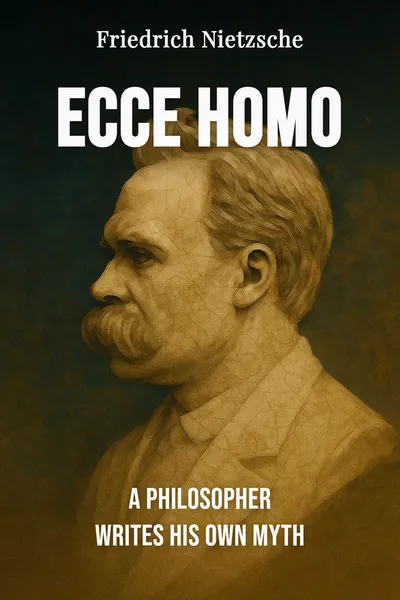
Ecce Homo
A philosopher writes his own myth
Description
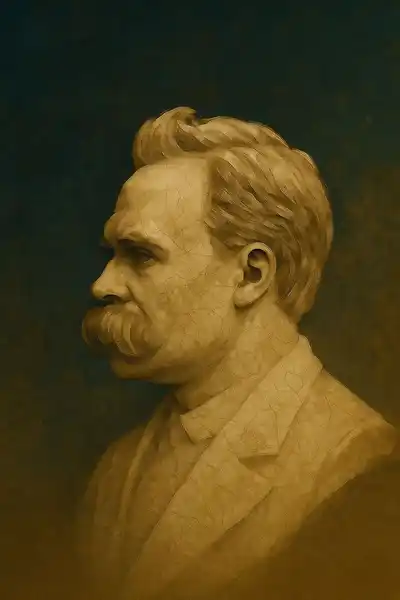
In the autumn of 1888, in a rented room in Turin, Friedrich Nietzsche sat down to write his own autobiography and called it Ecce Homo — "Behold the Man," the words Pontius Pilate used to present a beaten Christ to the crowd. He was forty-four, in poor health, and almost entirely unread. His books had sold a few hundred copies apiece; some he had paid to print himself. And yet the chapters he began drafting carried titles like "Why I Am So Wise," "Why I Am So Clever," "Why I Write Such Good Books." A man nobody was listening to was writing, with total seriousness and total mischief, the story of the most important person alive.
He finished it in roughly three weeks. A few weeks after that, in early January 1889, he collapsed in a Turin street and never wrote another coherent line; he spent his last eleven years in the care of his mother and sister, his mind gone. Ecce Homo would not be published until 1908, eight years after his death. So the book sits in a strange place: the last full statement of a philosopher about himself, composed on the very edge of the breakdown that ended him, and read forever after through the shadow of what came next.
That timing tempts an easy reading — that the grandiosity is simply madness talking. But the book is too controlled, too funny, too deliberate in its self-construction for that. Nietzsche is doing something on purpose here, and the something is philosophical.
The question we’re asking : When a thinker writes his own life in the language of myth, is he explaining himself or inventing himself?What we’ll see : A self-portrait composed at the edge of collapse, where a philosopher turns the account of his own existence into an act of philosophy.
Table of contents
01Chapter 1 — The book written months before the dark
To understand what Ecce Homo is trying to do, it helps to know where Nietzsche stood when he wrote it. By 1888 he had been living for years as a wandering invalid, moving between boarding houses in Italy, Switzerland, and the south of France in search of climates his ruined health could tolerate. He had left his professorship at Basel more than a decade earlier. He wrote in bursts between migraines and stretches of near-blindness. His major works — Thus Spoke Zarathustra, Beyond Good and Evil, On the Genealogy of Morals — had landed on almost no one.
And yet 1888 was the most productive year of his life. In a matter of months he produced The Case of Wagner, Twilight of the Idols, The Antichrist, and then Ecce Homo. There is a heat to the writing, a sense of a man clearing the table before something, though he could not have known what. He tells us plainly why he is writing this particular book: he expects, sooner or later, to be understood, and he wants to get ahead of the misunderstanding. "I know my fate," he writes. He would rather define himself than be defined by the followers he assumed were coming.

02Chapter 2 — Why I am so clever, and other chapter titles
The chapter titles are the first thing anyone notices, and they are meant to be. "Why I Am So Wise." "Why I Am So Clever." "Why I Write Such Good Books." "Why I Am a Destiny." Read cold, they sound like the ravings of a colossal ego. Read with Nietzsche's whole project in view, they are something stranger — a calculated provocation aimed at the reader's reflex to be modest, to defer, to hide behind humility. He is daring us to flinch.
The humor is real and it is knowing. Under "Why I Am So Clever" he does not discuss metaphysics; he talks about diet, climate, and which cities agree with his stomach. He is serious that these things matter — he thought the great questions of philosophy had been asked wrongly, up in the clouds, when the body decides most of what we call thought. But he is also plainly enjoying the deflation, the spectacle of the world-historical thinker announcing that Turin suits him and heavy meals do not. The grandiosity and the self-mockery run on the same track.
03Chapter 3 — Reading his own life backward
The most revealing section may be the one where Nietzsche walks through his own books, one by one, and tells us what each was really doing. He rereads Zarathustra and calls it the highest book there is; he reinterprets the earlier works he now half-disowns; he corrects, in advance, the readings he fears. It is criticism turned on himself, and it is where the self-mythology becomes a method. He is not remembering his life. He is composing it, giving it a shape and a direction it may not have had while he was living it.
This is where "how one becomes what one is" does its real work. Nietzsche did not believe in a fixed inner self waiting to be uncovered. He thought a person is made out of drives, accidents, illnesses, and choices, and that becoming who you are is an achievement, not a discovery. So writing his life backward — treating every wrong turn, every year of sickness, every failed friendship as though it had been aimed at the person he now was — is not vanity in the ordinary sense. It is the practice of amor fati, the love of one's fate, that runs through his late work: to want nothing to have been different, not even the worst of it.
04Chapter 4 — When a man decides to become a destiny
Step back from the jokes and the diet advice and Ecce Homo poses a question that outlives its author: can a thinker write his own reception? Most philosophers leave the meaning of their work to others — to students, critics, the slow verdict of time. Nietzsche refused. He tried to author not just his ideas but the story in which those ideas would be received, to hand the future a finished portrait rather than let the future paint one. "I am no man, I am dynamite," he writes near the end. It is a bid to control the explosion in advance.
There is something almost impossibly modern in this. We now live surrounded by people building their own myths in real time, narrating their lives as they live them, getting ahead of the story before anyone else can tell it. Nietzsche did it a century before the tools existed, and he did it for the highest stakes he knew: not reputation but meaning, the right to say what a life was for. The final chapter, "Why I Am a Destiny," is the whole gamble named out loud. He is not predicting he will matter. He is declaring it, and betting the declaration will make it true.
05Conclusion
He wrote it to be understood, and for eight years no one read it at all. When Ecce Homo finally appeared in 1908, its author had been dead since 1900, and the fame he had gambled on had arrived without him — arrived, in fact, already distorted, filtered through the family and the causes he had spent the book disowning. The self-portrait composed to prevent misunderstanding became one of the most misunderstood documents in modern thought. He had tried to close the door on his own meaning; instead he had left it wide open.
Related books