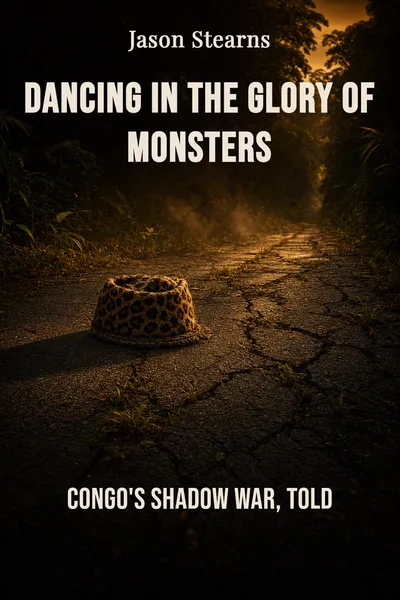
Dancing in the Glory of Monsters
Congo's shadow war, told
Description
On the night of May 16, 1997, a small, sick, exhausted man was flown out of Kinshasa in a private jet. Mobutu Sese Seko had ruled what he had renamed Zaire for thirty-two years, wearing his leopard-skin toque, hoarding a fortune in Swiss banks, letting the roads rot and the state hollow out around him. Now rebel columns were walking into the capital almost unopposed, and the dictator the West had propped up for decades slipped away to die of prostate cancer in Morocco a few months later. It looked, for a moment, like the end of something — a bad chapter closing, a fresh start for a country the size of Western Europe.
It was not the end. It was the overture. Within fifteen months the very men who had marched Laurent-Désiré Kabila into power turned on him, and the Congo tipped into a war that would pull in at least nine African nations and dozens of militias. Estimates of the dead run into the millions, most of them killed not by bullets but by the hunger, disease, and collapse that the fighting left behind. It became the deadliest conflict since the Second World War, and almost nobody outside the region could have named a single one of its battles.
Jason Stearns spent years inside this story — interviewing warlords, child soldiers, génocidaires, and ordinary survivors — and the book he built from it refuses the comfort of a simple morality tale. There are no clean heroes here, and the villains keep dissolving into circumstance. That refusal is what makes the account so unsettling, and so honest.
The question we’re asking : How does a war kill millions of people and still remain, for most of the world, invisible?What we’ll see : We follow the collapse of Mobutu's Zaire into a continental conflict, and the way its sheer shapelessness became its most durable feature.
Table of contents
01 Chapter 1 — The fall of a dinosaur
Mobutu had built a state designed to serve one man. He came to power in 1965 with quiet American backing, and for three decades he ran Zaire as a personal estate — nationalizing foreign businesses and handing them to cronies, printing money when he needed it, letting the army go unpaid until soldiers survived by robbing the people they were meant to protect. The Cold War kept the checks coming; Zaire was an anti-communist bulwark, and Washington paid for the privilege of not asking too many questions. When the Soviet Union fell, so did Mobutu's usefulness, and the money dried up.
What finally toppled him came from the east, not from within. The 1994 Rwandan genocide sent roughly two million Hutu refugees pouring across the border into eastern Zaire, and among them were the very militias and soldiers who had carried out the slaughter of Tutsis. They regrouped in the vast refugee camps, rearmed, and began launching attacks back into Rwanda. Kigali's new Tutsi-led government decided it would not wait to be attacked again.

02 Chapter 2 — The alliance that broke apart
Kabila owed his throne to Rwanda and Uganda, and everyone knew it. Rwandan officers ran his army; his chief of staff, James Kabarebe, was a Rwandan. For a new leader trying to establish that he was the ruler of a sovereign nation and not a puppet installed by neighbors most Congolese resented, this was intolerable. The men who had made him were also the men who most undermined his legitimacy, and the arrangement was never going to last.
In July 1998 Kabila made his move. He thanked his Rwandan advisers for their service and ordered them home. It was a declaration of independence, and Rwanda treated it as a declaration of war. Within days Kabarebe orchestrated an audacious operation: he loaded soldiers onto commandeered planes and airlifted them across the entire width of the country to seize the coast and the hydroelectric dam that powered Kinshasa, aiming to strangle the capital and topple Kabila in a matter of days.
03 Chapter 3 — A war with no front line
The conflict that followed had no shape that a newspaper map could capture. There were no great set-piece battles, no fronts advancing and retreating in clean lines. Instead there were dozens of armed groups — national armies, ethnic militias, self-defense units, bandits with a cause and bandits without one — fighting over villages, roads, mines, and cattle across a territory with almost no functioning roads. Alliances shifted month to month. A militia backed by Rwanda one year fought Rwanda the next. The line between soldier and civilian, between war and racket, dissolved.
Stearns tells it through people rather than through strategy, and this is the book's power. He sits with a commander who ordered massacres and finds a man who talks about it with the flat calm of someone describing paperwork. He listens to a young Rwandan officer, to a Mai-Mai fighter who believes magic water makes him bulletproof, to survivors of the killings around Kisangani. He refuses to let any of them become cartoons. The perpetrators had reasons; the reasons do not excuse anything; both things are true at once, and holding them together is the hardest thing the book asks of us.
04 Chapter 4 — When the numbers stop meaning anything
The figure most often attached to this war is over five million dead, drawn from surveys by the International Rescue Committee. The number has been contested — some later analyses argue it was inflated — but the argument itself is revealing. We can debate whether a war killed four million or five million people, and the debate can feel abstract, because almost none of those deaths came with a name, a photograph, or a headline. Most of the dead were not shot. They died of measles, malaria, dysentery, and starvation, in villages cut off from the clinics and markets that the fighting had destroyed. A war can kill on that scale and leave almost no images behind.
This is what Stearns's account forces into view: modern catastrophe does not always look like catastrophe. We know how to recognize a genocide with a perpetrator and a plan, or a war with two sides and a border between them. We are far less equipped to see a disaster that is diffuse, mercantile, and leaderless — one where the killing is done by hunger as much as by bullets, and where responsibility is smeared across nine governments, dozens of militias, and a global appetite for cheap minerals. There is no single face to put on the cover.
05 Conclusion
The jet that carried Mobutu out of Kinshasa in 1997 was supposed to be the ending. Instead it opened a decade of war that reshaped the center of a continent and killed on a scale the world never quite registered. Kabila the elder was murdered by his own guard; his son inherited a broken state and a peace that held everywhere except where it mattered most. The eastern provinces are still fought over now, by armed groups whose names change faster than anyone can track, over the same mines and the same grievances that were there when the columns first came through.
Related books