Condemned to Repetition
History's grip on Central America
Description
In July 1979, the Sandinistas marched into Managua and the Somoza dynasty that had ruled Nicaragua for more than four decades collapsed. In Washington, the reaction was less relief than a familiar dread. The Carter administration had spent months trying to manage the fall — to ease Anastasio Somoza out without letting the revolutionaries in, to find a moderate center that would hold. It failed on both counts. Robert Pastor, who sat on the National Security Council staff and handled Latin America for Carter, watched the whole thing up close, and the experience left him with an uncomfortable question that would not go away.
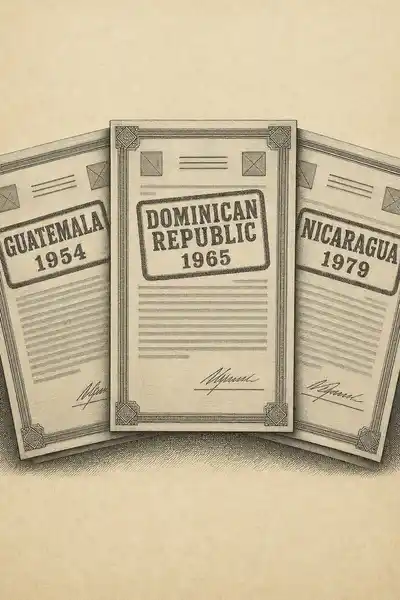
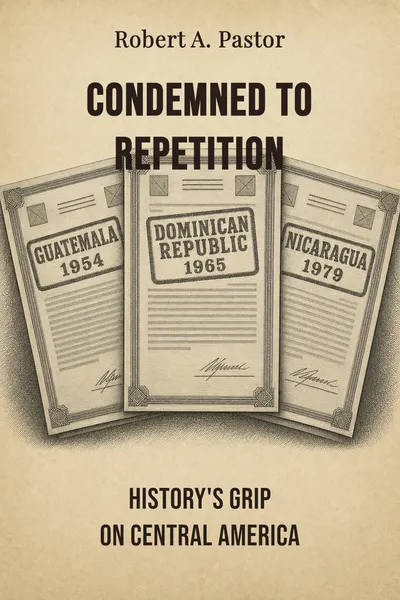
The question was not really about Nicaragua. It was about the United States. Why, Pastor asked, does Washington behave toward Central America the way it does — lurching between neglect and panic, backing dictators until the moment they fall, then discovering democracy too late to save it? The pattern had repeated so many times, across so many administrations, that it had the feel of something scripted. Guatemala in 1954, the Dominican Republic in 1965, Nicaragua in 1979: different presidents, different parties, oddly similar reflexes.
Pastor titled his book after a line from George Santayana — those who cannot remember the past are condemned to repeat it. But his argument is stranger than the epigram suggests. The repetition, he shows, does not come from forgetting. It comes from a relationship whose structure keeps producing the same moves, no matter who is in charge or what they have learned. Understanding that structure is the only way anyone gets to break out of it.
The question we’re asking : Why does the United States keep making the same mistakes in Central America, across administrations that seem to have nothing else in common?What we’ll see : How one revolution exposed a decades-old reflex, and what it would take for a small region to escape the great power next door.
Table of contents
01 Chapter 1 — A revolution that caught Washington unprepared
When Pastor arrived at the National Security Council in 1977, Central America was not on anyone's list of priorities. It rarely was. For most of the twentieth century the region drifted below the threshold of American attention, noticed only when something went wrong — a strongman toppled, a guerrilla movement gaining ground, a Cold War rival sniffing at the door. Nicaragua under the Somozas had been a fixture of that neglect. The family had run the country as a private estate since the 1930s, and successive administrations in Washington had found the arrangement convenient enough to tolerate.
By the late 1970s the arrangement was coming apart. Somoza's rule had grown more brutal and more corrupt, especially after a 1972 earthquake devastated Managua and the National Guard was seen looting the relief effort. Opposition spread from the countryside to the business class to the Catholic Church. The Sandinista National Liberation Front, once a marginal guerrilla band, became the sharp edge of a broad national revolt. Carter's human rights policy had already put distance between Washington and Somoza, but distance was not a plan.

02 Chapter 2 — Why the United States keeps reaching for the same script
Here is where Pastor widens the frame. The Nicaraguan collapse of 1979, he argues, was not an isolated misjudgment but the latest run of a pattern with a long history. He lays the episodes side by side. Guatemala in 1954, where a CIA-backed operation removed an elected government read as too far left. The Dominican Republic in 1965, where Lyndon Johnson sent in the Marines to prevent what he feared would be a second Cuba. Each time, the fear of communism on the doorstep overrode almost everything else, and each time the intervention produced consequences that outlasted the men who ordered it.
What links these cases is not ideology or party. Pastor points out that Democrats and Republicans, hawks and idealists, all fell into recognizably similar moves. The constant is a set of reflexes that the relationship itself keeps rewarding: treat the region as a security perimeter rather than a set of countries, read local conflicts primarily through the lens of superpower rivalry, and prefer the stability of a friendly strongman to the uncertainty of a genuine democratic opening.
03 Chapter 3 — Nicaragua, and the war Washington could not decide
The Sandinista victory did not end the story; it opened its longest chapter. Under Carter, Washington tried a policy of cautious engagement, offering aid in hopes of keeping the new government from tilting fully toward Cuba and the Soviet Union. Pastor is candid that this was a gamble with poor odds and modest results. When Ronald Reagan took office in 1981, the gamble was abandoned. The new administration saw Managua not as a country to be influenced but as a beachhead to be rolled back.
Out of that conviction grew the Contras — the armed opposition that the United States organized, funded, and directed against the Sandinista government through the 1980s. Pastor traces how the policy hardened into a war by proxy, and how it split the United States against itself. Congress veered between authorizing money for the Contras and cutting it off, most sharply through the Boland amendments restricting aid. The result was neither a decisive push to remove the Sandinistas nor a settled effort to live with them, but a costly stalemate that punished Nicaraguans and poisoned American politics.
04 Chapter 4 — When the region wrote its own way out
What finally cracked the deadlock did not come from Washington at all. In August 1987, the president of Costa Rica, Óscar Arias, brought the five Central American presidents together and won their signatures on a regional peace plan — the accord that carried his name and would earn him the Nobel Peace Prize that year. The plan called for cease-fires, an end to outside support for irregular forces, democratization, and national reconciliation across the region. It was, pointedly, a design by the countries whose fate was at stake rather than by the superpower that had spent a decade treating them as pieces on a board.
Pastor, writing his epilogue as events ran through early 1988, reads this as the more hopeful counter-note to his own argument. The Arias plan reframed the conflict as a Central American problem with a Central American solution, and by doing so it undercut the logic that had governed American policy. The debate in Washington over further funding for the Contras — a debate that came to a head in the House in early 1988 — now had to reckon with a peace process the region itself had launched and did not want disrupted. For once the small nations were setting terms.
05 Conclusion
The revolution that caught the Carter administration unprepared in 1979 set off nearly a decade of confrontation, and by the time Pastor closed his account in early 1988, the confrontation was still unresolved. What had shifted was the source of the initiative. The country that had spent the twentieth century managing Central America from a distance found itself reacting, for once, to a plan the region had written for itself.
Related books