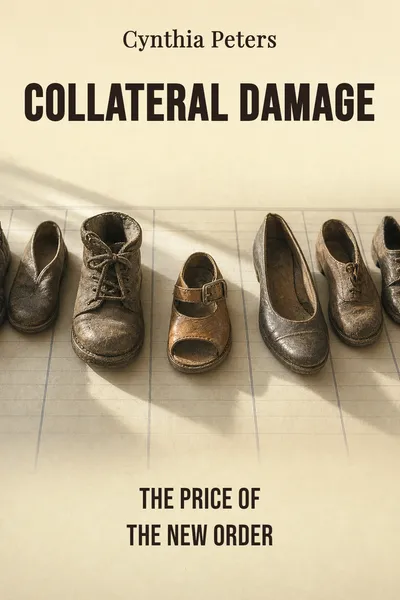
Collateral Damage
The price of the new order
Description
On January 16, 1991, as American bombs fell on Baghdad and the Cold War rivalry that had defined half a century collapsed into something new, a phrase entered the everyday vocabulary of politics: collateral damage. It named the harm done to people who were not the target — the civilians near the bridge, the family beside the barracks. The term was clinical, almost administrative. It described real deaths in the language of an accounting error. And in the years that followed, it stopped applying only to bombs. It became a way of talking about anyone whose life was disrupted by decisions made somewhere far above them.
Cynthia Peters gathered the essays in Collateral Damage to ask what that new order actually cost, and who was billed for it. Written from a progressive vantage point, the collection reads the triumphant story of the early 1990s — the end of history, the victory of the market, the promise of a peaceful and prosperous world — against the ledger of the people it ran through. Not the diplomats and economists who announced it, but the workers, the neighborhoods, the countries on the far end of a policy memo. The book treats their experience not as an afterthought to the story but as the story itself.
What the contributors share is a refusal to accept that the losses were incidental. A war has civilians. A market has losers. A restructuring has the restructured. The question is whether these are unavoidable accidents of progress or predictable results of who holds power and who does not. Peters and her collaborators come down firmly on the second answer, and they spend the book showing their work.
The question we’re asking : When a new political and economic order is declared a triumph, who absorbs its costs — and why do we call those costs accidental?What we’ll see : How the post-Cold War order was sold from above, and what it charged to the people who never got a vote on it, at home and abroad.
Table of contents
01 Chapter 1 — The order announced from above
The book opens with the story the 1990s told about themselves. The Soviet Union was gone. The great ideological contest was settled. What remained, in the words of the moment, was a new world order — a phrase George H. W. Bush used repeatedly in 1990 and 1991 to describe a future organized around American leadership, open markets, and the rule of law. It was a genuinely hopeful vocabulary. It promised that the machinery of superpower confrontation could be retired and its resources redirected toward something better.
Peters's contributors are less interested in whether the promise was sincere than in who got to make it. The order was announced, not negotiated. It came from summits, treasury departments, and editorial pages, and it arrived at everyone else as a settled fact. The essays keep returning to this asymmetry: a small set of institutions and officials described the terms of the coming decades, and the vast majority of people were positioned as beneficiaries of a plan they had no hand in writing.

02 Chapter 2 — Who pays for the peace dividend
The domestic essays turn the lens on the United States, where the new order was supposed to pay off first. The picture the contributors assemble is of a country in which the announced prosperity flowed in a very particular direction. Through the 1980s and into the 1990s, gains concentrated at the top while wages for much of the workforce stagnated. The end of the Cold War did not reverse this; it coincided with an acceleration of it. The savings from a shrinking military did not reliably become the schools and hospitals the dividend had promised.
Instead, the book argues, the period's guiding economic logic — lower taxes at the top, deregulation, cuts to public provision — treated social spending as a cost to be trimmed rather than an investment. The people who depended on that spending were not adversaries of the new order. They were simply not its intended winners. Peters's contributors document the communities where a factory closed, a program was defunded, a safety net thinned — and where the official story had no word for what happened except progress.
03 Chapter 3 — The world on the receiving end
The collection then widens to the countries where the new order arrived as policy imposed from outside. Here the peace dividend rhetoric met the machinery of global economic management — the loan conditions, the structural adjustment programs, the demands that governments open markets, cut public budgets, and privatize in exchange for credit and inclusion. The essays follow these prescriptions into the places that lived them, where austerity meant fees for schooling that had been free and cuts to clinics that had been open.
The contributors are careful not to treat these outcomes as unfortunate glitches in an otherwise sound design. The pattern repeated too consistently for that. Across very different countries, the same policy package produced the same distribution of pain: hardest on the poorest, lightest on those already positioned to benefit from open capital and cheap labor. When a result is that reliable, the book argues, it is not an accident of implementation. It is what the implementation does.
04 Chapter 4 — When the costs are called side effects
Step back from the individual cases and what Collateral Damage is really examining is a phrase, and the work a phrase can do. To call harm collateral is to grant it a specific moral status: unintended, incidental, regrettable but not chosen. It is the difference between a death you caused and a death that happened near you. The book's central move is to refuse that distinction wherever the harm was foreseeable — and the contributors argue that in most of the cases they examine, it plainly was.
This is what unites the bombed neighborhood, the shuttered factory, and the defunded clinic across three chapters. In each, someone decided, and the decision had knowable consequences for people who would not benefit. The word collateral does not describe the mechanism of the harm; it manages our reaction to it. It converts a political choice into something closer to a natural event, and in doing so it quietly removes the question of responsibility. A new order that can name its costs as side effects never has to defend them as decisions.
05 Conclusion
The phrase that entered public speech over Baghdad in 1991 has never really left it. It travels easily because it does a useful thing: it lets the people who make consequential decisions describe the harm those decisions cause without quite owning it. Collateral Damage follows the phrase out of the war and into the economy, from the neighborhoods near the bombing to the factory towns and the countries under adjustment, and finds the same logic operating in each. The order that promised a peaceful and prosperous new world kept a second set of books, and the contributors spend the collection reading them aloud.
Related books