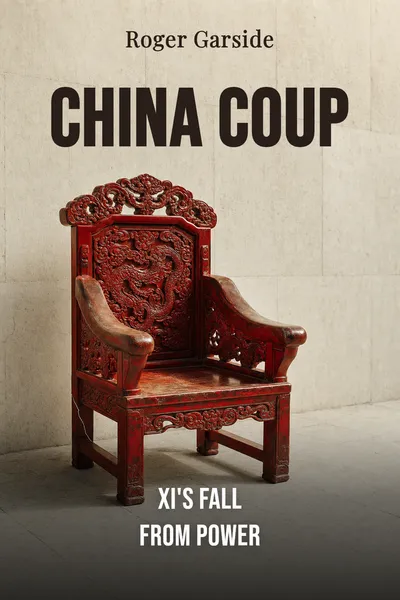
China Coup
Xi's fall from power
Description
In 2021, a retired British diplomat named Roger Garside published a book with an unusually bold promise on its cover. Before the Communist Party's twentieth National Congress, scheduled for the autumn of 2022, Xi Jinping would be removed from power — not by an election, not by protest in the streets, but by a coup mounted from inside the top leadership itself. Rivals at the summit of the Party, Garside argued, would move against Xi, dismantle the one-party dictatorship, and steer China toward democracy and the rule of law. He set a date. He named the mechanism. He wrote it in the future tense, the way a forecaster writes weather.
Garside was not a casual observer. He had served twice at the British embassy in Beijing, including during the death of Mao and the arrest of the Gang of Four in 1976 — a real palace turnover he had watched from close range. That experience runs underneath the whole book. He had seen the Party purge itself once, abruptly, when a small circle at the top decided the succession could not stand. His wager was that history could rhyme: that the same machinery of elite maneuver that ended one era could end another. The twentieth Congress came and went in October 2022. Xi did not fall. He secured a third term.
So the prediction failed on its own terms. That fact hangs over any honest reading of the book, and there is no point pretending otherwise. But a failed forecast is not the same as an empty one, and the argument underneath the headline is worth taking apart carefully — because it says as much about how the outside world reads a closed system as it does about China itself.
The question we’re asking : What made a seasoned China-watcher so certain that Xi Jinping would be toppled from within before the end of 2022?What we’ll see : How the book builds its case — the diagnosis of a brittle regime, the imagined plotters, and the future it insisted was coming.
Table of contents
01 Chapter 1 — A scenario dressed as reporting
The first thing to understand about China Coup is its form, because the form is doing a lot of the work. The book is split into three movements. The long middle section, which Garside calls Part 2, is analysis: a sustained argument about why the regime is more fragile than it looks. Around it, Parts 1 and 3 are something stranger — a narrative of the coup as it unfolds, complete with named officials, secure phone calls, troop movements and a dramatic reversal at the top of the Party. It reads like a thriller because that is more or less what it is.
This blend is deliberate, and Garside is fairly open about it. He is not claiming to report events that happened. He is writing a plausible future, and then reverse-engineering the conditions that would have to hold for it to occur. The technique has a respectable name in intelligence work — scenario planning — and it lets him do something a straight essay could not. He can show, scene by scene, how a handful of people at the very top might coordinate in secret, neutralize the security apparatus, and present the country with a fait accompli before anyone could organize resistance.

02 Chapter 2 — Why the regime cannot hold
Strip away the thriller and the core of the book is a diagnosis of weakness. Garside's argument is that Xi's China looks strong from the outside and feels brittle from the inside, and that the very moves Xi made to secure his own power were the ones hollowing out the system's stability. The concentration of authority in one man, he contends, did not eliminate rivalry. It suppressed it, and suppression is not the same as removal.
The centerpiece of the diagnosis is the anti-corruption campaign that Xi launched after taking power in 2012. Officially a cleanup, it swept through the Party, the military and the state, removing hundreds of thousands of officials and jailing figures once thought untouchable. Garside reads it as something closer to a purge — a tool for destroying rivals and terrifying survivors into obedience. His point is that a campaign like this creates enemies faster than it creates loyalty. Every official who watched a colleague fall understood that the same could happen to him, and that fear, over time, curdles into a shared interest in seeing the source of the fear removed.
03 Chapter 3 — The engineers of the fall
Every coup needs plotters, and Garside supplies them. His imagined conspiracy does not rise from the streets or from a democratic underground. It comes from inside the red aristocracy itself — senior figures who have spent their lives in the Party, who command respect within the military and the security services, and who conclude, coldly, that Xi has become a danger to the system they serve. The rebellion he imagines is not idealistic. It is self-preserving, launched by people who calculate that removing Xi is safer than living under him.
The mechanics matter to him, and this is where his diplomatic memory shows. He knows that in a state like China, power does not change hands through persuasion but through control of the instruments of coercion — the army, the internal security forces, state media, the levers that decide who gets arrested and who gives the orders. His plotters move first to secure those instruments, then present the change as accomplished before opposition can form. The 1976 arrest of the Gang of Two — sorry, the Gang of Four — sits behind every page: a small circle acting decisively, framing the move as rescue rather than seizure, and daring the rest of the system to object.
04 Chapter 4 — The transition nobody was allowed to imagine
Set the calendar aside for a moment and the book becomes a case study in how the outside world reads a closed regime — and how badly it wants that regime to be about to change. Garside is not a crank. He is an experienced, serious observer, and his misfire is instructive precisely because it comes from expertise rather than ignorance. The pull toward prediction, in his case, is really the pull of hope wearing the clothes of analysis.
This is the deeper thing China Coup exposes. When a system gives outsiders almost no reliable signals — no polls, no open factions, no visible succession fights — the space left over fills with the observer's own convictions. Garside believes, sincerely, that democracy is both better and more durable than dictatorship, and that belief shapes what he sees as inevitable. The regime looks fragile partly because he needs it to be fragile for the future he wants to be possible. The book's confidence is not fraud; it is the very human tendency to mistake what should happen for what will.
05 Conclusion
The twentieth Congress delivered the opposite of the book's headline. Xi Jinping walked out of the autumn of 2022 with a third term and a leadership team stacked with allies, his position looking not weaker but more entrenched than ever. Garside's plotters never appeared, his date passed, and the transition to democracy he sketched in such careful detail remained on the page. As a forecast, China Coup was refuted by the calendar it set for itself.
Related books