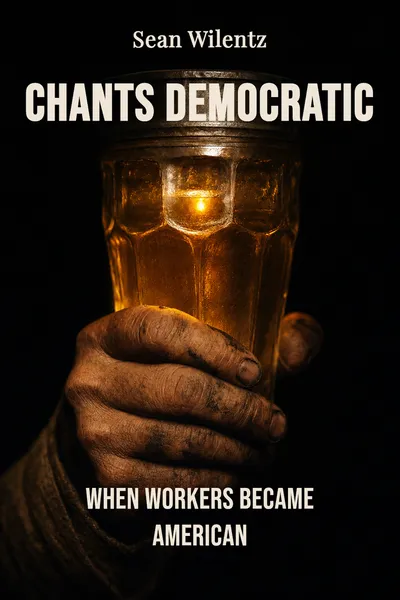
Chants Democratic
When workers became American
Description
In the 1820s, a New York journeyman printer or cordwainer would have called himself a republican long before he called himself a worker. The word carried the whole memory of 1776: independence, virtue, a producer's right to the fruit of his own labor, a suspicion of anyone who lived off the toil of others. It was the common inheritance of the city — merchants used it, masters used it, and so did the men who swung the hammers. For a while, everyone could agree on the vocabulary while meaning something quite different by it.
Then the workshops changed under everyone's feet. Between roughly 1790 and 1850, the intimate world of master and apprentice — the shop where men ate, learned, and often lodged together — was pulled apart by a widening market. Masters became employers, journeymen became wage-earners with no realistic path to a shop of their own, and the old promise that hard work led to independence started to sound hollow. Sean Wilentz's Chants Democratic follows that transformation street by street, trade by trade, in the one American city where it happened first and largest.
What makes his account a landmark of labor history is that he does not treat the working class as something the economy simply produced. He watches it get made — in mutual-aid societies, strike handbills, election-day brawls, penny newspapers, and Fourth of July toasts — as ordinary men argued over who the republic actually belonged to. The story is less about factories than about words, and what happens when two groups discover they can no longer share them.
The question we’re asking : How did the artisans and laborers of early New York come to see themselves as a class — and what did they build to say so?What we’ll see : A city remade by the market, a shared political language that quietly turned into a weapon, and the slow discovery of a common cause.
Table of contents
01 Chapter 1 — The city that made the class
New York in the early republic was still a walking city of small workshops, not a landscape of smokestacks. Wilentz begins there deliberately, because the American working class was not born in a mill town but in the crowded lanes of a mercantile port where craftsmen made shoes, furniture, ships, hats, and books largely by hand. To understand what was lost, you first have to see the world of the independent artisan in its own terms: a hierarchy of master, journeyman, and apprentice that people experienced less as a class ladder than as a life cycle every ambitious young man expected to climb.
That expectation was the quiet engine of the whole system. An apprentice served his years, became a journeyman earning wages, then saved and eventually opened a shop of his own, taking on apprentices in turn. The arrangement had its own dignity and its own code, and it fit neatly with the republican idea that a free man was one who owned his tools and answered to no master permanently. Craft skill was a kind of property. Independence was the reward at the end of the road.

02 Chapter 2 — A republicanism the merchants thought they owned
The vocabulary these men reached for was already lying around, and that is central to Wilentz's argument. They did not invent a new language of protest from scratch. They took the republicanism of the Revolution — the talk of virtue, corruption, independence, and the sovereignty of the producing citizen — and turned it toward the conditions of the workshop. In their hands, the merchant who grew rich off other men's labor started to look like exactly the kind of parasite the revolutionary generation had warned against.
This was a shared inheritance, which is what made it so combustible. Employers, master craftsmen, and Democratic politicians all spoke the republican idiom fluently and sincerely. Everyone claimed to be defending the legacy of 1776. The fight, then, was not over whether to be republican but over what republicanism required. Did it mean protecting the individual's right to contract and accumulate freely? Or did it mean guaranteeing that a working man could still earn a competence and a measure of independence? The same words pointed in opposite directions.
03 Chapter 3 — When the shop floor split in two
Ideas alone do not make a class; Wilentz is careful to show the institutions and the confrontations that gave the new consciousness a body. The period saw a wave of practical organizing: journeymen's societies that pooled funds for the sick and the striking, citywide federations of trades, cooperative workshops, and a lively artisan press that carried arguments from one shop to the next. These were the places where men learned to think of themselves in the plural — as printers, yes, but also as workers with interests distinct from their employers'.
The strikes made the split visible. When journeymen in a given trade walked out over wages or hours, they were doing something the old shop household had no category for. Masters answered that a turnout was a conspiracy against the natural harmony of the craft; the courts, in early cases, sometimes agreed and treated organized workers as criminal combinations. Each confrontation forced men to choose a side of a line that, a generation earlier, had barely existed. The master and the journeyman, once stages of one life, were becoming permanent stations.
04 Chapter 4 — Why a language matters more than a program
Step back from the strikes and the societies, and the deepest claim of Chants Democratic comes into view: a working class is not simply deposited by economic change, ready-made. It is assembled, and the raw material is often the political language already in circulation. Wilentz shows New York's artisans building an identity out of a republicanism they inherited rather than an ideology imported from elsewhere. The economy created the pressure; the shared vocabulary supplied the form the response would take.
That reframing matters because it cuts against two easy stories. One says class is a straightforward reflex of material conditions — factories in, proletarians out. The other says American workers, seduced by opportunity and democracy, never developed real class feeling at all. Wilentz's New York refuses both. The men he follows had a powerful sense of themselves as a distinct order, but they expressed it in the idiom of the American Revolution, which is precisely why it looked unlike its European counterparts. American radicalism spoke fluent republican, not borrowed Marxism.
05 Conclusion
Return to that journeyman printer of the 1820s, calling himself a republican before he had a word for what the market was doing to him. By the middle of the century he had found the words. The shared creed of independence had fractured along a new seam, and on one side of it stood men who now understood their wages, their hours, and their diminished prospects as a common condition rather than a personal failing. New York had made a class, and it had done so out of the very ideals the whole city thought it held in common.
Related books