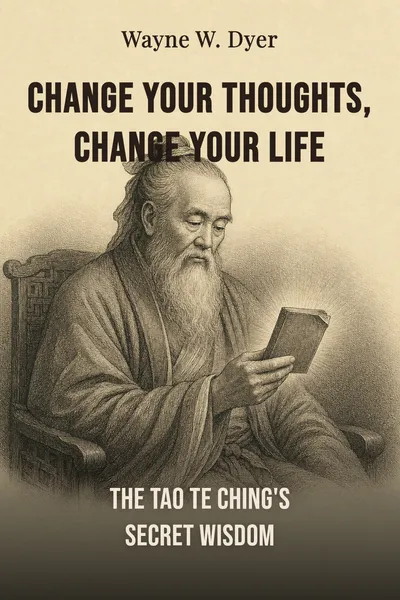
Change Your Thoughts, Change Your Life
The Tao Te Ching's secret wisdom
Description
In the mid-2000s, Wayne W. Dyer — a self-help author who had already sold tens of millions of books and become a fixture of American public television — set himself an unusual assignment. He would spend a year with the Tao Te Ching, the short book of eighty-one verses attributed to the Chinese sage Lao-tzu around the sixth century BCE. Not skim it. Not quote it. Live inside one verse at a time, for a week each, reading multiple translations side by side, sitting with the lines until they rearranged something in how he moved through his own days.
The result, published in 2007 as Change Your Thoughts, Change Your Life, is not a translation in the scholarly sense. Dyer wasn't a sinologist, and he said so plainly. What he offers instead is a companion: each of the eighty-one verses rendered in his own words, followed by an essay on what it asks of a person, and a set of small instructions for putting it into practice. The subtitle promised the Tao's "living wisdom," and the wager of the whole book is that a text this old could still speak, without footnotes, to someone stuck in traffic in Florida.
That wager is the interesting part. The Tao Te Ching is famous for being slippery — it opens by warning that the Tao you can name is not the real Tao. It resists the very thing self-help usually does, which is give you steps. Dyer took a book built on paradox and tried to make it usable for people who had never heard of Lao-tzu, and did it while, unknown to most readers, living with a diagnosis of leukemia.
The question we’re asking : How does a book that refuses to explain itself become a set of instructions for living — and what does Dyer actually ask his reader to change?What we’ll see : A year spent inside eighty-one verses, and what happens when the oldest advice about power, effort, and yielding gets handed to a modern reader who just wants to feel calmer.
Table of contents
01 Chapter 1 — A dying man's book, read eighty-one times
Dyer's method was the whole point. Rather than translate the Tao Te Ching from Chinese, which he couldn't do, he gathered a stack of existing English versions — Gia-Fu Feng, Stephen Mitchell, and others — and treated the disagreements between them as a feature, not a bug. Where translators split, he could see the range of what a verse might mean, and choose the reading that felt truest to him. He then committed to living with one verse per week for a full year, which is where the number eighty-one stops being trivia and starts organizing a life.
The book is structured accordingly. Each chapter takes one verse, prints Dyer's own rendering of it, and then unfolds into a short essay: what the verse observes about how life works, where we tend to resist it, and what changes if we stop resisting. He closes each one with practical suggestions — small experiments, a line to keep in mind, a habit to try for a few days. The self-help scaffolding is deliberate. Dyer knew his readers came to him for change, and he was building a bridge from a text that resists instruction to people who wanted some.

02 Chapter 2 — The pull of the low ground
If one image runs through Dyer's reading of the Tao, it's water. Lao-tzu returns to it again and again, and Dyer makes it the book's recurring lesson. Water always seeks the lowest place. It doesn't compete, doesn't force, doesn't announce itself — and yet nothing outlasts it. It wears down stone. Dyer takes this literally as advice: the person who stops needing to be highest, first, most right, is not weak but positioned where real strength gathers.
This runs directly against the grain of the culture Dyer was writing into. American self-improvement, including much of his own earlier work, tends to be about rising — more confidence, more achievement, more visibility. The Tao points the other way. Several verses praise the value of humility, of yielding, of staying soft. Dyer doesn't treat this as resignation. He reads it as a smarter relationship to power: the rigid tree snaps in the storm, the supple one bends and survives. Hardness looks like control and is actually brittleness.
03 Chapter 3 — Doing by not-doing
The strangest idea Dyer has to carry over is wu wei — usually rendered as "non-doing" or "effortless action." It sounds, to a Western ear built on hustle, like an instruction to do nothing. Dyer spends real effort untangling this, because it's the hinge of the whole philosophy and the easiest thing to get wrong. Wu wei doesn't mean inaction. It means acting in accordance with how things naturally move, rather than forcing them against their grain.
His favorite illustration is the one Lao-tzu keeps reaching for: nature accomplishes everything and hurries at nothing. The seasons don't strain. A tree doesn't try to grow. Things unfold when the conditions are right, and the wise person learns to work the same way — to sense the moment when action flows easily and to stop pushing when it doesn't. Dyer connects this to something most readers recognize: the way our best work often comes when we stop gripping it, and the way forcing an outcome tends to produce the opposite.
04 Chapter 4 — When the water wins
Step back and the real move in Change Your Thoughts, Change Your Life isn't any single verse — it's the claim that a text written in China roughly 2,500 years ago can be handled as a personal practice by someone who knows nothing about Taoism. Dyer strips away the scholarship on purpose. No debates about authorship, no lingering on whether Lao-tzu was one person or several, no comparison of Chinese characters. What's left is the Tao as a way of living, offered to a reader who is invited to try it rather than study it.
That's a genuine editorial choice, and it cuts both ways. A scholar would object that Dyer flattens a subtle, ambiguous work into eighty-one self-help lessons, and that some of what he draws out owes as much to his own New Thought lineage as to Lao-tzu. Fair enough. But Dyer would answer that the Tao Te Ching was never meant to be a museum piece. It's a manual for conduct, addressed originally to rulers and sages, about how to hold power and live well. Reading it as something to do rather than something to know may be closer to its intent than the footnotes are.
05 Conclusion
Wayne Dyer died in 2015, and the loyalty of his readers to this particular book has outlasted him. Of the more than forty titles he wrote, Change Your Thoughts, Change Your Life is the one many of them name as their favorite — perhaps because it feels less like Dyer talking and more like Dyer stepping aside to let something older speak through him. The year he spent with the eighty-one verses left a book that can be read the same way he wrote it: slowly, one verse at a time, over the course of a life rather than a weekend.
Related books