Beyond Your Numbers
Redefine what healthy really means
Description
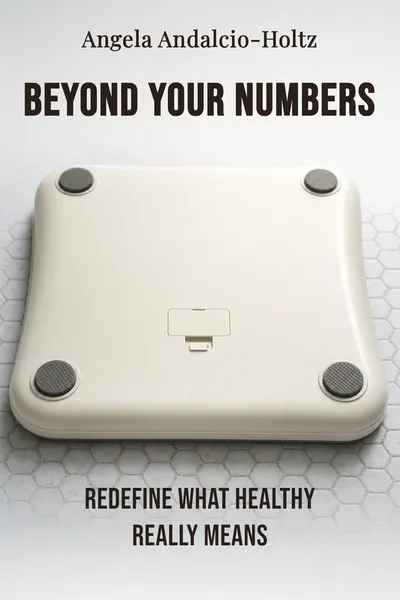
Somewhere in most homes there is a small flat device that has more authority over a person's morning than it has any right to. We step on it, we read a number, and the number decides how the day begins. A little lower than yesterday and there's a lift, an unearned lightness. A little higher and something tightens — the coffee tastes different, the mirror gets harsher. Angela Andalcio-Holtz opens her book Beyond Your Numbers with this exact scene because she knows how familiar it is, and how strange it should feel that a two-digit readout can quietly run the emotional weather of an adult who is, by every other measure, doing fine.
Her argument is not that numbers are useless. Weight, blood pressure, cholesterol, step counts — these things carry real information, and pretending otherwise would be its own kind of dishonesty. What she pushes back on is the slide from measurement to verdict, the moment a data point stops describing us and starts judging us. Once that happens, a whole wellness journey can reorganize itself around chasing digits, and the person doing the chasing can end up thinner, or fitter, or more monitored, without ever feeling better in the way they actually wanted.
So Beyond Your Numbers sets out to loosen that grip. Written as a warm, motivational guide rather than a clinical manual, it asks what health would look like if we stopped grading ourselves and started paying attention instead — to mindset, to daily habits, to the quiet signals a body sends that no scale can register.
The question we’re asking : What are we actually measuring when we measure our health, and what slips through the gaps of the numbers we trust?What we’ll see : A guide to loosening the scale's grip and rebuilding a steadier, more honest sense of what feeling well really means.
Table of contents
01 Chapter 1 — The tyranny of the scale
Andalcio-Holtz spends her opening chapters on a single, uncomfortable observation: for a lot of people, the number has stopped being a tool and become a boss. It sets the mood, hands out the rewards and the punishments, and demands to be consulted daily. She's careful not to caricature this. The people she describes aren't vain or shallow — they're often the most conscientious ones, the ones who did everything they were told, who bought the tracker and logged the meals and weighed in every morning because that's what taking care of yourself is supposed to look like.
The trouble, she argues, is that a number is a snapshot pretending to be a story. Body weight swings with water, sleep, hormones, salt, the time of day. A morning reading can move two or three pounds for reasons that have nothing to do with anything we did, yet we read it as a report card on our discipline. We congratulate ourselves for luck and flog ourselves for physiology. Over months this teaches a strange lesson: that our worth is volatile, revisable overnight, always one bad measurement from collapse.

02 Chapter 2 — What the numbers can't see
If the scale is a poor judge, the obvious next question is what a better one would look at. Andalcio-Holtz's answer is that most of what determines whether we feel well never shows up on any readout. Energy across a day. The quality of sleep. Whether the stairs leave us winded. Mood, patience, the steadiness of our attention. How our clothes sit, how our joints move, whether we wake up dreading the morning or meeting it. These are real, and they're the things people actually mean when they say they want to be healthy — yet none of them fit neatly into a chart.
She calls this the self-awareness gap, and she treats closing it as a skill rather than a gift. Most of us are surprisingly out of touch with our own signals, partly because the numbers have done the noticing for us. When a device tells you how you slept, you stop asking your body. So she pushes readers toward low-tech attention: checking in with how a meal actually landed an hour later, noticing which activities leave them energized versus drained, tracking mood alongside — or instead of — metrics. The instruments here are curiosity and honesty, not sensors.
03 Chapter 3 — Habits over milestones
The engine of the book is Andalcio-Holtz's insistence that lasting change lives in habits, not in milestones. A milestone is a finish line — a target weight, a goal race, a number to hit — and finish lines have a peculiar flaw: crossing them tends to end the behavior that got you there. She's watched people reach a goal and promptly unravel, because the goal was the point and now the point is gone. Habits don't work that way. A habit has no finish line; it's just the shape of an ordinary day, repeated until it stops requiring willpower.
This is why she's wary of dramatic overhauls. The thirty-day cleanse, the total diet reinvention, the sudden gym membership taken up with vengeance — these are milestone thinking in disguise, all intensity and no durability. What she recommends instead is almost boringly modest: small changes small enough to survive a bad week. A walk after dinner. One more glass of water. Cooking one extra meal at home. The bet is that a tiny habit kept for a year beats a heroic effort abandoned in three weeks, and the arithmetic backs her up.
04 Chapter 4 — Health as a relationship, not a verdict
Step back from the specific advice and what Andalcio-Holtz is really proposing is a change in the basic metaphor. We tend to treat health as a verdict — a judgment handed down by a scale, a lab, a doctor, delivering a sentence we've either earned or failed to. A verdict is final, external, and adversarial; you're on trial, and the numbers are the jury. Almost everything painful about the way people relate to their bodies flows from that framing.
Her alternative is that health is a relationship. Relationships aren't passed or failed; they're tended. They have good days and rough patches, they require attention rather than perfection, and they don't collapse because of a single bad week. You don't get graded by a relationship — you participate in one. Reframing wellness this way defuses the whole apparatus of self-punishment, because there's no exam to flunk, only an ongoing conversation with a body that keeps changing and keeps sending signals.
05 Conclusion
We come back, at the end, to the small flat device on the bathroom floor. Andalcio-Holtz never tells us to smash it, and that restraint is the point. Beyond Your Numbers isn't a rebellion against measurement; it's a demotion of it. The scale can stay. What changes is who's in charge of the morning — the readout, or the person reading it. Once the number is one voice among several rather than the only one that counts, stepping on it stops feeling like a sentencing and starts feeling like glancing at a gauge.
Related books