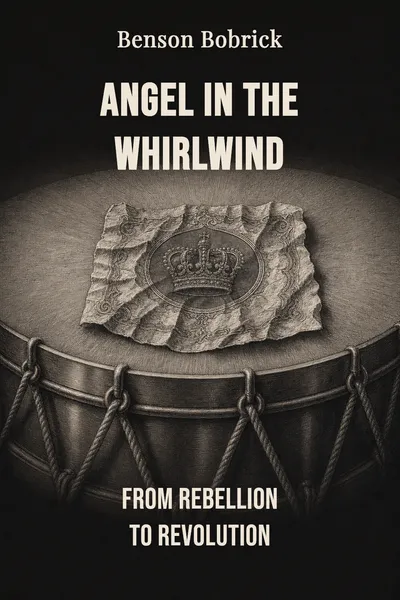
Angel in the Whirlwind
From rebellion to revolution
Description
In the spring of 1763, London had every reason to feel triumphant. The long fight against France in North America — what the colonists called the French and Indian War, part of the wider Seven Years' War — had ended with Britain holding Canada and dominance over half a continent. The empire had never looked larger. But victory came with a bill, and the bill was enormous: the national debt had roughly doubled, and the cost of keeping soldiers stationed across the newly won territory kept climbing. Someone, ministers in Westminster decided, ought to help pay for it. The obvious candidates were the colonists who had, after all, been the war's most immediate beneficiaries.
That decision — reasonable on paper, in a Whitehall ledger — set off a chain of resentments no one in London saw coming. A Sugar Act, a Stamp Act, duties on tea and glass and paper: measures that looked like ordinary bookkeeping to Parliament looked, in Boston and Philadelphia, like theft dressed as law. The colonists were not being asked their opinion; they were simply being charged. Within a dozen years, that grievance about money had curdled into something far larger, and a scattered collection of provinces that had never much liked one another found themselves shooting at the most powerful army on earth.
This is the story Benson Bobrick tells in Angel in the Whirlwind — a sweeping account that refuses to separate the muskets from the arguments, the generals from the shopkeepers and farmers who filled out the ranks and the diaries. Bobrick, whom the New York Times once called perhaps the most interesting historian writing in America, moves from the drawing rooms where policy was written to the stone walls at Concord where it was answered with gunfire.
The question we’re asking : How did a quarrel over taxes turn into a war for independence, and then into something the whole world would come to imitate?What we’ll see : A revolution told from both the top and the bottom — through its statesmen and its soldiers, its patriots and its loyalists, from the first shots to the last surrender.
Table of contents
01 Chapter 1 — The bill for a war already won
Bobrick opens where empires usually stumble: at the height of their success. Britain in 1763 was flush with new land and drowning in new debt, and the men who ran it made a calculation that felt like common sense. If a standing army was needed to hold the frontier, and if the colonies benefited most from that army, then the colonies could pay a share. The Stamp Act of 1765 was the sharpest expression of the idea — a tax on printed matter, from legal documents to newspapers to playing cards, that touched almost everyone who could read or trade.
What London misread was not the amount but the principle. The sums involved were modest. The insult was structural. Colonists had no members in Parliament, and so the taxes arrived without their consent — the objection compressed into the phrase that spread through every town: no taxation without representation. Bobrick lets the colonists speak in their own voices here, and the tone is less desperation than affront. These were British subjects who believed they were owed the rights of British subjects, and they experienced the new duties as a demotion.

02 Chapter 2 — The words that made a country
The shooting began before the argument was finished. In April 1775, British troops marched from Boston to seize colonial arms at Concord, and on the green at Lexington someone fired — no one ever settled who — and eight militiamen fell. By day's end the redcoats were retreating under fire from behind stone walls the whole way back, harried by farmers who had turned out at the ringing of bells. Bobrick treats the day as a hinge: after Lexington and Concord, petitions were beside the point. Blood had been spent, and blood tends to organize opinion.
Yet independence was not the immediate demand. For over a year, many colonists still imagined themselves loyal subjects wronged by a bad ministry, not by the Crown itself. What broke the spell, in Bobrick's telling, was partly argument and partly exhaustion. Thomas Paine's Common Sense, published in January 1776, sold in staggering numbers and did the unthinkable in plain language: it named the king, not merely Parliament, as the problem, and made monarchy itself sound absurd. A pamphlet did what years of resolutions had not — it made the leap thinkable for ordinary readers.
03 Chapter 3 — The war the amateurs were not supposed to win
The military story, as Bobrick tells it, is mostly a story of survival. George Washington's central achievement was less winning battles than keeping an army in existence — feeding it, holding it together through desertion and mutiny and winters that killed more men than musket fire. The early campaigns went badly. New York was lost, the army driven across New Jersey in retreat, the cause nearly dissolving before the surprise crossing of the Delaware and the strikes at Trenton and Princeton late in 1776 gave the patriots reason to believe the thing was not already over.
The turn came at Saratoga in the autumn of 1777, where an entire British army under Burgoyne surrendered after being cut off in the interior. Bobrick treats it as the war's diplomatic pivot as much as its military one: the victory persuaded France, long eager to wound Britain, that the Americans could actually win. French money, ships, and troops transformed a colonial insurgency into an international war, and stretched British resources across the globe. What had been a policing problem became a strategic emergency for London.
04 Chapter 4 — When a colonial rebellion became something the world watches
Step back from the battles, and Bobrick's larger claim comes into focus: the American Revolution mattered less for the territory it transferred than for the idea it put into circulation. A tax dispute could have ended in a compromise over duties, as such quarrels usually did. What made this one different was the moment the colonists stopped arguing about how much they owed and started arguing about who had the right to decide — the question of consent, of whether legitimate power flows upward from the governed or downward from a crown.
That shift is why the Declaration outlived the war. Its language was not tailored to Massachusetts grievances; it spoke of rights that belonged to people as such, and of governments that exist to secure them. Bobrick shows the founders themselves half-aware of what they were doing — writing a document meant to win a war and win over European opinion, but phrasing it in terms too broad to stay contained. Once the claim was made in universal words, it could be picked up by anyone who felt governed without a voice.
05 Conclusion
The war that began as an accounting exercise in Westminster ended with a new republic and a stubborn set of promises it had not yet learned how to keep. Bobrick brings the whirlwind full circle: the debt-burdened empire that tried to tidy its books lost a continent, and the quarrelsome provinces that could barely agree on anything held together long enough to outlast it. The flag came down at Yorktown, but the argument the colonists had raised — about consent, about who gets to say yes to power — did not settle. It hardened into something a country would spend centuries testing against itself.
Related books