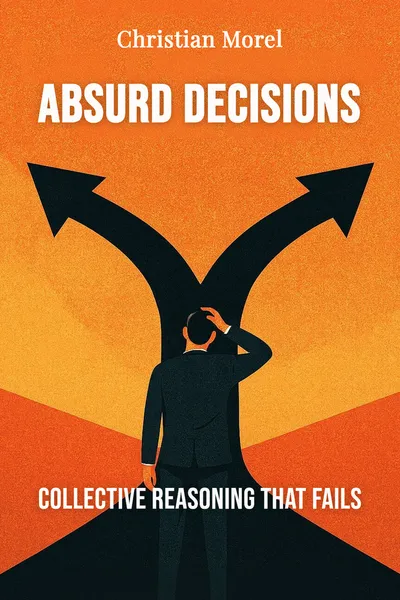
Absurd Decisions
Collective reasoning that fails
Description
On the night of December 29, 1972, an Eastern Air Lines jet was circling above the Florida Everglades because a small green landing-gear light had failed to come on. Three trained pilots and a flight engineer bent over the problem, unscrewing the bulb, checking the wiring, absorbed in a fault that might have been nothing more than a burnt-out lamp. While they worked, the autopilot quietly disengaged and the aircraft began a slow, imperceptible descent. Nobody noticed. The plane, fully functional, flew calmly into the swamp. Ninety-nine people died over a light bulb.
This is the kind of story that opens Christian Morel's book, and the reason it stays with us is that no one in the cockpit was incompetent, reckless, or malicious. Everyone did their job. Morel, a French sociologist who spent years inside companies, hospitals and cockpits, calls these events décisions absurdes — decisions that go radically, sometimes fatally, against the goal they were meant to serve, taken by intelligent people acting in good faith. His interest is not the spectacular error but the ordinary machinery that produces it.
What makes the book unsettling is that the machinery is familiar. We have all sat in a meeting where the obvious point went unsaid, watched a group talk itself into a plan nobody quite believed, or followed a rule long after it stopped making sense. Morel treats these moments not as accidents of character but as recurring failures of collective reasoning — and he wants to know why smart groups are so reliably capable of arriving, together, at the wrong answer.
The question we’re asking : Why do capable people, reasoning together in good faith, so often arrive at a decision that defeats their own purpose?What we’ll see : How ordinary reasoning, group silence and well-meaning rules combine into errors nobody intended — and why those errors are so hard to undo.
Table of contents
01Chapter 1 — The plane that flew into the ground
Morel builds his case from cases, and the ones he lingers on share an uncomfortable feature: the catastrophe grows out of something trivial. The Everglades crash is the emblem. A crew of experienced professionals focused so completely on a twenty-cent bulb that they let a working aircraft descend into the ground. The absurdity is not that they made a mistake — it is the scale of the gap between the tiny problem they were solving and the enormous one they created by solving it.
He collects other examples across very different worlds. A mountaineer, roped correctly and equipped, dies on an easy slope because a series of small, individually reasonable choices accumulate into a fatal one. An industrial team keeps running a process everyone privately doubts. A committee approves a project that, read coldly on paper, makes no sense. In each case Morel resists the easy verdict — that someone was stupid, distracted, or negligent. The people involved were often the most qualified in the room.

02Chapter 2 — Reasoning that turns on itself
The first place Morel looks is inside the reasoning itself. Human beings, he argues, do not reason like flawless logic engines, and the flaws are not random — they are patterned, predictable, almost mechanical. We latch onto an initial interpretation and then read every new piece of information as confirmation of it. The Eastern crew decided the problem was the light, and once that frame took hold, the descending altitude simply did not register as relevant. The mind had already filed the situation under the wrong heading.
One recurring trap he describes is what might be called reasoning by analogy gone wrong: we treat a new situation as if it were an old, familiar one, and apply a solution that fit the old case and not this one. Another is the tendency to prefer a coherent, satisfying story over a messy, accurate one. A group facing ambiguity does not tolerate the ambiguity for long; it converges on an explanation that feels complete, and the feeling of completeness gets mistaken for correctness.
03Chapter 3 — The silence in the room
Groups, one might hope, would cancel out individual error — more eyes, more objections, more chances to catch the mistake. Morel finds the opposite. Groups frequently amplify error, because the social dynamics of a group work against the very disagreement that would save it. His most striking material concerns not what people say in meetings but what they leave unsaid.
He describes situations where a majority of people in a room privately doubt the decision being taken, yet each keeps quiet, assuming the others agree. Everyone reads everyone else's silence as consent, and a plan that almost nobody believed in sails through unopposed. The group ends up committed to a course that no single member actually endorsed. Morel treats this not as cowardice but as an ordinary product of how status, deference and the fear of looking foolish operate among people who work together.
04Chapter 4 — When the fix becomes the fault
Stepping back, the deeper puzzle in Morel's work is not why absurd decisions happen but why they persist — why organizations that have every incentive to correct these errors keep reproducing them. His answer is that the machinery is self-reinforcing. The cognitive shortcut, the group's silence and the organization's rules do not merely coexist; they lock together into a loop that resists the very correction it needs.
Rules are where this becomes clearest. After a disaster, the natural response is to write a procedure so it never happens again. But Morel shows how rules, layered indefinitely, curdle into their opposite. A checklist meant to catch errors becomes so long that people stop reading it. A safety procedure grows so rigid that following it to the letter produces the accident it was designed to prevent. The fix becomes the fault. And because the rule now carries institutional authority, questioning it looks like negligence — so the absurdity is protected by the very seriousness that surrounds it.
05Conclusion
The Eastern crew over the Everglades were not fools. They were experts, doing the reasonable thing, right up to the moment the swamp came through the windshield. That is the whole of Morel's point, and the reason his book unsettles more than it accuses. The gap between their competence and their catastrophe is not a scandal to be blamed on anyone in the cockpit; it is a structural feature of how minds and groups and institutions decide. The light bulb was never the danger. The danger was everything that happened around it.
Related books