
Above the Clouds
Endurance at altitude, from the inside
Description
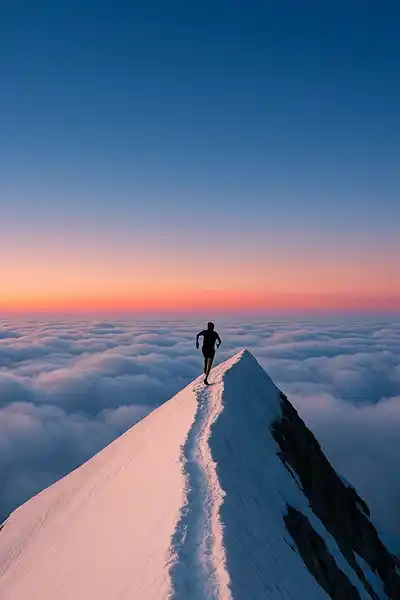
In May 2017, Kilian Jornet climbed Everest twice in under a week, without supplementary oxygen and without fixed ropes on his line, starting from the monastery at Rongbuk. On the first ascent he was slowed by a stomach bug that had him vomiting through the night as he pushed toward the summit in the dark. He reached the top, came down, rested a few days at base camp, and went back up. For a man who had spent his life turning mountains into stopwatches, it was almost a footnote — one more entry in a logbook that already held speed records on Mont Blanc, the Matterhorn, Denali, and a dozen other peaks.
Above the Clouds is his attempt to explain, from the inside, where that kind of endurance comes from and what it is actually for. Jornet grew up in a mountain refuge in the Catalan Pyrenees, learned to ski before he could read properly, and summited peaks over 3,000 meters as a small child with his parents. The book is not a highlight reel of victories. It is closer to a self-interrogation: why does he do this, what happens in the body and the mind at altitude, and what is he willing to lose for it.
The temptation with an athlete like Jornet is to file him under superhuman and move on. He resists that reading at every turn. What comes through instead is a person trying to describe a relationship with risk, effort, and the natural world honestly enough that it neither flatters him nor pretends the danger is smaller than it is.
The question we’re asking : What drives a person to spend a life running up and down the highest, most dangerous places on earth — and what does he knowingly accept in exchange?What we’ll see : How a childhood in the mountains became a method, a physiology, and finally a way of holding one's own death in view without looking away.
Table of contents
01Chapter 1 — A childhood measured in vertical meters
Jornet was raised in a refuge at Cap del Rec, high in the Cerdanya region of the Pyrenees, where his father worked as a mountain guide and refuge keeper. The mountains were not a hobby the family drove to on weekends; they were the yard, the commute, the weather that decided the day. By the time he was three he was on skis. By five or six he was summiting peaks that most adults train for. This was not pushed on him as achievement — it was simply the texture of the place he lived, and effort in the cold and the altitude registered as normal rather than exceptional.
That early immersion matters to the whole book, because it explains why Jornet talks about mountains without the awe of a visitor. He knows their moods the way we know a familiar street. He writes about learning to read snow, to sense when a slope is loaded and dangerous, to feel weather turning before the sky shows it — knowledge that came not from a course but from years of small, accumulated exposure. The mountain was never an opponent to conquer in those years; it was a home whose rules you learned or paid for.

02Chapter 2 — The engine and the discipline behind it
Behind the effortless-looking speed is a physiology that has fascinated sports scientists, and Jornet is unusually frank about the machinery. His maximal oxygen uptake — the VO2 max that measures how much oxygen the body can use under load — has been recorded among the highest ever measured, around ninety milliliters per kilogram per minute. But the book pushes back on the idea that a number explains him. Genetics gave him a large engine; everything else is what he has done with it across thousands of hours.
The training he describes is enormous in volume but deliberately varied, and it is inseparable from the terrain itself. He does not run laps on a track. He moves through the mountains for hours, up and down, in all conditions, letting the landscape set the intensity. Much of it is done at a conversational pace that builds an aerobic base most athletes never approach; the sharpness comes later, in smaller doses. What looks like natural ease is the visible surface of a metabolic system rebuilt, year after year, to burn fat efficiently and recover fast.
03Chapter 3 — Why records were never the point
Jornet holds a stack of speed records, and the book keeps insisting that they are not why he climbs. The distinction is easy to disbelieve from a man who has spent years shaving minutes off ascent times, but he argues it patiently. A record is a way of organizing an attempt, a reason to prepare seriously and commit fully. What he is actually after is a quality of experience — the total absorption of a hard line done well, the sensation of a body at the far edge of what it can do, in a place that demands everything.
This is where his philosophy of style comes in. He prizes ascents done light and fast, with minimal gear and minimal support, because that mode brings him closest to the mountain and to his own limits. Fixed ropes, oxygen, and large teams reduce uncertainty, and reducing uncertainty, for him, drains the experience of its meaning. The Everest double ascent without oxygen was not about proving toughness; it was about meeting the mountain on terms that left him exposed to it, honestly, with his own margin as the only safety net.
04Chapter 4 — Choosing the line, and living with it
The hardest thread in the book is death, and Jornet does not soften it. The mountains he loves kill people, including people he has known and admired, and he refuses to pretend that skill removes the danger. Skill lowers the odds; it does not abolish them. Avalanches, falls, weather, a single misjudged step on exposed terrain — these are not freak events at his level of the sport but present, calculated possibilities on almost every serious outing. To keep going, he has had to look at that squarely.
What emerges is not recklessness but a form of accepted risk that he has thought through as carefully as any training plan. He describes weighing conditions, turning back, choosing not to attempt something when the margins feel wrong — the discipline of the retreat as much as the push. And yet he also accepts that he has chosen a life in which one of these decisions could be his last, and that no amount of care fully closes that gap. He would rather live inside that bargain than trade it for a longer, safer, smaller existence.
05Conclusion
The image the book keeps returning to is not the summit but the movement — a body climbing through thin air, alone, at the edge of what it can sustain, fully present in the effort. The Everest ascents, the records, the extraordinary lungs and heart are the parts that make headlines, but Jornet writes them as almost incidental to the daily practice of moving well through the mountains that raised him. The clock and the fame are scaffolding around something older and quieter.
Related books