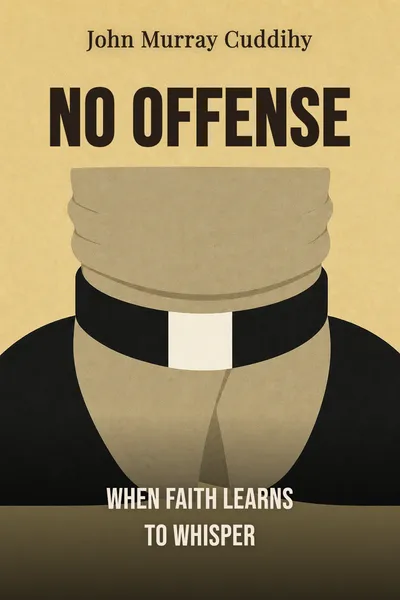
No Offense
When faith learns to whisper
Description
In 1978, a sociologist at Hunter College named John Murray Cuddihy published a slim, sharp-elbowed book called No Offense. The title was not a throwaway phrase. It was, for Cuddihy, the unwritten commandment of American public life — the rule that governs how a rabbi, a bishop, a televangelist, or a Supreme Court justice is allowed to talk about God in mixed company. You can believe almost anything in America, the country likes to say. What you cannot do is believe it out loud, at full volume, in a way that makes the person next to you wince.
Cuddihy was interested in what happens to a religion when it agrees to those terms. His earlier work had traced how Jewish thinkers absorbed the pressures of Western manners; No Offense widened the lens to the whole American religious scene — Protestant, Catholic, Jewish, and the vague civic faith that binds them. His argument was uncomfortable and deliberately so. The pressure toward good taste, toward the reasonable and the inoffensive, was not neutral. It was quietly rewriting what these traditions were permitted to claim, and doing it in the name of nothing more threatening than politeness.
That is the strange thing he set out to name. Not persecution, not secularization in the usual sense of empty pews, but something softer and harder to resist: a culture that asks faith to keep its voice down, and a faith that, more often than not, obliges. The interesting move is watching a demand for manners do the work that no law could.
The question we’re asking : What does a religion give up when it agrees never to give offense?What we’ll see : How American civility became a discipline that faith traditions learned to impose on themselves.
Table of contents
01 Chapter 1 — The rule nobody signed
Cuddihy starts from an observation anyone who has sat through an interfaith service will recognize. In public, American religions have agreed to behave. The Catholic does not tell the Protestant that his church is defective. The Protestant does not tell the Jew that he has missed the messiah. The Jew does not press the point that the whole Christian scheme rests on a mistake. Everyone smiles, everyone speaks warmly of shared values, and the specific, load-bearing claims that make each tradition itself are left politely at the door.
This truce, Cuddihy argues, is not written into any doctrine. No creed says thou shalt not embarrass thy neighbor. It comes instead from the surrounding culture — from the demands of a pluralistic society that has to house dozens of incompatible faiths on the same street without violence. The mechanism that keeps the peace is not tolerance in the philosophical sense. It is taste. The believer who insists too hard on the truth of his own tradition commits a social offense long before he commits an intellectual one. He has been rude.

02 Chapter 2 — Taste as a social discipline
The genius of the arrangement, in Cuddihy's telling, is that it never announces itself as coercion. Nobody is jailed for bad taste. There is no inquisition into a preacher's manners. Instead the sanction is embarrassment — the flush of shame that arrives when you realize you have said something that marks you as crude, tribal, unenlightened. Cuddihy treats this shame as a genuinely powerful force, more effective than any statute, because it works from the inside. The believer polices himself.
He leans on the sociology of manners to make the case. A society of strangers needs some way to make interaction predictable and safe, and manners are that technology. They tell you how close to stand, when to lower your voice, which subjects to avoid at dinner. Religion, in a pluralistic society, gets folded into the same etiquette. The particular truth-claims of a faith are reclassified from serious business into potential faux pas, the conversational equivalent of asking someone's salary. You simply do not do it.
03 Chapter 3 — The theology of the polite
The heart of the book is the claim that this pressure does not stay outside the tradition, tugging at its public manners while leaving the core intact. It seeps in. A religion that has spent generations muting its offensive claims begins, Cuddihy argues, to revise the claims themselves. The whisper becomes the theology. What started as a concession to the neighbors turns into a conviction about what the faith really, deep down, always meant.
He watches this happen across the major American traditions. Liberal Protestantism becomes ever more comfortable framing itself as one expression of a universal human longing, its specific doctrines softening into metaphor. Post-conciliar Catholicism, opening itself to the modern world, learns to speak of other faiths as partners rather than as errors. Reform and much of American Judaism, having entered the mainstream, reframe chosenness and covenant in terms designed to give no umbrage to the Christian majority. In each case the sharp edges are sanded down, and the sanding is celebrated as spiritual progress.
04 Chapter 4 — When religion learns to blush
Step back from the specific denominations and Cuddihy is describing the terms on which a faith is admitted to full American citizenship. The country does not demand that you abandon your religion. It asks something subtler: that you make it presentable. The immigrant creed, like the immigrant himself, is welcomed on the condition that it dress appropriately, lower its voice, and refrain from insisting that its way is the only way. Assimilation, in this reading, is not just something that happens to people. It happens to their gods.
What gives the argument its bite is the question of who sets the standard. Manners always encode a class and a history. The template of American civility, Cuddihy suggests, is essentially a genteel Protestant one, later generalized and secularized — the tone of the mainline, the reasonable, the well-bred. When other traditions are asked to become inoffensive, they are being asked, quietly, to conform to that particular sense of good taste. The faith that seems most naturally civil is not the most tolerant one. It is the one whose accent already matches the room.
05 Conclusion
Cuddihy came to the subject as a scholar of how modernity trains its converts in manners, and No Offense is the point where he turns that lens on the whole American religious settlement. The book does not end with a verdict, because its author does not think there is a clean one to reach. A faith that learns to whisper has kept the peace and lost some of its nerve, and Cuddihy declines to tell us which matters more.
Related books