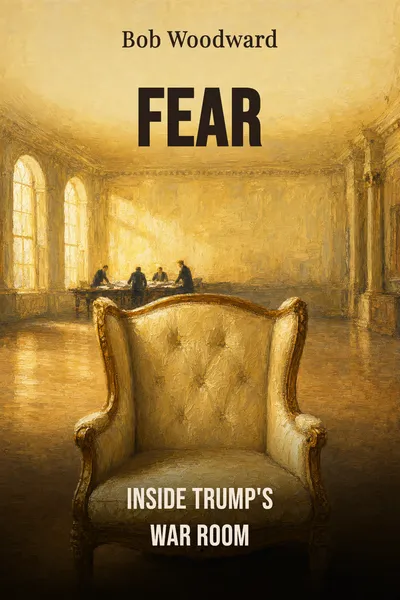
Fear
Inside Trump's war room
Description
In September 2017, a one-page letter sat on the Resolute Desk in the Oval Office. It was a draft notice withdrawing the United States from its free-trade agreement with South Korea, and President Donald Trump was ready to sign it. Gary Cohn, his chief economic adviser and a former Goldman Sachs president, watched the document, walked over, and quietly removed it. Trump, distracted by the day's churn, never mentioned it again. According to Bob Woodward's reporting, this was not a one-time act of sabotage but a recurring method: senior staff physically taking papers off the desk so a decision they considered catastrophic could not be made.
Woodward, the reporter who broke Watergate alongside Carl Bernstein and who has now chronicled nine presidencies, built his 2018 book Fear from hundreds of hours of interviews with firsthand sources, from meeting notes, diaries, files, and internal documents. The picture that emerges is not a partisan verdict. It is something closer to an operating manual gone wrong: a portrait of how decisions on trade, war, and national security actually got made inside the Trump White House during its first eighteen months, and of the people who spent their days trying to steer, delay, or quietly block them.
What makes the account unsettling is not any single revelation. It is the accumulation of scenes in which the formal machinery of government — the National Security Council process, the chain of command, the briefing cycle — kept running while a parallel, improvised system ran underneath it, staffed by aides who had concluded that part of their job was to protect the country from the man they served.
The question we’re asking : How were the most consequential decisions actually made inside Trump's White House, and who was really steering them?What we’ll see : An insider's account of the improvised system that grew up around a president who governed by instinct — and what kept it running.
Table of contents
01 Chapter 1 — The paper that vanished from the desk
The Korea letter was not an isolated episode. Woodward reports that Cohn, and later staff secretary Rob Porter, developed a shared practice of slowing or intercepting documents they believed Trump might sign on impulse. When the president wanted to pull the United States out of the North American Free Trade Agreement, or to withdraw troops from the Korean peninsula, papers went missing from the desk or were simply never brought forward. The bet was that Trump's attention would move on before the decision hardened into an order.
This was, on its face, an extraordinary thing for civil servants and appointees to do. Cohn described it, in Woodward's account, as protecting the country. Others might call it something less flattering. The book does not resolve the tension, and that refusal is part of its method: Woodward lays out the scene, names the actors, and lets the reader sit with the fact that the removal of a single sheet of paper had become a tool of foreign policy.

02 Chapter 2 — A staff that learned to manage upward
The people around Trump in Woodward's telling are not caricatures. They are, for the most part, serious operators who took their jobs believing they could impose order on the West Wing. Reince Priebus, the first chief of staff, compared the place to a snake pit and said the natural predators would eventually eat each other. H.R. McMaster, the national security adviser, tried to run a disciplined interagency process and found himself worn down by a president who preferred to make calls off the cuff, often after watching cable news.
Woodward shows how each of them developed private techniques for managing upward. Some learned when to bring an issue to the president and when to let it wait. Some learned to frame options so that the choice they favored looked like the president's own idea. Defense Secretary Jim Mattis, a retired Marine general, would slow-walk directives he found dangerous and quietly reinterpret others, betting that careful execution could blunt the sharpest instincts coming from the Oval Office.
03 Chapter 3 — The room where the world gets decided
The most tense passages in Fear take place where the stakes are highest: the Situation Room, Air Force One, the residence late at night. Here the subject is not trade tariffs but war — North Korea's missile tests, the question of a preemptive strike, the movement of forces on the peninsula. Woodward reconstructs meetings in which military and intelligence officials tried to convey how catastrophic a miscalculation could be, and a president who oscillated between belligerence and a genuine desire to make a deal.
The North Korea material is where the book's method pays off. Woodward has the meeting notes, the readouts, the recollections of people who were present. He shows Mattis quietly moving to reassure allies, staying up to track missile launches, praying, by his own account, that a test would not be misread as an attack. He shows the intelligence community briefing scenarios in which a conflict on the peninsula could kill hundreds of thousands within days. The gap between that gravity and the president's public taunts is the engine of the chapter.
04 Chapter 4 — The word Trump gave Woodward
The book takes its title from Trump himself. In a 2016 interview, he told Woodward and a colleague that real power is fear. It is a line Woodward returns to as an organizing principle, because it names the logic he found running through the White House. Fear was not incidental to this presidency in Woodward's reading; it was the currency. Fear of the president's temper, of a hostile tweet, of sudden dismissal, shaped how staff spoke to him and to one another, and it shaped how the wider world calculated what he might do.
Step back from the individual scenes and the book becomes an argument about what happens to institutions when process is replaced by instinct. The postwar American system was built on the premise that expertise, deliberation, and stable procedure would constrain any single person's impulses. Woodward's account is of that premise under strain — of a government that kept functioning largely because career officials and appointees improvised a shadow discipline the formal system no longer supplied.
05 Conclusion
The letter Cohn lifted off the desk never became policy, and the reader is left to notice how much rode on a gesture that small. Woodward closes not with a verdict but with the accumulated weight of the scenes: a presidency in which the most consequential outcomes often turned on whether an adviser chose to bring a document forward, slow it down, or make it disappear. The formal government kept its shape while an informal one did much of the steering.
Related books