
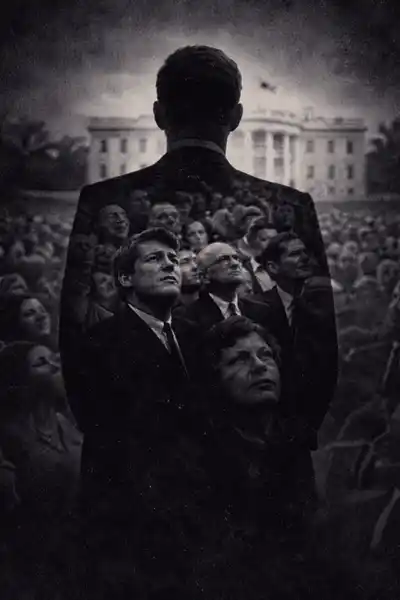
The Kennedy Assassination, Part 2
Oswald and the official account
Description
On the afternoon of November 22, 1963, a Dallas police officer walked into the Texas Theatre on West Jefferson Boulevard, where a matinee of War Is Hell was playing, and arrested a twenty-four-year-old warehouse clerk named Lee Harvey Oswald. Roughly ninety minutes earlier, President John F. Kennedy had been shot from behind while riding in an open motorcade through Dealey Plaza. A Dallas patrolman, J. D. Tippit, had been shot dead in a residential neighborhood not long after. By nightfall Oswald sat in a police interrogation room, having been charged first with killing Tippit and then, near midnight, with killing the President.
He never stood trial. Two days later, as Dallas police moved him through the basement of their headquarters on the way to a county jail, a nightclub owner named Jack Ruby stepped forward and shot Oswald in front of live television cameras. The only person the state had charged with the murder of a sitting President was himself dead within forty-eight hours, and the case that would normally have been argued in a courtroom, with a defense, would now be settled somewhere else entirely.
Where it was settled was a federal commission, appointed within a week and chaired by the Chief Justice of the United States. Its job was to establish what had happened and to say so plainly enough that a shaken country would believe it. Ten months later it delivered an answer: Oswald acted alone, and so did Ruby. That answer became the official account of the century's most examined killing — and the object of more sustained doubt than perhaps any government document in American history.
The question we’re asking : What did the official investigation actually conclude about Oswald, and how did it reach that conclusion?What we’ll see : How a commission built to reassure a nation assembled its case against one man, and where its own method left the door open.
Table of contents
01 Chapter 1 — The man arrested in a movie theater
Lee Harvey Oswald was not a stranger to the authorities before that afternoon. Born in New Orleans in 1939, he had joined the Marines, trained as a radar operator, and qualified as a marksman. In 1959 he did something almost no American did at the height of the Cold War: he defected to the Soviet Union, renouncing his citizenship at the U.S. embassy in Moscow. He lived in Minsk, married a Russian woman named Marina, and then, disillusioned, returned to the United States in 1962 with his wife and infant daughter. The FBI knew who he was and had interviewed him more than once.
By the fall of 1963 he was living apart from Marina, drifting between jobs, and — in October — had started work at the Texas School Book Depository, the tall brick building on the northwest corner of Dealey Plaza. The motorcade route, published in the Dallas papers days ahead, ran directly beneath its windows. Oswald had access to the sixth floor, where boxes of textbooks were stored and where investigators would later find a sniper's nest of stacked cartons by a corner window.

02 Chapter 2 — Ninety-six minutes, one afternoon
The killing itself was a matter of seconds. Kennedy's limousine turned off Houston Street onto Elm at around 12:30 in the afternoon, slowing as it did so, and passed below the depository. Amateur film, most famously the twenty-six seconds shot by a local dressmaker named Abraham Zapruder, captured the sequence in silent color. The President raised his hands toward his throat, then, moments later, was struck in the head. Governor John Connally, riding in front of him, was also wounded. The car accelerated toward Parkland Memorial Hospital, where Kennedy was pronounced dead at one o'clock.
The official investigation had to reconstruct those seconds from fragments: the film, the wounds documented at autopsy, the cartridge cases, the trajectory lines, and the recollections of hundreds of witnesses scattered across the plaza, many of whom heard three shots and several of whom disagreed about where they came from. The Commission concluded that three shots were fired from the sixth-floor window, that one missed, and that the other two accounted for all the wounds to both men.
03 Chapter 3 — The single bullet and the closed case
The Warren Commission was formally the President's Commission on the Assassination of President Kennedy, created by Lyndon Johnson on November 29, 1963, and chaired by Chief Justice Earl Warren. Its members included two senators, two congressmen, a former CIA director in Allen Dulles, and the banker John McCloy. It heard testimony from more than five hundred witnesses and, in September 1964, published an 888-page report backed by twenty-six volumes of supporting material. Its two central conclusions were stark: Oswald fired all the shots and acted alone, and Ruby also acted alone.
Holding the timeline together required one particular piece of reasoning, and it became the report's most contested single claim. If three shots were fired and one missed, then two bullets had to account for seven separate wounds across Kennedy and Connally. That forced the Commission to argue that a single bullet had passed through Kennedy's neck and gone on to wound Connally in the back, chest, wrist, and thigh. The bullet in question was recovered in near-pristine condition on a stretcher at Parkland, which struck many observers as difficult to square with the damage it was said to have done.
04 Chapter 4 — What a rushed report leaves undone
The Warren Commission was built at least as much to settle a country as to investigate a crime, and the two purposes pulled against each other. Johnson wanted an authoritative finding fast, partly to head off the fear — real in late 1963 — that the assassination might be pinned on Cuba or the Soviet Union and drag the nation toward war. Speed and reassurance were features of the mandate, not accidents of it. A body assembled to produce confidence within a year is not the same instrument as one designed to follow every thread wherever it leads.
That shaped the method in ways later reviewers would flag. The Commission leaned heavily on the FBI and CIA for its evidence, agencies that were themselves subjects of legitimate questions and that, it later emerged, had withheld material — including the full extent of their prior knowledge of Oswald. The autopsy was conducted hastily and by pathologists with little experience of gunshot wounds, leaving the physical record thinner than a case of this magnitude deserved. Testimony was collected, but leads that pointed outward were not always pursued with the same energy as those that pointed at one man.
05 Conclusion
The man arrested in the Texas Theatre never got to answer the charge, and that absence has shadowed everything since. The Warren Commission stepped into the space a trial would have occupied and did the work a courtroom does — assembling evidence, weighing testimony, reaching a verdict — but without the adversary who would have tested every claim in front of a jury. Its conclusion, that Oswald acted alone with a mail-order rifle from a sixth-floor window, remains the best-supported account of what happened in Dealey Plaza, and no rival version has ever matched it for evidence.