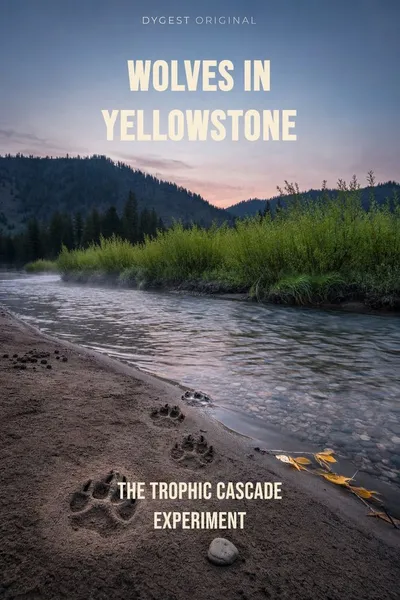
Wolves in Yellowstone
The trophic cascade experiment
Description
In January 1995, fourteen gray wolves were trapped in Jasper National Park in western Canada, transported across the international border, and released into the northern range of Yellowstone National Park in northwestern Wyoming. The animals were the first members of their species to inhabit the park in sixty-nine years. The last resident wolves had been killed in 1926 as part of the systematic predator-eradication program that the United States National Park Service had conducted across the 1910s and 1920s, motivated by what was then understood as good ecosystem management. The decision to reintroduce them, made by the Fish and Wildlife Service after a decade of policy planning and substantial political contestation, was one of the more substantial deliberate ecological interventions of the twentieth century. The seventeen additional wolves released in early 1996 brought the total founder population to thirty-one animals. The population grew rapidly across the subsequent two decades, reaching approximately one hundred wolves by 2010 and stabilizing around that number across the subsequent fifteen years.
The ecological consequences of the reintroduction have become one of the more discussed cases in modern conservation science. The conventional account, which has been substantially popularized through documentary films, TED talks, and a viral 2013 video narrated by the British writer George Monbiot, has held that the reintroduction triggered what ecologists call a trophic cascade — a sequence of effects propagating downward through the food chain from the apex predator to lower trophic levels. The wolves, in this account, reduced the elk population that had been overgrazing the park’s vegetation, which allowed willow and aspen to recover along streams, which produced habitat for beavers, which created wetlands that supported amphibians and birds, which reshaped the geomorphology of rivers as the recovering riparian vegetation stabilized stream banks. The story has been one of the most widely shared narratives in contemporary conservation, with the rivers actually changing course in response to the return of a single predator becoming the central memorable image.
The empirical reality of these effects has been more complicated than the popular narrative has suggested. Subsequent ecological research has substantially supported some of the cascade effects, partially supported others, and substantially contested the most dramatic claims about river geomorphology. The case has become one of the standard examples in conservation science of how ecological narratives can substantially outpace the underlying empirical evidence, and of how the public reception of conservation findings shapes what gets remembered and amplified about complex ecological systems.
The question we’re asking: what did the wolf reintroduction actually produce, where does the popular trophic cascade narrative depart from the evidence, and what does the case reveal about how ecological science communicates with the public?
What we’ll see: the eradication history and the reintroduction decision, the documented cascade effects, the contested geomorphology claims, and what survives.
Table of contents
01Eradication and reintroduction
The American program of wolf eradication had been substantial. Across the late nineteenth and early twentieth centuries, the federal government, state agencies, and individual ranchers conducted systematic predator control programs that reduced the wolf population of the contiguous United States from several hundred thousand animals to fewer than one thousand by the 1930s. The Yellowstone wolves had been killed off as part of a federal predator-control program conducted in cooperation with the U.S. Biological Survey across the 1910s and 1920s. The last documented Yellowstone wolves were killed in 1926.
The ecological consequences of the eradication had become apparent across the subsequent decades. The elk population of Yellowstone, freed from substantial predation pressure, had grown to levels that produced visible overgrazing of the park’s vegetation. The willow and aspen along streams had been substantially reduced. The beaver population, which depended on willow as a food source, had declined to near-extinction within the park. The park managers had attempted to manage the elk population through culling programs across the 1950s and 1960s, but the culling was politically controversial and was discontinued in 1968. The elk population grew further across the 1970s and 1980s, reaching approximately 20,000 animals by the early 1990s, with continued visible impacts on park vegetation.

02The trophic cascade research
The ecological effects of the reintroduction began to be documented systematically from the late 1990s. The Yellowstone Wolf Project, led by the wildlife biologist Doug Smith, collected data on wolf-prey interactions, pack dynamics, and population trajectories. The elk population began to decline in the late 1990s, with the population reaching a low of approximately 4,000 animals by 2013 — a reduction of roughly 80 percent from the pre-reintroduction peak. The decline was substantially attributable to wolf predation, with additional contributions from drought, harsh winters, and the recovery of grizzly bear and cougar populations across the same period.
The documented effects on vegetation have been substantial. The willow communities along Yellowstone’s streams have shown measurable recovery across the period since the reintroduction, with stem heights and density increasing in the areas with the most concentrated wolf activity. The aspen recovery has been more variable, with some areas showing substantial regeneration and others showing little change. The 2010 study by William Ripple and Robert Beschta at Oregon State University, which has been one of the most-cited studies of the cascade, documented these vegetation changes and argued that they were substantially attributable to wolf predation on elk and to the behavioral changes in elk that the presence of wolves produced.
03The contested geomorphology claims
The most dramatic claim in the popular narrative — that the wolves changed the courses of Yellowstone’s rivers — has been substantially contested in the subsequent scientific literature. The original Ripple and Beschta papers argued that the recovering willow and aspen vegetation along streams stabilized the banks, reduced erosion, and produced measurable changes in channel geomorphology. The 2013 Monbiot video amplified this claim, with the river-course-changing framing becoming the central memorable element of the popular narrative.
The geomorphology claims have been substantially challenged by subsequent research. The 2018 study by Daniel Marshall and colleagues at Colorado State University, published in Ecological Monographs, examined stream channel data across the post-reintroduction period and found that the documented changes in channel geomorphology were substantially smaller than the popular narrative had implied and were attributable to multiple factors including climate variability and beaver activity that operated independently of the wolf cascade. The 2019 review by Arthur Middleton and colleagues at UC Berkeley found that the empirical evidence for the most dramatic cascade claims was weaker than the popular accounts had suggested, and that the actual ecological effects, while real and substantial, were more modest and more variable than the popular narrative implied.
04What survives, and what the case shows
he Yellowstone wolf population has continued to operate as one of the most-studied wild wolf populations in the world. The ecological effects continue to be documented and analyzed across an increasingly long time series. The conservation success — the recovery of a functionally extinct predator population in one of the most heavily visited national parks in the United States — has continued to be one of the more substantial accomplishments of American wildlife management in the past century.
The deeper lesson the case offers is about how ecological narratives operate in the public sphere. The trophic cascade framework has been one of the most communicatively effective concepts in modern conservation. The narrative arc — apex predator returns, ecosystem heals — has been substantially more compelling to general audiences than the alternative scientific framing of complex ecosystems with multiple interacting factors. The communicative effectiveness has produced substantial public support for wolf reintroduction and broader predator-conservation initiatives, but it has also produced expectations that the actual ecological evidence cannot fully support.
05Conclusion
The Yellowstone wolves continue to operate as the functional apex predator of the park ecosystem. The annual wolf census has been conducted continuously since the reintroduction, with the most recent count of approximately 105 wolves in the northern range and broader greater Yellowstone area. The research program continues to produce papers and to refine the understanding of what the reintroduction has actually produced.
Related books