Wittgenstein’s Tractatus
The book that asked to be thrown away
Description
In 1921, a small Austrian philosophical journal called Annalen der Naturphilosophie published a seventy-five-page text by a thirty-two-year-old Austrian philosopher named Ludwig Wittgenstein. The text was titled Logisch-Philosophische Abhandlung, and it had been written, in significant part, in the trenches of the Italian front of the First World War. Wittgenstein had been an artillery officer in the Austro-Hungarian army from 1914 to 1918, had been captured by Italian forces near the end of the war, and had spent his captivity in a prison camp near Cassino working on the final draft of the manuscript. The book was published in English translation a year later as Tractatus Logico-Philosophicus, with a preface by Bertrand Russell, and would become one of the most ambitious philosophical projects of the twentieth century.
The book had an unusual structure. It was organized as a series of numbered propositions arranged hierarchically — proposition 1 followed by 1.1, 1.11, 1.12, then proposition 2, and so on — with seven main propositions structuring the whole. The form was meant to enact the argument; Wittgenstein believed that philosophy had been deformed by being conducted in ordinary expository prose, and that a properly logical philosophy required a properly logical form. The seven main propositions ran from “The world is everything that is the case” through to “Whereof one cannot speak, thereof one must be silent.” Between these, in nested propositions, Wittgenstein developed a comprehensive theory of language, thought, and reality, and arrived at the conclusion that most of what philosophers had spent their careers discussing was, strictly speaking, nonsense.
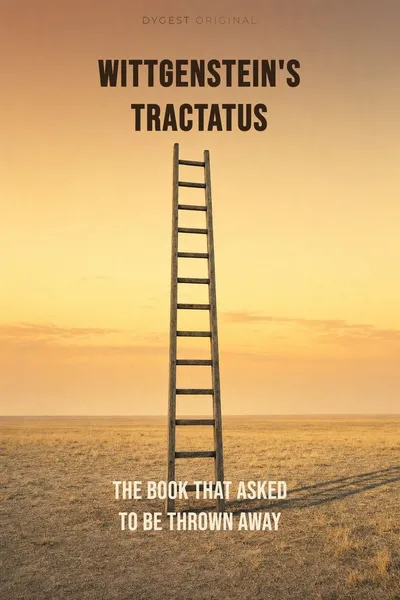
The book’s most famous claim, made near the end of the text, was that the propositions of the Tractatus itself were nonsensical in the same way as the propositions of traditional philosophy, and that the reader who had understood the book should recognize this and throw the book away. The metaphor Wittgenstein used was that of a ladder: the book had served as a ladder that the reader could climb to reach a certain understanding, but having reached the top, the reader had to kick the ladder away. The book that contained the philosophy was also, by its own argument, a piece of the philosophy it was rejecting. The paradox has remained one of the most discussed features of the work for over a century.
The question we’re asking: what did Wittgenstein actually argue in the Tractatus, what did he mean by asking readers to throw the book away, and how has the work aged after a hundred years?
What we’ll see: the philosopher and the war, the structure of the argument, the famous final injunction, and the legacy.
Table of contents
01 A Viennese engineer becomes a philosopher
Ludwig Wittgenstein had been born in 1889 into one of the wealthiest families in the Austro-Hungarian Empire. His father, Karl Wittgenstein, was a steel magnate whose fortune was comparable to Andrew Carnegie’s. The household was a center of Viennese intellectual life; Mahler, Brahms, and Klimt were regular guests. Ludwig was the youngest of eight children. Three of his brothers committed suicide.
He had initially trained as an aeronautical engineer, studying in Berlin and at Manchester, where he worked on propeller design for early aircraft. The engineering led him into mathematical foundations, which led him into mathematical logic. By 1911 he had abandoned engineering, traveled to Cambridge, and arrived unannounced at Bertrand Russell’s office. Within a few months, Russell had concluded that Wittgenstein was, as he later wrote, “perhaps the most perfect example I have ever known of genius as traditionally conceived: passionate, profound, intense, and dominating.”

02 The picture theory of language
The central philosophical argument of the Tractatus is what Wittgenstein called the picture theory of language. The argument is that a meaningful proposition is a picture of a possible state of affairs in the world. The proposition has the same logical structure as the state of affairs it represents; the elements of the proposition correspond to the elements of the state, and the configuration of the elements in the proposition corresponds to the configuration of the elements in the world. The proposition is true if the state of affairs it pictures actually obtains. It is false if the state of affairs it pictures does not obtain. But in either case, the proposition is meaningful only if there is a possible state of affairs it could be picturing.
The argument has substantial consequences for what kinds of propositions can be meaningful. The propositions of natural science describe possible states of affairs and are therefore meaningful they are either true or false, depending on how the world actually is. The propositions of mathematics and logic are tautologies that do not picture any particular state of affairs; they are meaningful in a different way, as forms that any meaningful proposition must respect. The propositions of ethics, aesthetics, and metaphysics are not pictures of possible states of affairs at all. They are attempts to speak about what cannot be pictured about values, about meaning, about the transcendent. On Wittgenstein’s analysis, such propositions are not meaningful in the strict sense; they are, technically, nonsense.
03 The ladder and what came after
The famous penultimate proposition of the Tractatus is 6.54: “My propositions serve as elucidations in the following way: anyone who understands me eventually recognizes them as nonsensical, when he has used them — as steps — to climb beyond them. He must, so to speak, throw away the ladder after he has climbed up it.” The book itself falls under the same analysis as the traditional philosophy it criticizes. The Tractatus is also nonsense, in the technical sense, because it is itself attempting to say what cannot be said.
The implication is that the book is a kind of self-consuming text. It serves to bring the reader to a particular understanding, but having brought the reader there, it ought to be discarded. The reader who has understood the Tractatus should recognize that the propositions of the Tractatus are themselves not propositions in the strict sense, and should therefore be silent about them silent about everything the book has been doing. The book ends with the proposition that has become one of the most quoted in twentieth-century philosophy: “Whereof one cannot speak, thereof one must be silent.”
04 The return, the second philosophy, and the legacy
Wittgenstein returned to Cambridge in 1929 with a doctoral thesis: the Tractatus itself. G.E. Moore and Russell, who examined him, found themselves officially examining a candidate whose thesis they had been studying as a major work of philosophy for nearly a decade. The thesis was approved. Wittgenstein took up a fellowship at Trinity College and began the work that would develop into a substantial revision of the Tractatus position.
The later work, published posthumously as Philosophical Investigations in 1953, argued that the picture theory of language was wrong. Language, in the mature Wittgenstein’s framing, is not a uniform system that can be analyzed as a calculus. It is a heterogeneous collection of what he called language games practices, embedded in forms of life, with their own rules and purposes. The meaning of a word is, in the famous formulation, its use in the language. The whole Tractatus framework turned out to be one of the confusions the older Wittgenstein wanted to dissolve.
05 Conclusion
Ludwig Wittgenstein died in Cambridge in 1951, two days after his sixty-second birthday. His last reported words were “Tell them I’ve had a wonderful life.” The Philosophical Investigations, published two years later, would join the Tractatus in the philosophical canon.
Related books