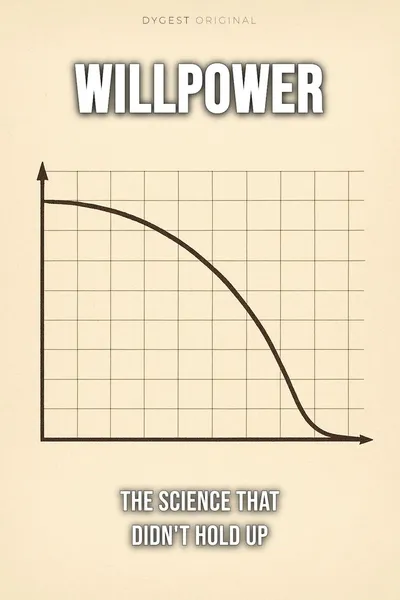
Willpower
The science that didn't hold up
Description
For about fifteen years, from roughly 1998 to 2015, psychologists believed they had figured out how willpower
worked. The theory was elegant, the experimental evidence looked solid, and the popular-science translation
was a bestseller. The idea was that willpower functions like a muscle it tires with use, it can be depleted, and
it runs on glucose. You could measure it in the lab, you could predict failures of self-control from prior tasks
that had drained the reserve, and you could even, according to some of the research, restore it by drinking
lemonade. A generation of self-help books built their framework around this idea.
The theory was called ego depletion, and it turned out to be largely wrong. Starting in 2016, a series of high-
powered replication attempts failed to find the effects the original studies had reported. A large-scale
preregistered multi-lab study published in 2016 found essentially no evidence of ego depletion. Subsequent
meta-analyses, once corrected for publication bias, found the effect shrinking toward zero. The muscle
metaphor, and the glucose hypothesis in particular, have not survived the scrutiny of the last decade. This is one
of the clearest cases of a seemingly settled psychological finding that collapsed under better methods.
What makes the story worth telling is not just that a piece of science went wrong. It is that the underlying
question what is willpower, why do some people have more of it, and how does it actually work in everyday
life is still worth answering, and the answers that have survived the replication crisis look different from the
ones that were popular in 2010. The cleanup is in progress, and the contemporary picture of self-control is more
nuanced, more context-dependent, and more aligned with what the habit-formation research has been saying for
decades.
● The question we're asking: if ego depletion didn't hold up, what actually explains the difference
between people who follow through and people who don't?
● What we'll see: the folk theory of willpower, the rise and fall of the glucose model, and what the
contemporary science actually shows.
Table of contents
01The folk theory
Willpower in the folk sense is a moral category before it is a psychological one. For most of Western intellectual history, the capacity to resist temptation and pursue a long-term good over a short-term pleasure was treated as a virtue, a sign of good character, and, in many religious traditions, evidence of spiritual formation. The Stoics wrote about it. Medieval Christian theology organized its vision of the soul around it. Enlightenment moralists turned it into a universal measure of human worth. You were a better person, in this tradition, because you could want the right things more than you wanted the wrong ones.
This moral framework survived the nineteenth-century transition into psychology remarkably well. William James's account of habit and volition in 1890 still treated the will as a thing you could strengthen through practice, weaken through neglect, and hold responsible for most of the variation in human outcomes. The Victorian popularization of the idea self-help books of the 1870s and 1880s, the character-building tradition that produced figures like Samuel Smiles framed willpower as the master key to success, health, and moral seriousness. This framing is still present in most contemporary self-help, often unchanged in its assumptions.

02The rise of ego depletion
Roy Baumeister, then at Case Western Reserve, published what became the foundational ego-depletion paper in 1998. The experimental design was memorable. Undergraduates were led, one at a time, into a room smelling of freshly baked cookies. Half were allowed to eat the cookies. Half were asked to ignore the cookies and eat radishes instead. Both groups were then given an unsolvable geometry puzzle. The radish group gave up significantly faster. Baumeister's interpretation: resisting the cookies had depleted a finite resource, and the puzzle task was drawing on the same depleted resource.
The model was extended through hundreds of studies over the next fifteen years. Resisting emotion, making difficult decisions, suppressing stereotypical thoughts all of these were shown, in the published literature, to deplete the self-control resource and make subsequent tasks harder. Baumeister and science journalist John Tierney published a popular book in 2011, Willpower, that synthesized the research into a commercially successful framework. The book became one of the defining popular-psychology titles of the early 2010s, and the ego-depletion paradigm dominated self-control research in academic psychology.
03The replication crisis
In 2016, the Association for Psychological Science ran a preregistered multi-lab replication of one of the canonical ego-depletion paradigms. Twenty-three labs, using a standardized protocol worked out in advance with Baumeister himself, ran the study with roughly 2,100 participants. The effect size they found was essentially zero. The result was a serious blow to the field. Baumeister responded that the replication had used a different version of the task than his original work. The critics pointed out that the original work had reported effects across many variants of the task, with the original authors claiming the paradigm was robust. The retrospective goalpost moving did not land well.
Further meta-analyses, using increasingly sophisticated methods to correct for publication bias, found the ego-depletion effect shrinking toward negligible size. The glucose-specifically studies have fared even worse. The connection between blood sugar and self-control, if it exists, is much weaker than the original claims suggested, and several direct replication attempts have found no effect at all. The muscle metaphor, as an empirical claim about how willpower works, has been effectively abandoned by the research mainstream.
04What we actually know
The current picture of self-control is less elegant than the muscle metaphor but more accurate. The capacity to delay gratification and pursue long-term goals is partly a trait the marshmallow-test correlation with later outcomes is real, even if smaller than originally claimed and partly a skill. People who look like they have exceptional self-control are, on close inspection, usually people who have arranged their environment so they do not have to exercise self-control very often. The high-discipline dieter does not heroically resist ice cream every night. They do not keep ice cream in the house. The productivity-famous executive has a calendar assistant, a phone-off policy, and twenty years of institutional infrastructure that routes temptation away from them.
Angela Duckworth's work on grit, which became influential in the mid-2010s, suggested that sustained pursuit of long-term goals was itself a trait worth measuring. The research has held up better than ego depletion, though subsequent studies have shown that grit overlaps substantially with conscientiousness, one of the Big Five personality dimensions psychology has been measuring since the 1980s. The practical implication is that some of what we call willpower is captured by a stable personality trait, heritable to a significant degree, visible in childhood, and not easily trained up through motivational exercises.
05Conclusion
Willpower is worth discussing, even after the science has been reorganized, because the concept still governs how most people think about personal change. If you believe self-control is a moral quality you either have or lack, every failure to follow through is a failure of character, and the rational response to repeated failure is guilt. If you believe self-control is an environmental-design problem, every failure is evidence that the setup is wrong, and the rational response is to redesign. The two framings produce very different behavior. The second one is more supported by the evidence and much more useful in practice.
Related books