Trade Unions
Collective bargaining, then and now
Description
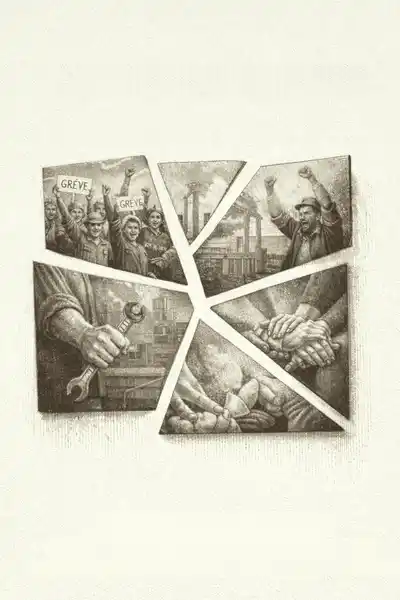
On February 11, 1937, the workers occupying General Motors' Fisher Body plants in Flint, Michigan, walked out having won something almost nobody thought they'd get. For forty-four days they had sat inside the factories, sleeping on car seats, refusing to leave, refusing to let the machines run without them. GM had cut power, brought in police, tried to starve them out. It didn't work. When the company finally signed, it recognized the United Auto Workers as the bargaining agent for its employees. Within a few years, an autoworker's wages could support a house, a car, and children who'd go further than their parents.
That scene — bodies between capital and its machines — is roughly the founding image of the modern union. For a few decades it looked permanent. In the early 1950s, around a third of American workers carried a union card; in some European countries the figure ran higher still. The contract they bargained collectively set the terms not just for members but, by pressure and precedent, for whole industries. Then, slowly and then quickly, the whole edifice began to shrink. Today private-sector union density in the United States sits near six percent, and the picture across much of the rich world tells a milder version of the same story.
So we have an institution that once felt like weather — always there, shaping everything — and now feels, to many workers, like something their grandparents did. The wages, the weekend, the eight-hour day didn't fall out of the sky; a lot of them were bargained for, sometimes bloodily. Which raises the obvious question of what exactly went missing when the unions thinned, and whether the thing they were built to fix went with them.
The question we’re asking : What did collective bargaining actually give workers, and what happened when it faded?What we’ll see : How a union turns individual weakness into leverage, why that leverage eroded, and where the impulse to organize is turning up in unfamiliar shapes.
Table of contents
01Chapter 1 — The bargain that built the middle class
The logic of a union is almost embarrassingly simple. One worker asking for a raise is easy to refuse, and easier to fire. A thousand workers asking together, with the credible threat of stopping the work, are a different proposition. The union converts a crowd of individuals — each replaceable — into a single party the employer has to deal with. That's collective bargaining: not charity, not politics in the abstract, but a negotiation between two sides that each hold something the other needs.
For most of the nineteenth century, the law treated such combinations with suspicion, sometimes as criminal conspiracies to restrain trade. Workers organized anyway, often at real cost. The turning point in the United States was the Wagner Act of 1935, which gave private-sector workers the legal right to organize, to bargain collectively, and to strike, and set up a board to police the process. Across the Atlantic, similar recognitions had come earlier and by different routes, but the shape was comparable: the state stopped treating a union as a threat to commerce and started treating it as a party to it.

02Chapter 2 — How a contract actually gets made
Strip away the mythology and a collective agreement is a document, hammered out across a table, that governs the daily life of a workplace. Getting there is a process with fairly fixed steps, and understanding those steps explains a lot about where unions gained and lost their grip. It starts with recognition: the workers have to establish that the union speaks for them, usually through some form of vote or membership threshold. Only then is the employer legally obliged to sit down.
Then comes the bargaining itself, which is less dramatic than the strikes that occasionally punctuate it. Both sides table demands — on pay, hours, safety, job classifications, how discipline works, who gets laid off first. Most of it is settled by ordinary give-and-take. The strike, or the threat of one, is the pressure valve behind the talk: it's what gives the workers' side weight, because it imposes a cost on the employer for saying no. A union that can't credibly stop the work is a union negotiating with an empty hand.
03Chapter 3 — The long thinning-out
The decline wasn't a single event, and it doesn't have a single culprit. Start with what the union movement was built on: large concentrations of workers doing similar jobs in the same place, in industries like steel, autos, mining, and shipping. That physical fact — thousands of people under one roof — made organizing feasible and a strike devastating. As those industries shrank, automated, or moved to lower-wage regions and countries, the ground the movement stood on literally eroded. You cannot occupy a factory that has closed.
Globalization sharpened the squeeze. When an employer could plausibly relocate production abroad, the strike threat lost some of its bite; the workers' leverage depended on the work having to happen here, and increasingly it didn't. Meanwhile the growth in the economy came in services, in scattered workplaces, in smaller firms and part-time and franchised arrangements that were far harder to organize than a single vast plant.
04Chapter 4 — When the workplace stopped standing still
Here's the thing the decline story tends to miss. The union weakened, but the problem it was invented to solve did not. The core imbalance — that a single worker facing a large employer negotiates from a position of near-total weakness — is if anything sharper now than it was in Flint. What changed is that the old container for addressing it, built for the factory floor, fits the current economy badly. A delivery driver logging into an app, a warehouse picker whose pace is set by an algorithm, a contractor formally classified as their own boss: none of them stands where the autoworker stood, but all of them face the same lopsided bargain.
And so the impulse keeps reappearing, often outside the traditional forms. Recent years have seen organizing drives in places the old movement barely touched — coffee chains, online retailers, tech offices, video-game studios, graduate students. Some have won recognition; many haven't; the wins are often fragile against employers with deep pockets and strong incentives to resist. But the reflex is unmistakable, and it's the same reflex as 1937: people discovering that alone they can be refused, and together they might not be.
05Conclusion
The workers who sat down in the Flint plants weren't making an argument about labor economics. They were doing something blunter: putting their bodies where the profit was made and refusing to move until someone dealt with them. That physical fact — leverage rooted in the work having to happen, here, through these hands — is what collective bargaining turned into contracts, and what the decades since have steadily dissolved as the work scattered and the leverage leaked away.
Related books