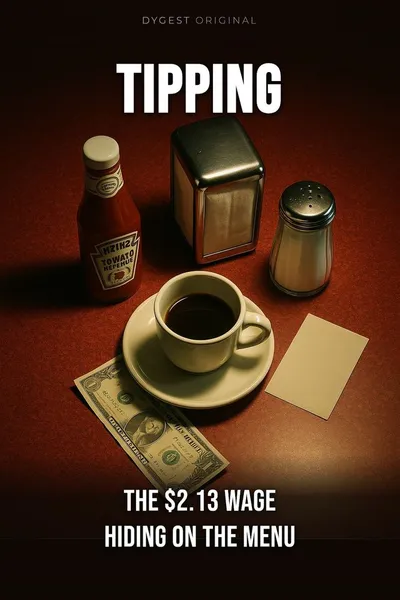
Tipping
The $2.13 wage hiding on the menu
Description
In 2024, an American buying a coffee at a self-service kiosk in Atlanta is asked, before the transaction goes through, to choose between tipping 18%, 22%, or 25%. There is no server. The coffee was made by a machine. The choice is offered by a screen. It is now routine in the United States to be asked for gratuity in contexts where a decade ago the question would not have been asked, and in ways that make the refusal visible to the person behind the counter.
The American tipping system is historically unusual. Most of the world either doesn't tip at all — Japan considers it rude — or tips marginally and optionally — Europe leaves coins. The US is the only major economy where tipping is expected, where servers are legally paid below minimum wage on the assumption that customers will cover the rest, and where the expected rate has crept from 10% to 15% to 18% to 22% over roughly two generations.
The question of how this happened doesn't start in restaurants. It starts on postbellum railway cars staffed by formerly enslaved workers, then in the politics of Reconstruction, then in a 1938 labor law compromise that was supposed to be temporary. Tipping in America looks like a cultural habit and is actually an industrial wage structure, held in place by a very specific history.
● The question we're asking: how did the United States end up with a uniquely dependent tipping culture, and why can't it get out of it?
● What we'll see: the European habit that crossed the ocean and got banned, the Pullman porter economy that made tipping racial, the 1938 labor law that created the sub-minimum wage, and the structural reasons every attempt at reform has failed.
Table of contents
01How an aristocratic habit became American
Tipping began as a European aristocratic habit — seventeenth-century English lords pressing coins into the hands of servants at country houses. It traveled around Europe and remained a marker of the relationship between the upper and serving classes. When wealthy Americans began crossing the Atlantic in the nineteenth century, they picked up the practice and brought it home, mostly as a way to signal they were the kind of people who did things the European way.
The initial American reception was hostile. Tipping was seen as aristocratic, un-democratic, un-American. Newspapers editorialized against it. Labor leaders denounced it as a way for employers to get customers to pay wages the employers themselves should pay. Between 1909 and 1926, seven states passed anti-tipping laws — Washington, Mississippi, South Carolina, Tennessee, Iowa, Nebraska, and Arkansas. Tipping was briefly illegal in much of the country.

02Why it stuck: Pullman and post-Reconstruction labor
Pullman's bet was this: he would hire exclusively Black men, almost all of them formerly enslaved or the sons of formerly enslaved people, to staff his sleeping cars. He would pay them almost nothing. The men — called Pullman porters — would shine white passengers' shoes, make their beds, carry their bags, and be available through the night. Their income would come, in practice, from tips from those passengers. The model was plantation labor economics transposed onto free-wage conditions.
It worked extraordinarily well for Pullman. By the 1920s, his company was the largest single employer of Black workers in the United States, and the porter job had become a stable working-class position in Black communities. It also worked extraordinarily well at teaching the American public a specific habit: service workers who were Black were, by default, tipped workers. Pay them a gratuity for good service. Don't expect their employer to pay them a wage.
03The $2.13 wage
The Fair Labor Standards Act of 1938 created the federal minimum wage in the United States. It was a signature achievement of the Roosevelt administration and it set a floor for the wages of American workers — with exceptions. Several industries were left out entirely, including agriculture and domestic work, which happened to be the industries where Black workers were most concentrated. Restaurants were brought under the minimum wage eventually, but the industry lobbied hard for accommodation, and it got one.
In 1966, Congress amended the Fair Labor Standards Act to include a new category: the tipped minimum wage. Employers of tipped workers would be allowed to pay below the regular minimum, as long as tips brought total earnings up to the regular minimum. The initial tipped minimum was set at 50% of the regular minimum wage. It would rise with the regular minimum wage.
04Why reform keeps failing
Multiple attempts have been made, over decades, to end this system. No-tip restaurants have opened in major cities, trying to include service in menu prices and pay servers regular wages. City-level campaigns have pushed for eliminating the tipped minimum. Several high-profile restaurateurs — most famously Danny Meyer in New York in 2015 — have tried the switch. Almost all of these experiments have failed.
The failures have a consistent pattern. Customers experience higher menu prices as an increase, even when total spending is identical. Servers at top restaurants often earn more under tipping than they would at any wage a restaurant could afford, and they vote with their feet — they leave for tipped competitors. Owners struggle to make the numbers work with labor costs that are now fully visible. The constituencies that would benefit most from a wage system — low-tipped workers, workers of color, workers at diners rather than fine-dining establishments — have the least political voice in the industry.
05Conclusion
A customer tapping 22% on a coffee kiosk in 2024 is the latest version of a compromise that started with Pullman hiring Black porters in the 1870s and ran through a 1966 amendment that is still in force. The habit looks like a cultural quirk — Americans tip a lot, Europeans don't — and is actually a specific labor arrangement with a specific history, held in place by specific interests.
Related books